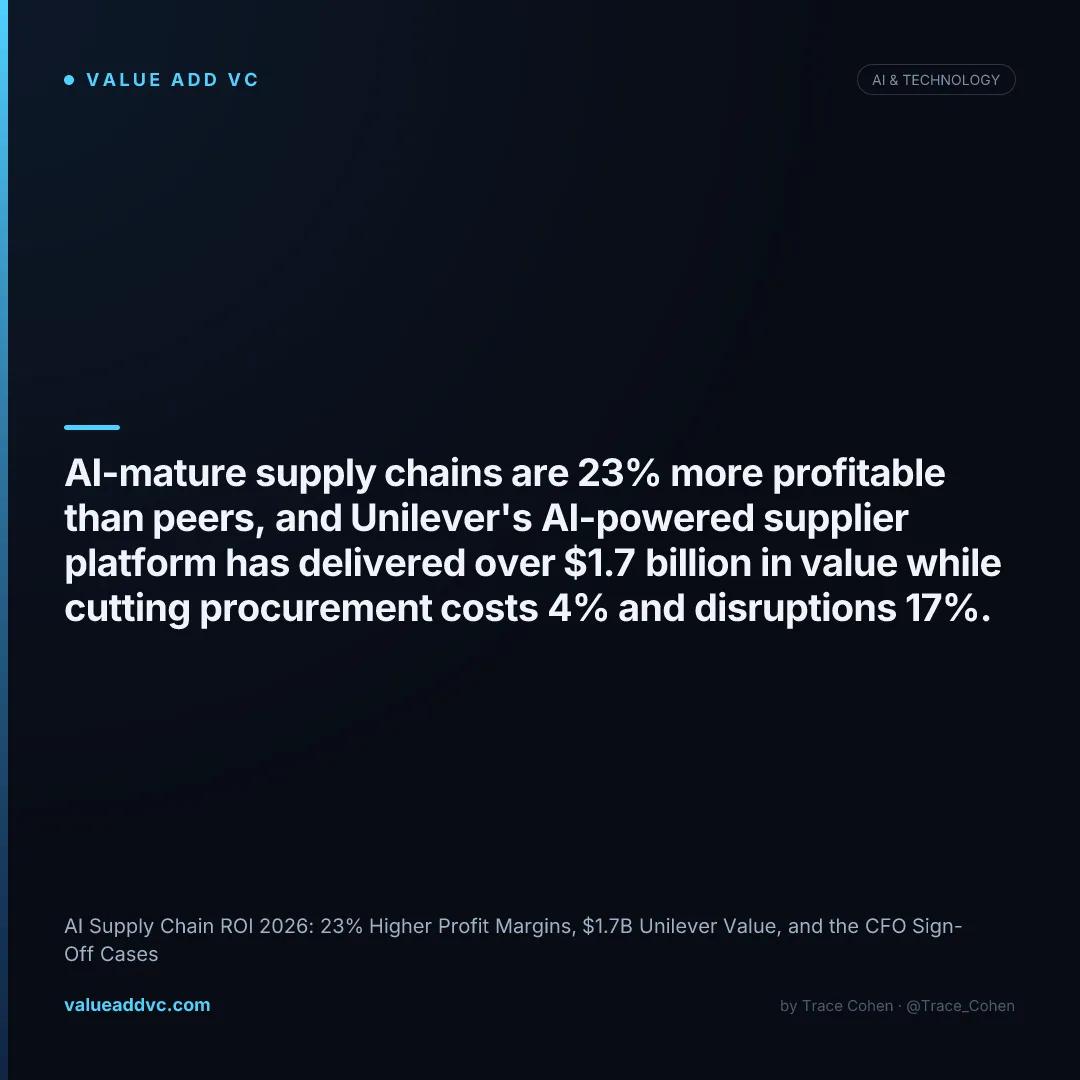
AI-mature supply chains post 23% higher profit margins than peers, and Unilever alone has banked over $1.7 billion in value from one AI supplier platform. The useful question is which specific AI supply chain use cases are actually clearing CFO budget review in 2026, and which ones are still stuck as unfunded pilots.
Every supply chain vendor pitch deck in 2026 claims transformative AI ROI. CFOs have gotten far more skeptical after two years of watching pilots stall. I pulled the actual disclosed numbers — from McKinsey, Gartner, PwC survey data, and named company case studies at Unilever, Walmart, and Maersk — to separate the AI supply chain investments with provable payback from the ones still burning budget with nothing to show a board.
Sources: McKinsey Global Institute supply chain operations research, Anaplan/Incisiv 2026 Supply Chain Resilience & AI Adoption Study, Unilever public disclosures, checked July 2026.
AI Supply Chain ROI 2026: What CFOs Are Actually Funding
The AI supply chain ROI 2026 question CFOs ask isn't "does AI help supply chains" — it's which specific use case pays back inside one budget cycle. 85% of executives plan to increase AI spending in 2026, with one in five expecting a 20%+ increase, but only 23% of supply chain organizations have a formal AI strategy in place. That gap is the whole story: broad transformation budgets get cut, narrow metric-bound use cases get funded.
McKinsey's operations research shows AI-enabled distribution delivers 5-20% logistics cost reduction, 20-30% inventory reduction, and 5-15% procurement spend reduction — each of those is a line item a CFO can underwrite individually, which is exactly why demand forecasting and inventory optimization are the two use cases getting approved fastest in 2026, while open-ended "AI transformation" programs are getting cut first in budget reviews.
The Named Company Case Studies Behind the AI Supply Chain ROI Numbers
Vendor-reported statistics are easy to dismiss. Named, audited company disclosures are harder to wave away. Three cases dominate the 2026 conversation because each ties AI spend to a specific, disclosed financial outcome rather than a vague efficiency claim.
| Company | AI Use Case | Disclosed Result | CFO Sign-Off Basis |
|---|---|---|---|
| Unilever | AI supplier risk & management platform (100,000+ suppliers, 190 countries) | $1.7B+ value delivered | 17% fewer supply disruptions, 4% lower procurement cost |
| Walmart | AI inventory, routing, and store-replica simulation | Network ~10% cheaper than competitors | 20-30% overstock reduction from real-time inventory tweaks |
| Maersk | AI-based route and fuel optimization | Lower fuel spend and emissions | Predictive routing tied directly to bunker fuel cost line item |
| Industry average (McKinsey) | Gen AI shipping documentation automation | Up to 60% faster doc turnaround | 10-20% cut in logistics coordinator workload hours |
| Industry average (Anaplan/Incisiv) | AI demand forecasting & decision support | 94% planning adoption within 2 years | Directly reduces working capital tied up in inventory |
| Industry average (all AI-mature firms) | Blended AI supply chain stack | 23% higher profit margin vs. peers | Composite of cost, inventory, and service-level gains |
Sources: Unilever public news releases, Walmart supply chain disclosures via industry case studies, Maersk investor and sustainability materials, McKinsey Global Institute operations research, and the Anaplan/Incisiv 2026 Supply Chain Resilience & AI Adoption Study, compiled July 2026.
Why Most AI Supply Chain Pilots Never Reach CFO Sign-Off
67% of supply chain leaders say they're more confident in AI than a year ago, and only 3% report declining confidence — the sentiment is genuinely positive. The failure point isn't belief in AI, it's proof. Here's where budget approvals stall:
Only 6% of organizations see ROI within 12 months, so any pitch promising fast payback gets flagged and re-underwritten by finance before approval
54% of supply chain organizations prefer a hybrid model where AI suggests and a human planner decides — full-autonomy pitches face far more scrutiny and slower sign-off
Only 10% of leaders are comfortable letting AI make decisions solo, which kills business cases built around headcount replacement rather than augmentation
71% plan to invest in generative AI over the next 3-5 years (up 12 points from 2025), but the money is following disclosed use cases like forecasting and supplier risk, not general-purpose "AI copilot" licenses
By 2029, Gartner projects CFOs who implement strategic AI deployment could add 10 margin points of growth — a long enough horizon that most 2026 approvals are staged, not lump-sum
How Founders and Operators Should Pitch AI Supply Chain ROI in 2026
I've sat on the other side of enough vendor and startup pitches to know what makes a CFO say yes. The pattern across Unilever, Walmart, and Maersk's approved projects is consistent: every one ties to a specific, auditable cost line, not a vague productivity claim.
Anchor to one disclosed cost line
Procurement spend, inventory carrying cost, or fuel cost — not 'overall efficiency.' Unilever's 4% procurement cut and Maersk's fuel savings both map to a single existing budget line a CFO already tracks.
Keep humans in the loop for year one
54% of supply chain leaders want AI to suggest, not decide. Pitching augmentation over autonomy shortens the sign-off cycle materially in 2026.
Prove payback inside 24 months, not 4 years
Only 6% of projects show ROI in under a year, but staged pilots (single warehouse, single supplier category) that hit breakeven within two years clear budget review far more easily than platform-wide bets.
Benchmark against named comps, not vendor averages
Citing Unilever's $1.7B or Walmart's 10% cost advantage lands better with a CFO than an aggregated industry percentage with no attributable source.
Bottom line: AI supply chain ROI in 2026 is real but narrow — 23% higher margins for AI-mature companies, $1.7 billion in disclosed value at Unilever, and a 10% cost advantage for Walmart's logistics network are the proof points CFOs are actually funding against. The 71% of leaders planning generative AI investment over the next three to five years will keep growing, but only the pitches tied to one auditable cost line, staged for sub-24-month payback, are clearing sign-off in this budget cycle. Compare how AI-native operators are being valued on our AI Valuations dashboard, and read our earlier deep dive on the real ROI of AI in supply chain operations at Value Add VC.
Latest from the Pulse
Get VC data most people never see
— free to subscribe
Trace's notes on venture, AI and startups, a few times a week. Join 5,000+ subscribers. No spam.