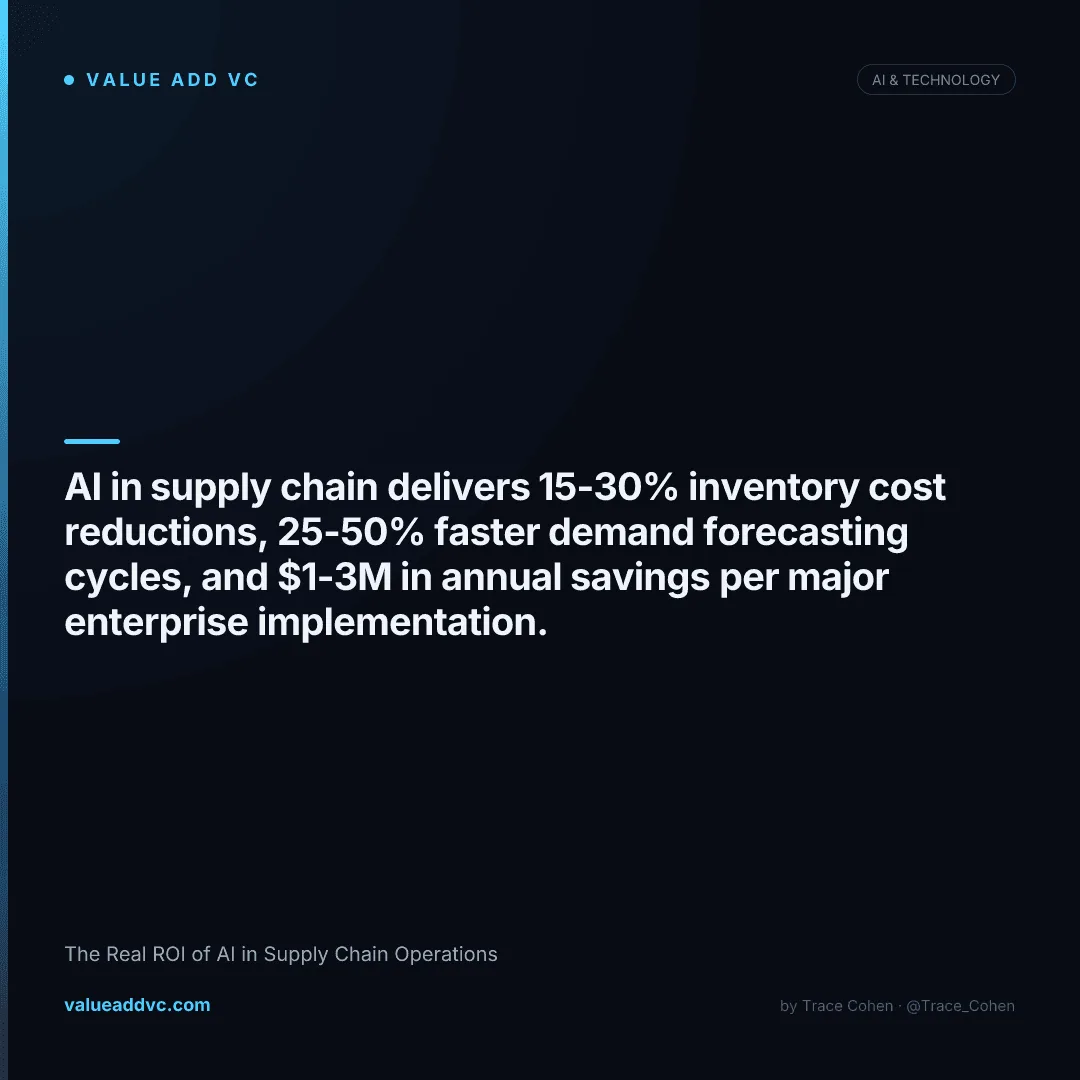
Supply chain is one of the few enterprise categories where AI is generating real, auditable, dollar-denominated returns — and it's happening mostly out of the spotlight.
While the press covers AI chatbots and coding assistants, Fortune 500 procurement teams are quietly running AI-powered demand forecasting that outperforms their 30-year-old ERP systems by 40% on accuracy. The gap between what's being reported and what's actually working is massive.
Why Supply Chain Was AI's First Real Enterprise Beachhead
Supply chain problems have three characteristics that make them unusually well-suited to AI: enormous data volume, clear optimization objectives, and directly measurable financial outcomes. You either held too much inventory or too little. The truck arrived on time or it didn't. The model was right or it wasn't.
This is fundamentally different from most enterprise AI use cases, where success is fuzzy. In supply chain, you can measure a 23% reduction in stockout events against a baseline and translate that directly to recovered revenue. That clarity has driven adoption faster than in almost any other enterprise vertical.
The market reflects this. The global AI in supply chain market was valued at $3.2B in 2023 and is projected to hit $41.2B by 2030 — a 44% CAGR that significantly outpaces overall enterprise AI growth. Gartner estimates that by 2026, 75% of large supply chain software vendors will have embedded AI-native forecasting as a default feature, not an add-on.
Where AI Is Actually Delivering ROI
- •Demand Forecasting: AI-powered forecasting reduces mean absolute percentage error (MAPE) by 30-50% versus traditional statistical methods. For a retailer with $1B in inventory, a 10-point MAPE improvement translates to roughly $20-40M in freed-up working capital.
- •Inventory Optimization: Companies deploying AI-driven inventory management report 20-35% reductions in safety stock requirements without increasing service-level risk. That's pure balance sheet improvement — cash released from working capital into operations.
- •Supplier Risk Monitoring: Real-time AI monitoring of supplier financial health, geopolitical signals, and production disruptions reduces unplanned supply disruptions by 30-45%. COVID-19 exposed this gap violently — the companies with AI-driven supplier visibility recovered 60 days faster on average.
- •Route Optimization: Dynamic routing AI cuts last-mile delivery costs by 15-25% and improves on-time delivery rates by 8-12 percentage points. UPS estimates its ORION routing optimization saves 100 million miles annually — roughly $300-400M in fuel and vehicle costs.
- •Warehouse Automation: AI-guided robotic picking systems increase warehouse throughput by 2-3x while reducing labor costs per unit by 40-65%. Amazon's 750,000 warehouse robots have eliminated roughly 1.3 million manual hours of walking per day across its network.
- •Quality Control: Computer vision inspection systems catch defects with 99.7%+ accuracy at throughput speeds no human team can match. In automotive manufacturing, where a single defective component recall can cost $100M+, this ROI calculation is trivially easy to make.
The 77% Problem: Why Most Implementations Stall
Here's what the vendor case studies don't tell you: only 23% of enterprise AI supply chain projects make it to full production scale. I've seen this pattern across multiple portfolio companies that sell into supply chain — the pilots look great, the POC data is compelling, and then the project dies somewhere between IT, procurement, and operations.
The failure modes are consistent. First, data quality: most mid-market ERPs have 5-10 years of inconsistent master data — product codes that changed, suppliers that merged, warehouse locations that moved. AI models trained on this data produce garbage outputs that planners immediately distrust. It takes 3-6 months of data remediation before the model can run cleanly, and most enterprise teams don't budget for this.
Second, the "last mile of decision-making" problem: the model produces a recommendation, but the 20-year-veteran planner ignores it because she's seen the system hallucinate before. This is a change management problem, not a technology problem — and almost nobody in the vendor stack gets paid to solve it. The best supply chain AI companies I've seen embed workflow change management directly into their implementation methodology, not as an afterthought.
Third, organizational ownership: who owns the AI system's outputs when they're wrong? In mature implementations, this is answered clearly before go-live. In failed ones, finger-pointing between IT (who maintains the model) and operations (who acts on it) kills adoption within 90 days of launch.
What the Investment Opportunity Looks Like
From an investment lens, the supply chain AI category is maturing quickly but unevenly. The horizontal platforms — Blue Yonder, o9 Solutions, Kinaxis — have locked up the large enterprise segment at $1M+ ACV. That's a hard market to break into as a startup without a serious differentiation story.
The opportunity for new entrants is vertical-specific and mid-market. Specialty chemicals, food & beverage, pharmaceutical distribution, and defense supply chains all have unique regulatory constraints and operational nuances that generic platforms handle poorly. A purpose-built AI system for pharmaceutical cold-chain logistics has a completely different competitive environment than one competing directly with Blue Yonder for a Walmart contract.
The second greenfield is the "supply chain copilot" layer — tools that sit on top of existing ERP systems and translate AI recommendations into the language planners actually use, with built-in explanation and override mechanisms. The companies solving the last-mile decision problem have a clear wedge that the big platforms haven't prioritized.
The ROI of AI in supply chain is real and measurable — but it accrues to the 23% that solve the implementation problem, not the 77% that run a good demo.
Stay current with VC and startup trends at Value Add VC. Originally published in the Trace Cohen newsletter.
Latest from the Pulse
Get VC data most people never see
— 100% free
Weekly benchmarks, valuations, and fund data. Join 5,000+ investors. No spam.