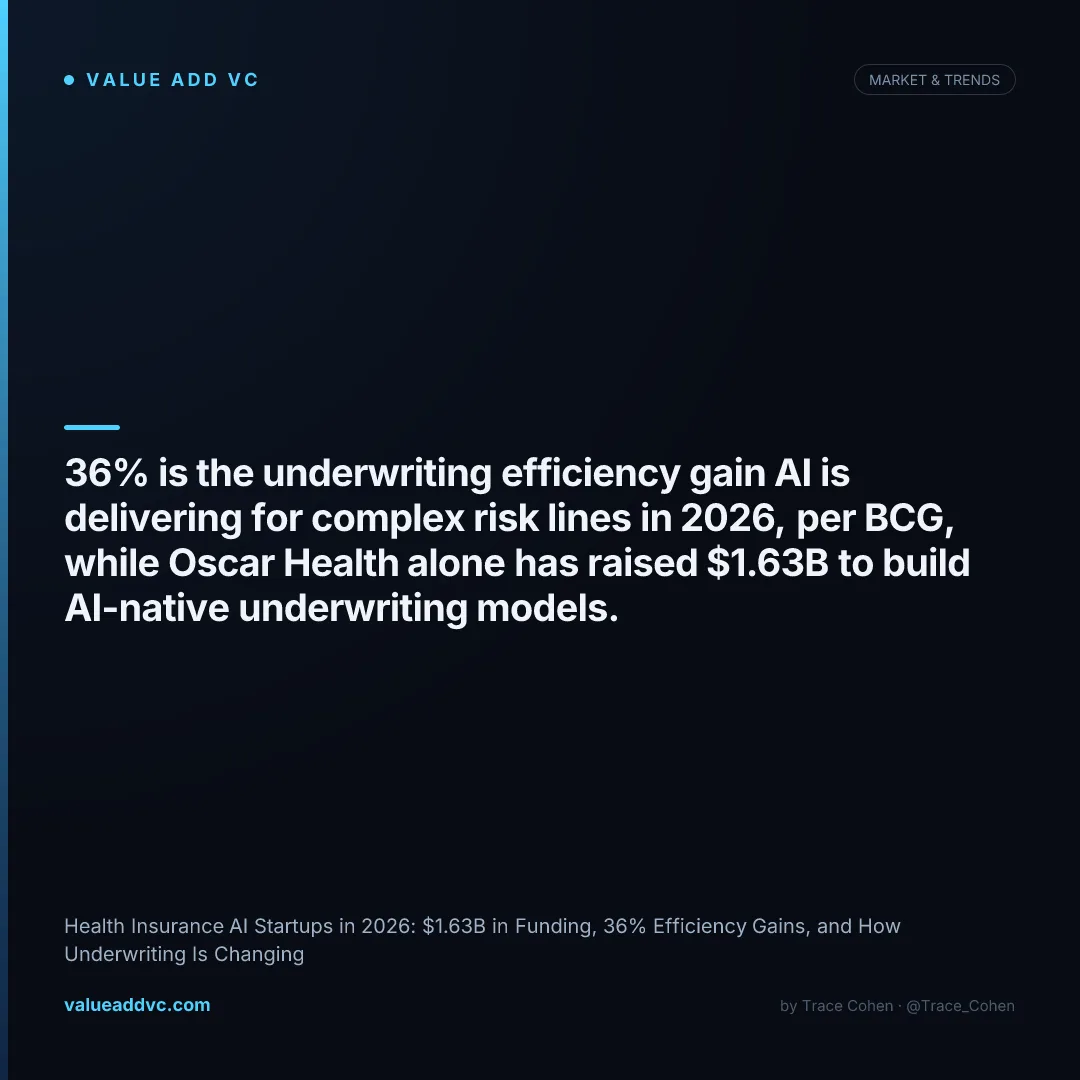
AI is cutting insurance underwriting timelines from three days to three minutes and improving loss ratios by 3 to 5 percentage points, and health insurance startups like Oscar Health, Sidecar Health, and Devoted Health have raised a combined $2.3B+ to build underwriting models around it. The deeper story is what happens when risk pricing stops being a once-a-year actuarial exercise and becomes a live, continuously updating model.
Legacy health insurers price a policy using static tables built off historical claims data, reviewed annually at best. AI-native insurers are doing something structurally different in 2026: feeding real-time claims, member engagement, provider-network, and even shopping behavior back into underwriting models continuously, so risk gets re-priced as it changes rather than a year after the fact. That shift is reshaping who can compete in health insurance, and it's why venture capital keeps flowing into a category most investors avoided for the past decade.
Figures from BCG's P&C/health underwriting AI research (2026), Crunchbase and PitchBook funding data, and industry agentic-AI insurance benchmarks compiled across 2025-2026 case studies.
How Health Insurance Startups Are Using AI to Underwrite Risk Differently in 2026
Health insurance AI startups underwrite risk by continuously ingesting live claims, member behavior, and provider-network data instead of relying on static, periodically-updated actuarial tables. Oscar Health's underwriting models update in real time from every member interaction, letting the company adjust for adverse selection before it turns into a large claim, rather than discovering the problem in a quarterly loss report. That single architectural difference — continuous versus periodic risk pricing — is the core distinction between AI-native insurers and the legacy carriers they're competing against.
The efficiency numbers back up why this matters commercially. BCG found AI improves underwriting efficiency by up to 36% in complex lines of business and reduces loss ratios by approximately 3 percentage points through better use of unstructured, previously inaccessible data — medical notes, claims narratives, provider utilization patterns. On a $1 billion premium book, a 3-to-5-point loss ratio improvement translates to roughly $40 million in annual underwriting profit, which is the number every health insurtech CFO is now chasing.
Oscar Health, Sidecar Health, and Devoted Health: Three Different AI Underwriting Bets
Oscar Health is the clearest public proof point. The company has raised $1.63B across 10 rounds from 49 investors, most recently adding $225M, and its Oscar+ AI telehealth and underwriting tools have cut emergency room visits by 20% among members who use them. Every member interaction — a telehealth visit, a claims submission, a provider search — feeds Oscar's underwriting models in real time, letting the company compress medical loss ratio and steer members toward lower-cost care before a claim materializes. Oscar is expanding to 573 counties across 20 states for 2026, including new entries into Alabama and Mississippi, using that AI underwriting advantage as the wedge.
Sidecar Health takes a different angle: price transparency as the underwriting input. The company has raised roughly $328M-$426M across four rounds, including a $165M round that pushed its valuation to $1.2B and unicorn status, from 18 investors. Instead of a fixed provider network, Sidecar gives members a cash benefit and lets them shop for care directly, which generates a stream of real-world pricing data that feeds back into how the company prices risk for future cohorts — a data flywheel legacy insurers with static networks simply don't have access to.
Devoted Health is applying AI risk modeling to the toughest underwriting segment in the business: Medicare Advantage, where margins are historically thin and adverse selection risk is highest. Devoted secured $317M in January 2026 alone to keep building out AI-driven risk stratification for an older, higher-acuity population — a segment where a 3-to-5-point loss ratio improvement matters more than almost anywhere else in health insurance, because Medicare Advantage members generate more claims events per year to learn from and more cost per adverse-selection miss.
AI Underwriting vs Legacy Actuarial Pricing: The Six-Row Comparison
The table below lines up the mechanics of AI-native underwriting against the legacy actuarial-table approach most incumbent carriers still run on. This is the operational gap venture investors are underwriting when they price a Series C for a company like Sidecar Health or Devoted Health.
| Dimension | Legacy actuarial underwriting | AI-native underwriting |
|---|---|---|
| Repricing frequency | Annual, sometimes quarterly | Continuous, real-time signal ingestion |
| Data inputs | Historical claims, demographic tables | Claims, engagement, provider utilization, unstructured notes |
| Processing time per case | 1-3 days | As little as 3 minutes |
| Straight-through processing rate | 10-15% | 70-90% |
| Loss ratio impact | Baseline | 3-5 point improvement |
| Adverse selection detection | After the claim is filed | Before it becomes a loss (Oscar's model) |
| Risk assessment accuracy gain | Baseline | ~20% improvement per industry benchmarks |
Figures are 2026 estimates blended from BCG underwriting research, agentic AI insurance market benchmarks, and public disclosures from Oscar Health, Sidecar Health, and Devoted Health. Processing-time and STP figures reflect industry-wide agentic AI deployments, not a single company's internal metrics.
The Regulatory and Data Reality Behind AI Underwriting
None of this works without navigating a regulatory environment that was built for static, once-a-year rate filings, not continuously updating models. Every US state insurance department still requires carriers to file and justify their rating methodology, and regulators have been explicit that AI-driven underwriting has to be explainable — a model can't reprice a member's risk for a reason the carrier can't articulate to a state regulator on request. That's part of why Oscar, Sidecar, and Devoted have built their AI underwriting in-house rather than buying a black-box vendor tool: an unexplainable model is a compliance liability in a heavily regulated line of insurance, not just a technical one.
The data advantage compounds unevenly, too. A startup that launches in a new state starts with none of the claims history a 20-year regional carrier has, which is why Oscar's expansion into Alabama and Mississippi for 2026 matters as much as its underwriting model — geographic footprint is what feeds the model fresh data. Sidecar's price-transparency approach sidesteps this partially by generating pricing signal from member shopping behavior rather than waiting years to accumulate claims history, which is one reason a four-round, $426M-raised company can already carry a $1.2B valuation despite a much smaller book of business than Oscar's.
Legacy carriers are responding by buying rather than building. UnitedHealth, Cigna, and other incumbents have all made AI-underwriting-focused acquisitions or partnerships over the past 18 months, and that acquisition appetite is itself a signal for where the venture-backed exits in this category are likely to come from — strategic buyers paying for the underwriting model and the data pipeline behind it, not just the member book. For founders and LPs evaluating this category, the diligence question worth asking isn't "does the company use AI" but "how many quarters of proprietary claims or engagement data feed the model, and how fast is that data compounding relative to a competitor's."
Why Investors Care: The Underwriting Moat Is the Business Model
In most software categories, an AI feature is a nice-to-have that competitors can copy within a year. In health insurance, an AI underwriting model that continuously improves is closer to a data moat — it compounds. Every additional member interaction Oscar's models see makes the next risk-pricing decision slightly better, and that gap widens over time versus a legacy carrier repricing once a year off a static table. That's a fundamentally different kind of defensibility than most Series B pitch decks claim to have, and it's part of why we track AI business models closely on our AI valuations dashboard.
The unit economics are also just better once the model works: a 3-to-5-point loss ratio improvement on a $1B premium book is $40M in annual profit that a legacy carrier structurally cannot capture without rebuilding its entire underwriting stack. That's the argument behind $3B+ in cumulative venture funding into Bright and Oscar alone, and it's why Sidecar's $1.2B valuation and Devoted's fresh $317M round both make sense even in a health insurance funding environment that's been selective everywhere else. The same underwriting-moat thesis is showing up even faster outside health: Corgi's AI insurance valuation quadrupled to $4B in three rounds across eight weeks, and in commercial lines, Ledgebrook's $200M raise is applying the same continuous-underwriting pitch to excess and surplus insurance. Watch how these bets are showing up in the broader AI capital cycle on our Big Tech Earnings Tracker.
Bottom line: Health insurance AI startups aren't just adding a chatbot on top of a legacy carrier — they're rebuilding underwriting itself around continuous, real-time risk pricing instead of annual actuarial tables. Oscar Health's $1.63B, Sidecar Health's $1.2B valuation, and Devoted Health's fresh $317M all point to the same thesis: a 36% underwriting efficiency gain and a 3-to-5-point loss ratio improvement are real, measurable moats, not marketing claims. The agentic AI insurance market growing 26% year-over-year to $7.26B in 2026 suggests this is still early, and the startups that get continuous underwriting right first are going to be very hard for legacy carriers to catch.
Latest from the Pulse
Get VC data most people never see
— free to subscribe
Trace's notes on venture, AI and startups, a few times a week. Join 5,000+ subscribers. No spam.
No spam, unsubscribe anytime. Sent via Substack · Privacy · or subscribe on Substack ↗