
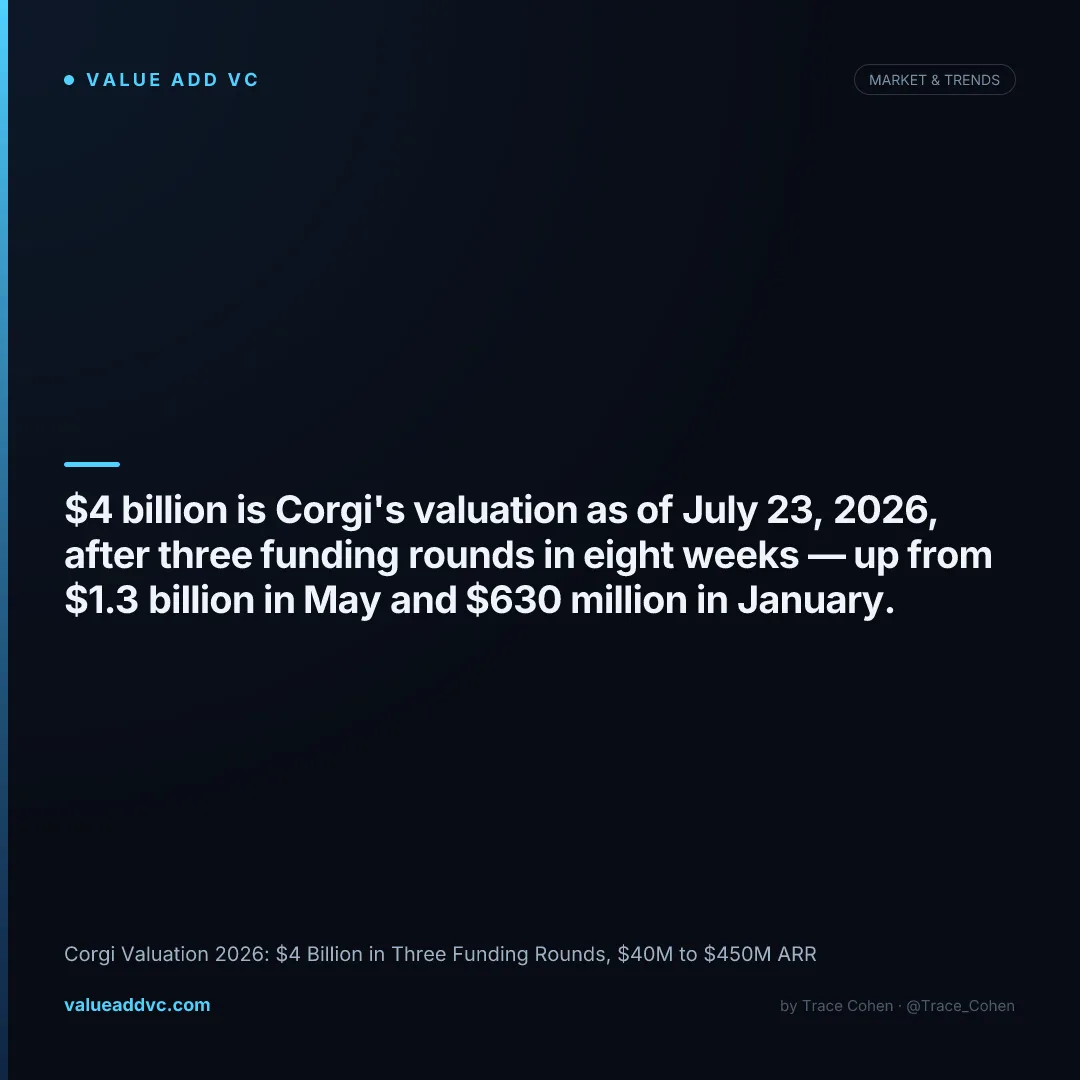
Corgi's valuation hit $4 billion on July 23, 2026 — its third funding round in eight weeks, and roughly 6.3x what it was worth in January.
Most startups raise a round every 12 to 18 months. Corgi, a two-year-old AI-native insurance carrier for startups, has now raised four rounds in seven months, with the valuation moving from $630 million to $1.3 billion to $2.6 billion to $4 billion along the way. The company is also famous in Silicon Valley for a seven-day work week and a founder who reportedly sleeps on a mattress in the office. Both things are true at once, and the fundraising pace is the more useful story for anyone trying to underwrite what's actually happening in AI-adjacent fintech right now.
Corgi AI Insurance Startup Valuation: How It Reached $4 Billion in 2026
Corgi's AI insurance startup valuation reached $4 billion around July 22-23, 2026, in a Series B extension — the third priced round in eight weeks and the fourth since its January Series A. The jump came in three steps: $630 million in January, $1.3 billion in early May, $2.6 billion three weeks after that, then $4 billion in July, a compounding climb driven by revenue growth investors say is real, not just narrative.
The Four-Round Timeline: From $630 Million to $4 Billion
Corgi went through Y Combinator's Summer 2024 batch, founded by CEO Nico Laqua (previously behind gaming company Basket Entertainment) and COO Emily Yuan, a Stanford computer science graduate. The company received full regulatory approval to operate as a licensed insurance carrier in July 2025 — the unlock that turned it from a wrapper on top of existing carriers into a full-stack underwriter with its own balance sheet exposure and its own upside.
Corgi's Valuation Climb, January-July 2026
Valuation moved from $630M to $4B in roughly six months, with three separate priced rounds inside the final eight weeks
TechCrunch, Forbes, and MLQ News reporting, as of July 23, 2026.
Data
| Item | Value |
|---|---|
| Jan 2026: Series A | $630M |
| May 6: Series B | $1.3B |
| May 28: Series B1 | $2.6B |
| Jul 2026: Series B2 | $4B |
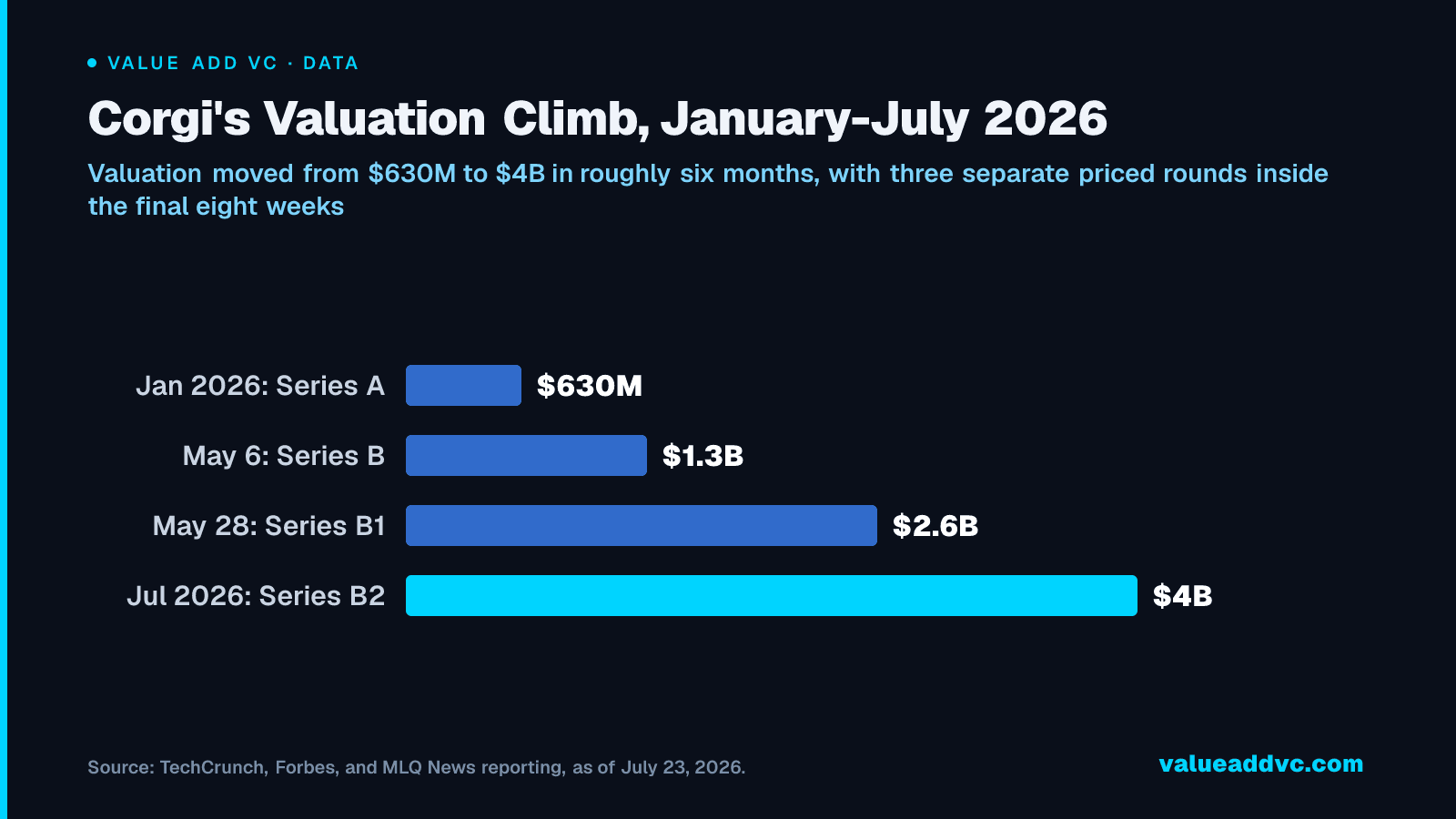
The gap between the May 6 and May 28 rounds is the detail worth sitting with: $1.3 billion to $2.6 billion in seventeen days, a straight double, before the company had even finished spending the prior round. That's not the behavior of a market pricing in new information about the company — it's the behavior of a market that's afraid of not being in the round at all, a dynamic we've tracked before in how AI valuations detach from revenue once FOMO takes over a cap table.
Corgi's Revenue: $40 Million to a Projected $450 Million ARR
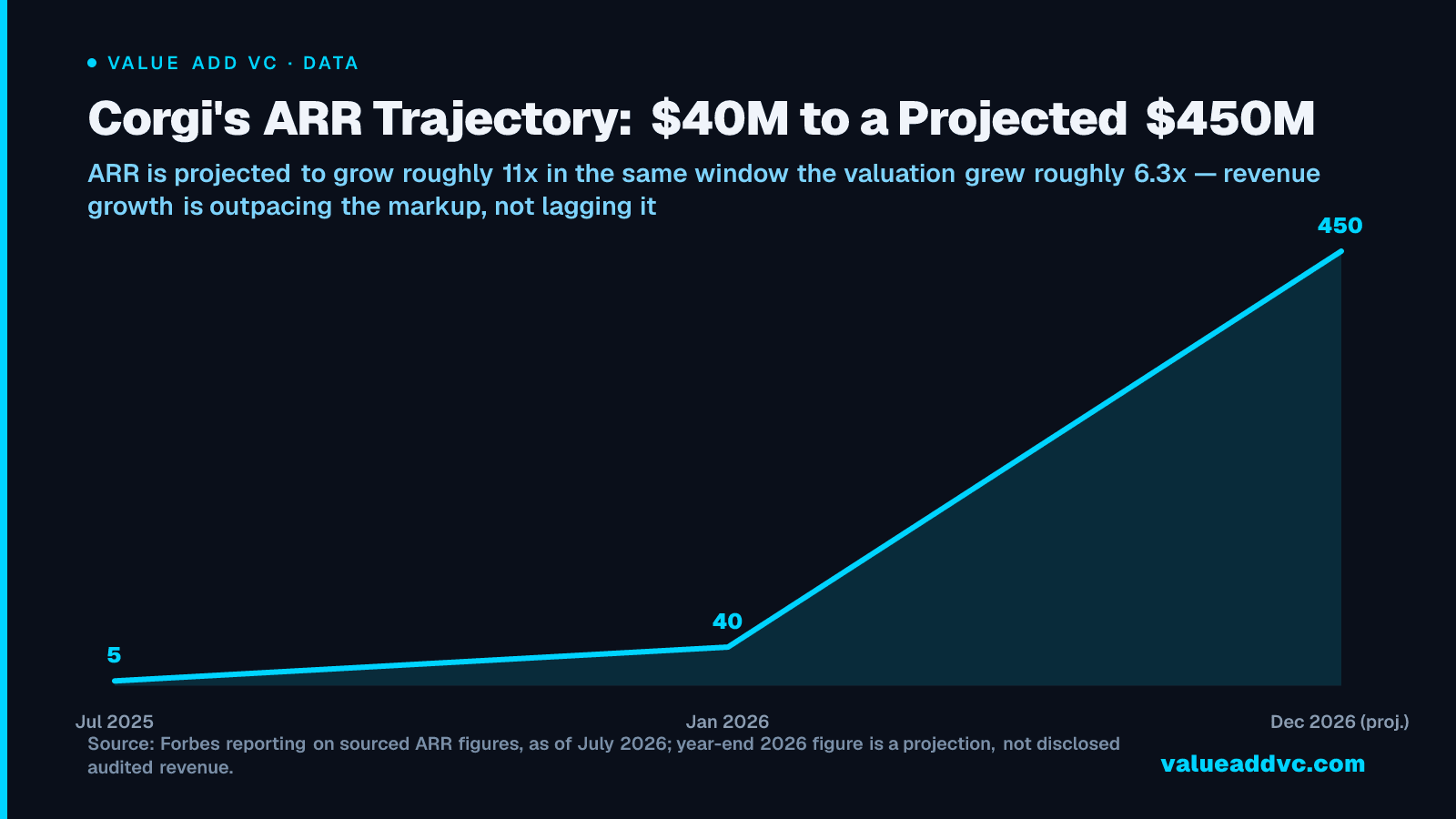
The number doing the actual work behind the valuation is revenue, not press coverage. Corgi's annualized revenue run-rate surpassed $40 million shortly after its July 2025 carrier license went live, and sources told Forbes the company is on track to hit roughly $450 million in ARR by the end of 2026 — an 11x increase in about seventeen months. That growth rate, if it holds, is what separates Corgi from a hype-only fundraise: a $4 billion valuation against a $450 million ARR projection implies roughly an 8.9x forward revenue multiple, aggressive but not disconnected from reality the way some AI-labeled fintech valuations have been.
Corgi's ARR Trajectory: $40M to a Projected $450M
ARR is projected to grow roughly 11x in the same window the valuation grew roughly 6.3x — revenue growth is outpacing the markup, not lagging it
Forbes reporting on sourced ARR figures, as of July 2026; year-end 2026 figure is a projection, not disclosed audited revenue.
Data
| Item | ARR ($M) |
|---|---|
| Jul 2025 | 5 |
| Jan 2026 | 40 |
| Dec 2026 (proj.) | 450 |
What Corgi Actually Sells
Corgi is a full-stack, AI-native insurance carrier, not a broker reselling someone else's policies. Three things make up the product: AI-generated underwriting that prices insurance quotes for startup customers faster than legacy carriers, an embedded-insurance layer that lets startups white-label Corgi's policies and resell them to their own end customers, and AI-driven claims management that automates the adjustment process end to end. Holding its own carrier license — rather than fronting for a legacy insurer — is what lets Corgi capture underwriting economics directly instead of just origination fees, which is also why its revenue can scale faster than a pure MGA (managing general agent) model would allow.
| Round | Date | Amount | Valuation |
|---|---|---|---|
| Series A | Jan 2026 | $108M | $630M |
| Series B | May 6, 2026 | $160M | $1.3B |
| Series B1 | May 28, 2026 | $106M | $2.6B |
| Series B2 (extension) | Jul 22-23, 2026 | Undisclosed | $4B |
| Total confirmed (pre-July) | Jan-May 2026 | $374M | — |
| Days between B and B1 | — | 17 days | 2x markup |
Figures blended from TechCrunch, Forbes, MLQ News, and Fintech.Global reporting on Corgi's 2026 funding rounds, as of July 23, 2026. July round amount was not disclosed publicly at time of writing.
The Seven-Day Work Week That Made Corgi Famous Before the Valuation Did
Corgi's culture became a Silicon Valley talking point before most people had heard the valuation numbers. CEO Nico Laqua has publicly said he expects employees to work seven days a week, and has described sleeping on a mattress in the office to match that pace. The company also runs an all-night café in San Francisco — part hiring tool, part physical embodiment of the always-on culture the founders are selling to prospective engineers. It's an aggressive stance in a labor market where most competitors lead with flexibility, and it's fair to ask whether the culture is a genuine productivity edge or a recruiting filter that only works while the company is small enough for everyone to see the founders living it too.
What's harder to dispute is that the culture hasn't slowed the business down: four rounds and a valuation move from $630 million to $4 billion happened in the same window the seven-day-week story was going viral, which suggests investors are pricing the revenue trajectory, not the work-life balance headlines, even if the headlines are what most people remember.
Corgi's AI Insurance Startup Valuation vs. the Rest of Insurtech
Corgi's pace stands out even against a hot insurtech market. Most licensed-carrier insurtechs took years to reach a $1 billion-plus valuation and did so on the back of years of loss-ratio data proving the underwriting model works; Corgi did it in four months from its Series A, on roughly a year of revenue history since its carrier license went live. That's a much shorter track record underwriting a much bigger price tag — which is exactly the AI-era pattern we've tracked across categories from inference chips to coding tools on the AI Valuations dashboard: revenue growth rates are compressing the time between "interesting seed" and "multi-billion-dollar company" to a fraction of what it took a decade ago.
The risk sitting underneath that compression is straightforward: an insurance carrier's real test isn't revenue growth, it's loss ratios across a full claims cycle, including the bad years. Corgi hasn't been licensed long enough to have been through one yet. A $4 billion price is a bet that AI-assisted underwriting produces materially better loss ratios than legacy carriers at scale — a bet that won't be provable or disprovable until Corgi has weathered at least one full underwriting cycle with real claims data, not just revenue-run-rate projections.
How Corgi Compares to Other Insurtech Unicorns
Corgi isn't the first insurtech to reach a multi-billion-dollar valuation, but it's compressing the timeline that category usually takes. Next Insurance, a small-business insurer, took roughly six years to cross a $2 billion valuation before its 2023 acquisition by Munich Re. Coalition, a cyber-insurance underwriter, took about five years to reach unicorn status. Vouch, which also targets startups specifically, has raised over $185 million across seven years without a disclosed valuation near Corgi's. Corgi crossed $1 billion in roughly four months from its Series A and $4 billion in about six and a half months — a fraction of the time any of those three comparable companies needed, on a much shorter operating history as a licensed carrier.
| Company | Focus | Time to $1B+ |
|---|---|---|
| Corgi | Startup insurance, AI underwriting | ~4 months from Series A |
| Next Insurance | Small-business insurance | ~3 years |
| Coalition | Cyber insurance | ~5 years |
| Vouch | Startup insurance | Not yet disclosed at that level |
Figures blended from company funding announcements, Munich Re's 2023 Next Insurance acquisition disclosure, and Crunchbase-tracked rounds as of July 2026. Timelines are approximate and based on publicly reported valuation milestones.
Not every AI-native insurer is racing toward a disclosed valuation the way Corgi is. Ledgebrook's $200 million raise, co-led by Allianz X, came with a premium-written figure instead of a valuation number — a reminder that this category still has more than one way to prove traction.
Why Investors Are Paying Up for Corgi Specifically
Three things are driving the repricing beyond generic AI enthusiasm. First, Corgi holds its own carrier license rather than fronting through a third-party insurer, which means it keeps underwriting economics instead of splitting them with a fronting partner — a structural advantage over MGA-model competitors that shows up directly in gross margin. Second, the embedded-insurance product turns Corgi's own startup customers into distribution partners, since those startups can resell Corgi's policies to their own end users, which is a lower customer-acquisition-cost growth channel than most standalone insurtechs get access to. Third, the ARR growth from $40 million to a projected $450 million happened inside twelve months of holding a full carrier license, which is a genuinely fast ramp for a regulated financial-services product, where compliance and state-by-state licensing usually slow growth far more than they've slowed Corgi so far.
None of that erases the underwriting-cycle risk. A carrier's true cost structure only becomes visible after claims come in against a full book of business, ideally across more than one calendar year and more than one macro environment. Corgi's entire track record as a licensed carrier is about twelve months old, all of it during a benign period for the specific startup-liability and startup-property risks it underwrites. The $4 billion price is, in effect, a bet that the underwriting model generalizes to a worse year — a bet that hasn't been tested yet, no matter how fast the ARR line is moving.
The Bottom Line
Corgi's $4 billion valuation is the product of two real things happening at once — revenue growing roughly 11x in seventeen months, and a fundraising market so eager to be in the round that it re-priced the company twice in the same month. The ARR trajectory from $40 million toward a projected $450 million is the part of this story that will hold up regardless of what happens to the seven-day-work-week headlines; whether the $4 billion price holds up depends on loss ratios nobody outside the company can see yet, through claims cycles that haven't happened.
Track valuation multiples across fast-moving AI-adjacent startups on the AI Valuations dashboard and new unicorns on the Unicorn Tracker at Value Add VC.
Latest from the Pulse
Get VC data most people never see
— free to subscribe
Trace's notes on venture, AI and startups, a few times a week. Join 5,000+ subscribers. No spam.
No spam, unsubscribe anytime. Sent via Substack · Privacy · or subscribe on Substack ↗