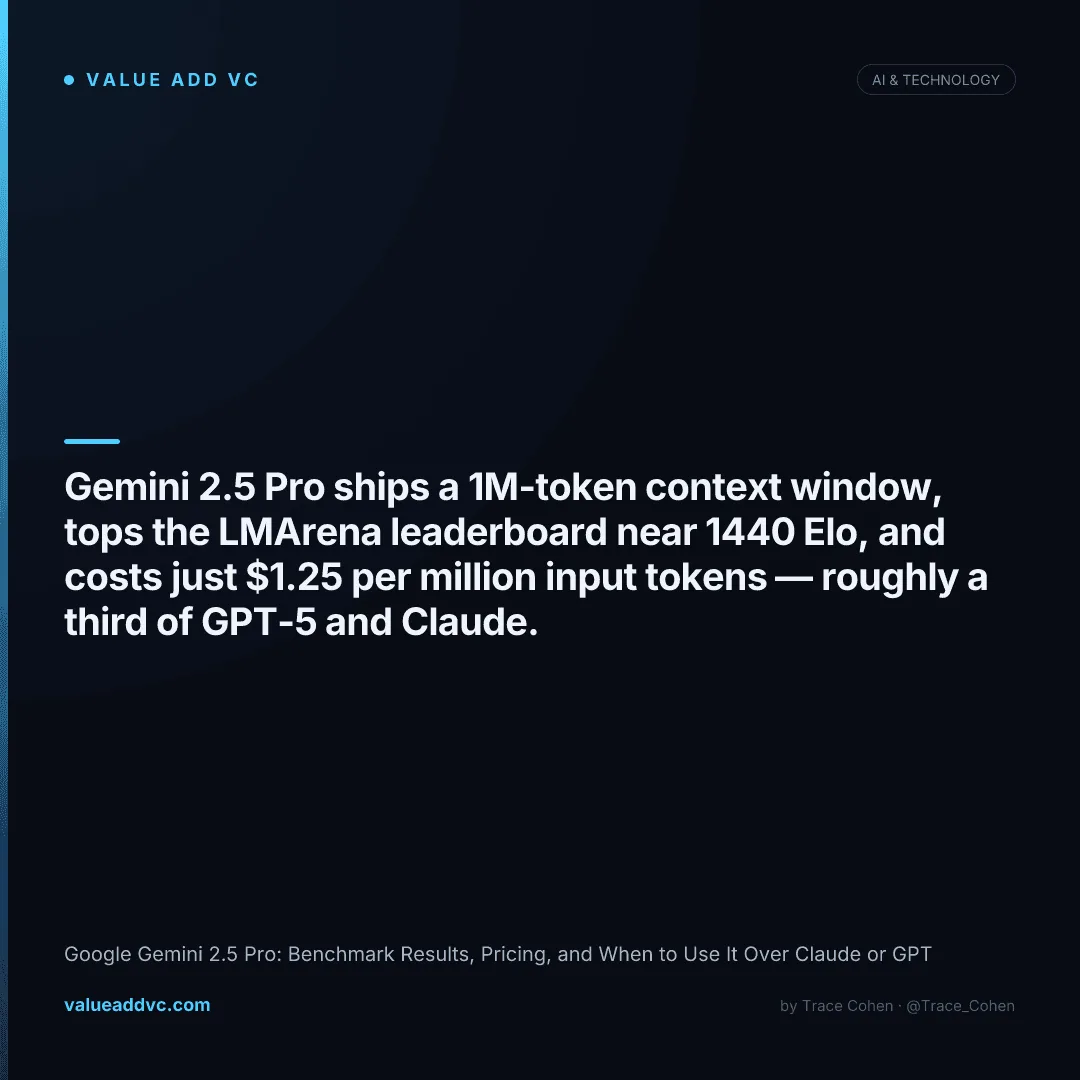
Gemini 2.5 Pro pairs a 1M-token context window with a ~1440 LMArena Elo and a $1.25-per-million-input-token price — making it the best value-per-capability deal at the AI frontier in 2026. When that value case actually beats Claude or GPT is the useful question.
Google spent two years looking like it was losing the model race. Gemini 2.5 Pro is the version that flipped the narrative: it tops the public leaderboard, undercuts both OpenAI and Anthropic on price by roughly 3x, and holds context lengths no competitor matches natively. The catch is that "best on the leaderboard" and "best for your specific job" are still two different questions.
Gemini 2.5 Pro Review: Benchmark Results and What They Mean
Gemini 2.5 Pro is Google's flagship reasoning model that posts a ~1440 LMArena Elo (frequently #1), ~84% on GPQA Diamond science, ~88% on AIME 2025 math, and ~84% on MMMU multimodal reasoning where it leads every rival. Its native 1M-token context window is the largest at the frontier. On reasoning and multimodal tasks it is class-leading; on production coding it lands a half-step behind Claude, scoring in the high-70s% on the Aider polyglot benchmark versus Claude's ~80%+.
The thing to understand about Gemini 2.5 Pro is that Google built a "thinking" model — it reasons through chains before answering, which is why its math and science scores jumped a full tier over Gemini 1.5. The benchmark wins are real and broad, not cherry-picked. But the daily-use story is dominated by two structural advantages, context length and price, more than by any single benchmark row.
Gemini 2.5 Pro vs Claude vs GPT-5: Side-by-Side Comparison
Here's the head-to-head that matters. These are approximate, fast-moving figures — treat them as directional, not gospel, since every lab re-benchmarks constantly.
| Attribute | Gemini 2.5 Pro | Claude (Anthropic) | GPT-5 (OpenAI) |
|---|---|---|---|
| LMArena Elo | ~1440 (#1) | ~1410 | ~1420 |
| AIME 2025 math | ~88% | ~90% | ~92% |
| GPQA Diamond science | ~84% | ~84% | ~88% |
| Aider/SWE coding | ~70% | ~78% | ~72% |
| MMMU multimodal | ~84% (lead) | ~75% | ~80% |
| Context window | 1M (2M rolling out) | ~1M | ~400K |
| Input price /1M tokens | $1.25 | $3.00 | $3.50 |
| Output price /1M tokens | $10 | $15 | $15 |
The pattern is clear: Gemini 2.5 Pro wins on multimodal, context length, and price; Claude owns coding reliability; GPT-5 edges ahead on raw math and science. No single model dominates — which is exactly why the price and context columns matter more than the benchmark rows for most buyers running real workloads.
Gemini 2.5 Pro Pricing: The Full Tier Breakdown
Price is where Gemini 2.5 Pro does the most damage to its rivals. The API charges $1.25 per million input tokens and $10 per million output tokens under 200K tokens, stepping up to $2.50 and $15 above that threshold. For high-volume pipelines — document processing, RAG, batch analysis — that roughly 3x input-cost gap compounds into real money. A workload that costs $3,000/month on Claude or GPT-5 can run closer to $1,100 on Gemini.
Google AI Studio (free)
Full model access with rate limits — the cheapest way to evaluate it
Google AI Pro — ~$19.99/mo
Higher limits in the Gemini app, plus Deep Research and 2.5 Pro priority
API under 200K tokens
$1.25 input / $10 output per million tokens
API over 200K tokens
$2.50 input / $15 output per million tokens
What Gemini 2.5 Pro Is Actually Good At
Long-context analysis
1M tokens holds ~1,500 pages, full codebases, or hours of transcript in one prompt
Multimodal reasoning
Native video, audio, image, and PDF input — leads MMMU at ~84%
Cost-sensitive pipelines
$1.25/M input is ~3x cheaper than Claude or GPT-5 at scale
Deep Research
Agentic multi-step web research that returns sourced, structured reports
The Infrastructure Story: Why Google Can Price This Low
Gemini 2.5 Pro runs on Google's own TPU v5 and Trillium silicon, not Nvidia GPUs — which means Google avoids the ~75% margin Nvidia charges everyone else and can price inference aggressively. That vertical integration is the real moat behind the $1.25 input price. When you don't pay the GPU tax, you can win on cost while competitors are still paying it.
It also explains the strategy. Google reportedly committed roughly $75B in 2025 capex, much of it to data centers and custom chips. For context on how that spend stacks up against Microsoft, Meta, and Amazon, the Big Tech Earnings dashboard tracks the quarterly capex race, and the AI Valuations dashboard puts the model labs' economics side by side.
When to Use Gemini 2.5 Pro Over Claude or GPT
Reach for Gemini 2.5 Pro when
- ✓ You need 1M-token context for docs or full repos
- ✓ Multimodal input (video, audio, image) is core
- ✓ API cost at scale is the deciding factor
- ✓ You want strong reasoning at frontier-leading value
Reach for Claude or GPT-5 when
- ✕ You're running production coding agents (Claude)
- ✕ You need the deepest third-party tool ecosystem (GPT-5)
- ✕ You want the absolute top math/science scores (GPT-5)
- ✕ Your stack is already built around one provider
The honest read: Gemini 2.5 Pro is the value champion of the frontier, not the outright best at any single hard task. Claude's ~78% coding reliability still wins serious engineering work, and GPT-5's ecosystem and top-end math scores win breadth and precision. But for long-context, multimodal, and high-volume workloads, Gemini wins on the two axes that actually move budgets: context length and cost.
Gemini 2.5 Pro proves the frontier race is now about economics, not just capability.
It's not the best at everything — but at $1.25 per million tokens with a 1M-token window, it's the best deal at the frontier.
Compare frontier model economics on the AI Valuations dashboard at Value Add VC. Originally published in the Trace Cohen newsletter.
Latest from the Pulse
Get VC data most people never see
— 100% free
Weekly benchmarks, valuations, and fund data. Join 5,000+ investors. No spam.