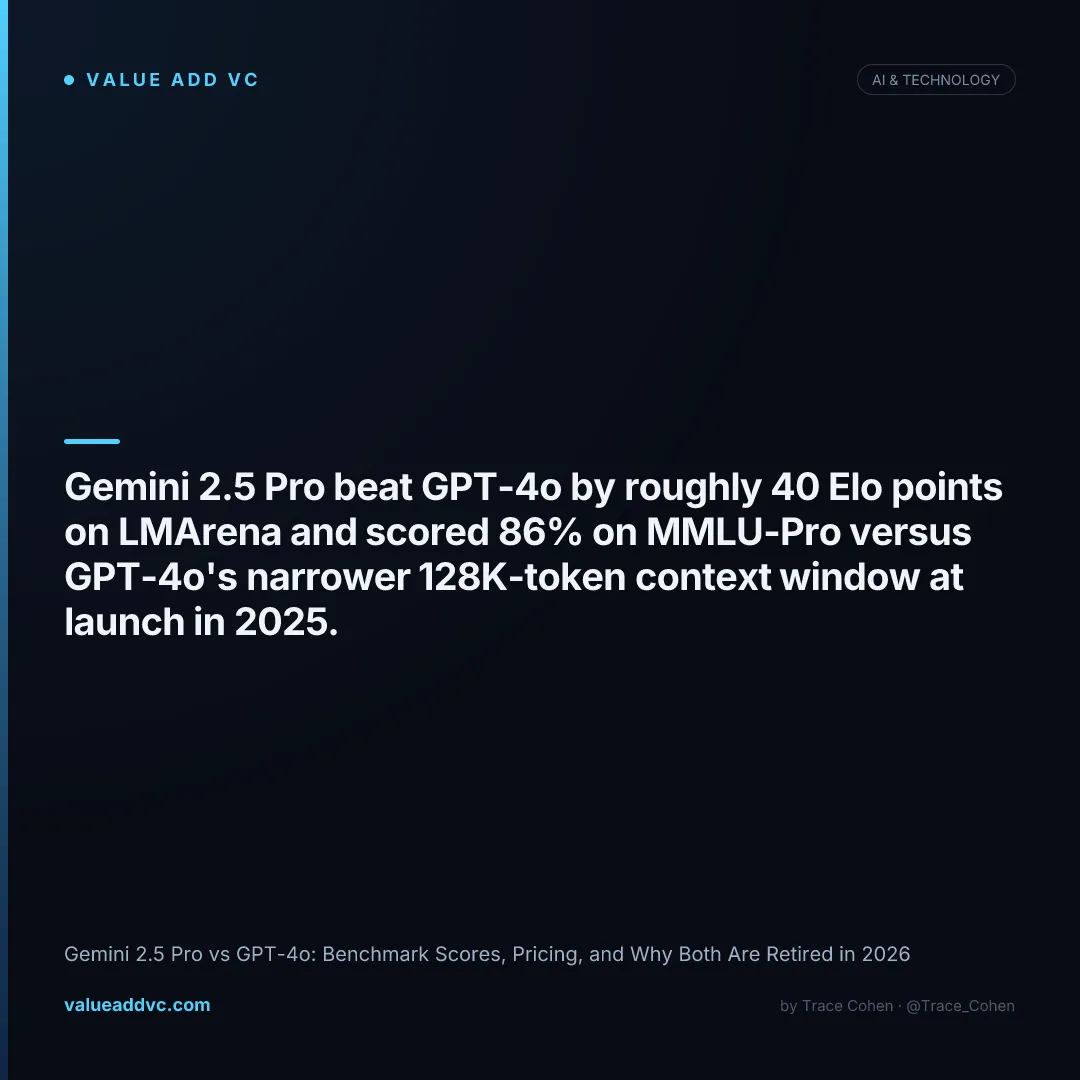
Gemini 2.5 Pro beat GPT-4o by roughly 40 Elo points on LMArena and scored 86% on MMLU-Pro when both were flagship models in 2025. The twist is that neither model is available to consumers anymore — GPT-4o was fully retired from ChatGPT on April 3, 2026, and Gemini 2.5 Pro was replaced by Gemini 3 Pro five months before that.
I still get asked which one "won" almost weekly, usually by an operator whose engineering team locked in a model choice in mid-2025 and never revisited it. The comparison is now a historical snapshot rather than a live buying decision, but the underlying numbers — and the retirement timeline that followed — tell you a lot about how fast the foundation model market actually moves and what that means for any team building on top of it.
Figures blended from Google DeepMind's March 2025 Gemini 2.5 technical report, LMArena leaderboard archives, OpenAI's retirement notices, and artificialanalysis.ai benchmark data.
Gemini 2.5 Pro vs GPT-4o: The Head-to-Head Comparison
Gemini 2.5 Pro outscored GPT-4o on nearly every published reasoning and coding benchmark when both were current, while GPT-4o held its ground on real-time multimodal responsiveness and had a full year of production hardening behind it by the time Gemini 2.5 Pro launched in March 2025. Google's model won on raw capability; OpenAI's model won on ecosystem maturity and integration depth at the time.
| Attribute | Gemini 2.5 Pro | GPT-4o |
|---|---|---|
| MMLU-Pro | 86% | ~75% (reported range) |
| SWE-bench Verified | 63.8% | ~33% (reported range) |
| LMArena Elo (launch) | ~1,300-1,310 | ~1,260-1,270 |
| Context window | 1M tokens (2M enterprise) | 128K tokens |
| Max output per request | 8K tokens | 16.4K tokens |
| Input price (per 1M tokens) | $1.25 | $2.50 |
| Output price (per 1M tokens) | $10.00 | $10.00 |
| Consumer availability, July 2026 | Retired (superseded by Gemini 3.x) | Fully retired since Apr 3, 2026 |
Figures are 2025 launch-era estimates blended from Google DeepMind's technical reports, artificialanalysis.ai, llm-stats.com, and OpenAI's published API pricing archives. GPT-4o benchmark ranges reflect commonly cited third-party evaluations rather than a single official OpenAI disclosure.
Gemini 2.5 Pro Benchmark Scores That Mattered
Gemini 2.5 Pro debuted at the top of the LMArena leaderboard with an Elo score in the 1,300-1,310 range, a lead of nearly 40 points over the next-best model at the time. On task-specific evaluations it scored 92% on AIME 2024, 83% on AIME 2025, 93% on the MRCR long-context retrieval test, 88.6% on Global-MMLU-Lite, and 84.8% on Video-MME — a spread that made it the strongest reasoning and long-context model available for most of 2025.
The Pricing Gap: Gemini 2.5 Pro vs GPT-4o
On standard API pricing, Gemini 2.5 Pro undercut GPT-4o by 50% on input tokens — $1.25 per million versus $2.50 per million — while both converged at $10 per million output tokens. That input-side advantage mattered most for retrieval-augmented generation and document-heavy workloads, where input tokens dominate the bill, but it came with a catch: Gemini doubled its input rate to $2.50 per million once a single request crossed 200,000 tokens of context, a threshold several enterprise teams hit without realizing it on long-document use cases.
Gemini 2.5 Pro vs GPT-4o: API Pricing per Million Tokens
Google AI for Developers pricing page and OpenAI API pricing archives, 2025-2026.
Neither price held. Both companies cut list prices repeatedly through 2025 and 2026 as competition from Anthropic, xAI, and open-weight labs compressed margins across the board — a pattern worth tracking on our AI Valuations dashboard if you're modeling how compute costs feed into foundation model company economics.
Why Both Gemini 2.5 Pro and GPT-4o Are Now Retired
OpenAI retired GPT-4o from ChatGPT on February 13, 2026, with Business, Enterprise, and Edu customers keeping limited access inside Custom GPTs until April 3, 2026, after which it left the consumer product entirely. On the API side, OpenAI had already pulled the chatgpt-4o-latest snapshot on February 17, 2026, six months after first notifying developers of the deprecation on November 18, 2025 — the same day Google shipped Gemini 2.5 Pro's own replacement.
Gemini 2.5 Pro's run was even shorter: Google replaced it with Gemini 3 Pro and Gemini 3 Deep Think on November 18, 2025, roughly eight months after Gemini 2.5 Pro launched. Google then announced the next-generation Gemini 3.5 Pro at I/O on May 19, 2026, targeting a rebuilt architecture aimed at closing the gap with OpenAI's GPT-5.6 and Anthropic's Fable 5 — a launch that slipped three separate deadlines before finally targeting July 17, 2026 for general availability.
The compressed cycle isn't unique to these two labs. Anthropic, xAI, and a growing set of open-weight competitors from Meta and Mistral all shipped at least one major model generation in the same window, which means any "current" comparison post — including this one — has a realistic shelf life of well under a year before the specific numbers go stale. What doesn't go stale as quickly is the pricing pressure: every subsequent generation from both Google and OpenAI launched at flat or lower per-token pricing than its predecessor, a trend that's held since Gemini 2.5 Pro's debut and shows no sign of reversing as inference costs continue to fall industry-wide.
The Real-World Gaps Benchmarks Didn't Capture
Benchmark tables never told the full story, and the Gemini 2.5 Pro vs GPT-4o comparison is a clean example of why. Gemini 2.5 Pro's 1 million token context window looked like an overwhelming advantage on paper against GPT-4o's 128K, but production teams building retrieval pipelines in 2025 found that Gemini's effective recall degraded well before it hit that ceiling — the MRCR score of 93% measured needle-in-haystack retrieval on curated test sets, not the messier multi-document reasoning most enterprise use cases actually needed. GPT-4o's smaller window forced tighter context engineering, which in practice produced more consistent output for teams that hadn't yet built sophisticated retrieval-augmented generation infrastructure.
Latency told a similar story. GPT-4o was purpose-built for real-time voice and live-video interaction, and it held a meaningful edge in time-to-first-token for conversational products even though Gemini 2.5 Pro won on raw reasoning depth. Teams building customer-facing chat products in 2025 frequently ran a hybrid stack — Gemini 2.5 Pro for offline batch reasoning and document analysis, GPT-4o for anything latency-sensitive and user-facing — rather than standardizing on a single "winner." That hybrid pattern, more than either benchmark table, is what actually shaped enterprise AI architecture through 2025 and into early 2026.
Coding was the sharpest divide. Gemini 2.5 Pro's 63.8% on SWE-bench Verified against GPT-4o's roughly 33% wasn't a marginal edge — it was close to double, and it showed up directly in developer tooling. Cursor, Windsurf, and other AI coding products defaulted new users to Gemini 2.5 Pro or Claude variants for agentic coding tasks through most of 2025, relegating GPT-4o to simpler autocomplete-style suggestions where its faster response time still mattered more than deep multi-file reasoning.
What the Gemini 2.5 Pro vs GPT-4o Cycle Means for Enterprise AI Buyers
The practical lesson isn't which model won a benchmark race that ended over a year ago — it's that flagship foundation models now have a shelf life of 8 to 15 months before the lab that built them replaces them outright. Google shipped three major Gemini generations (2.5, 3, and 3.5) in roughly 14 months; OpenAI moved from GPT-4o through multiple GPT-5.x releases in a similar window. Enterprise teams that hardcoded model identifiers into production pipelines in 2025 had to migrate at least once, sometimes twice, before mid-2026.
For operators evaluating AI infrastructure spend today, the more durable question is total cost of ownership across a model's realistic 12-month lifecycle, not a single benchmark snapshot — a framework we track alongside broader capex trends on Big Tech Earnings. Building an abstraction layer over the model provider, rather than betting on any one flagship, is now table stakes for any startup whose product depends on frontier-model quality.
It also changes how I evaluate AI-native startups as an investor. A company whose entire moat is "we fine-tuned on top of GPT-4o" had a forced migration event baked into its roadmap the moment OpenAI announced the retirement — that's a real technical and cost risk, not a hypothetical one, and it's exactly the kind of dependency I now ask founders to walk through explicitly in diligence. The startups that treated model choice as a swappable commodity layer weathered both the Gemini and GPT-4o transitions with a config change; the ones that baked provider-specific prompting and fine-tuning deep into their product had to rebuild.
Gemini 2.5 Pro beat GPT-4o on benchmarks by a wide margin in 2025. Both were retired within 14 months of that comparison mattering.
In frontier AI, the winner of last year's benchmark race is this year's deprecated model ID.
The Bottom Line
Gemini 2.5 Pro was the better model on paper — better benchmarks, a bigger context window, and cheaper input pricing than GPT-4o. But "better" lasted about eight months before Google replaced it, and GPT-4o's own retirement followed a similarly compressed timeline. The Gemini 2.5 Pro vs GPT-4o comparison is now a useful historical marker for how fast this market moves, not a decision either engineering team should still be making.
If you're tracking how foundation model economics feed into valuations, see our breakdown of what AI benchmarks actually measure, or check current model pricing and capex trends on the AI Valuations dashboard.
Follow AI and venture market data on Value Add VC. Reach out at t@nyvp.com or @Trace_Cohen.
Latest from the Pulse
Get VC data most people never see
— free to subscribe
Trace's notes on venture, AI and startups, a few times a week. Join 5,000+ subscribers. No spam.
No spam, unsubscribe anytime. Sent via Substack · Privacy · or subscribe on Substack ↗