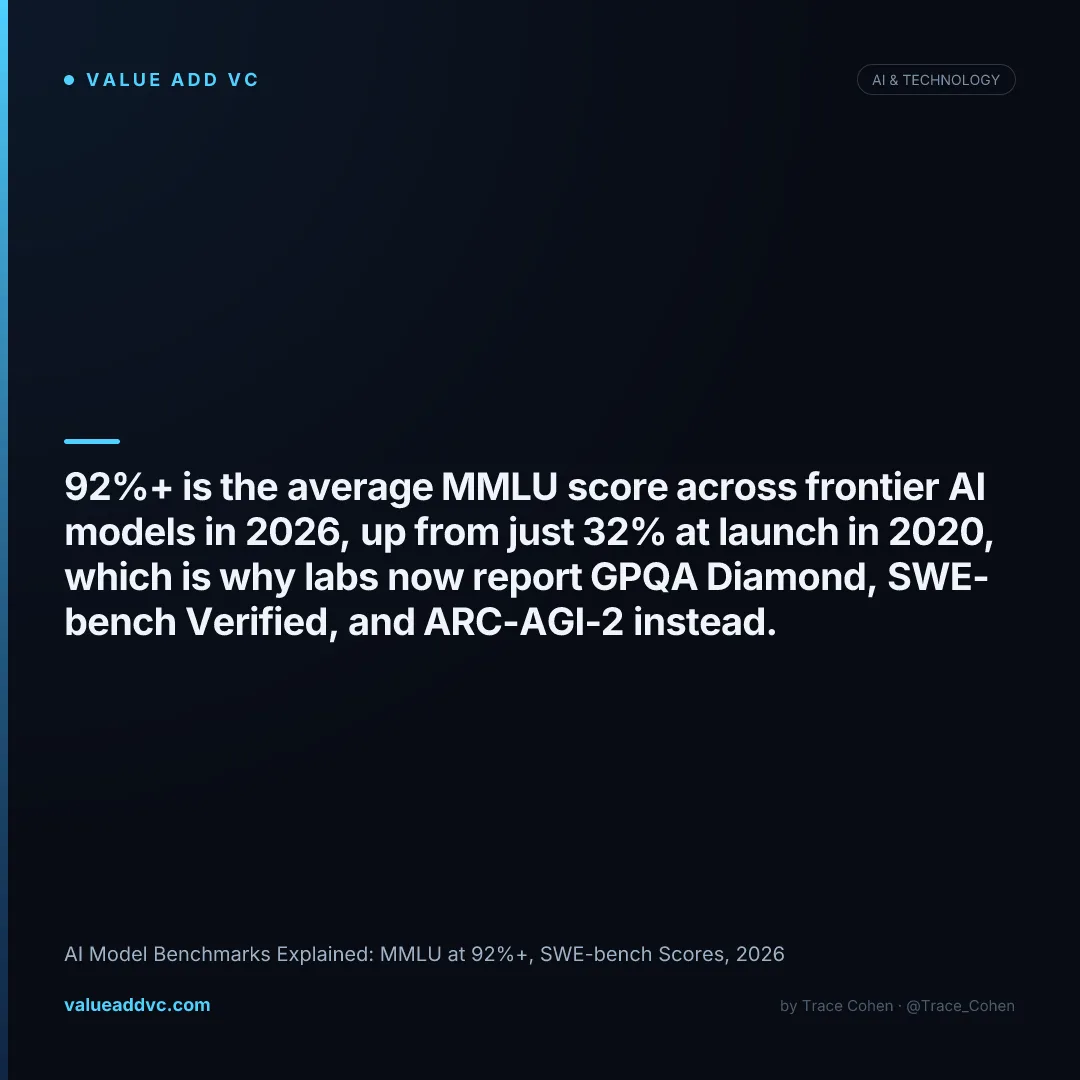
92%+ is the average MMLU score for frontier AI models in 2026, up from just 32% when the benchmark launched in 2020 — which is exactly why every major lab has quietly stopped treating it as a real differentiator.
The problem is that the entire scoreboard investors and buyers use to compare AI models has been rebuilt in the last 18 months, and most people evaluating vendors are still citing numbers that no longer mean anything.
AI Model Benchmarks Explained: What MMLU, HumanEval, and Arena Actually Test
MMLU tests broad academic knowledge across 57 subjects via multiple choice, HumanEval tests whether a model can write a working function from a docstring, and Arena (the platform formerly branded LMArena and before that LMSYS Chatbot Arena) collects blind human votes between two anonymous model outputs and converts them into an Elo rating. All three were built between 2020 and 2023, and all three have since been pushed toward their ceilings by frontier models.
The problem is saturation, not irrelevance. MMLU shipped in 2020 with frontier accuracy near 32%; by Q1 2026 every frontier system reports above 92%, and the dataset carries documented label errors that cap real headroom near 95%. HumanEval tells a similar story — most frontier models now clear 90%+ on a test designed to separate models just three years ago. When every vendor can point to a 90%+ score, the number stops being useful for a buying decision.
Why Benchmarks Saturate: Contamination and Overfitting
Saturation doesn't happen because models got smart enough to answer everything correctly — it happens because the test sets are public, and public data eventually leaks into training corpora. This is called benchmark contamination: a model that has seen a question (or a close variant) during pretraining will score well on it without demonstrating the underlying skill the benchmark was designed to measure. MMLU and HumanEval are both five-plus years old and have been scraped, mirrored, and discussed across the open web thousands of times, which makes them especially vulnerable.
There's a second, subtler effect: even without direct contamination, labs optimize training recipes and post-training fine-tuning against whichever benchmarks the industry is currently watching. Once a benchmark becomes the headline number in every launch announcement, it stops being a neutral measurement and starts being a target — which is exactly why GPQA Diamond, ARC-AGI-2, and SWE-bench Pro were built with harder, more novel, or private-held-out tasks that are much more expensive to game. ARC-AGI-2 in particular was designed so that each task requires a genuinely novel reasoning pattern rather than pattern-matching against training data, which is why even frontier models still score under 30% on it in 2026.
Benchmark Saturation, by the Numbers
Plotting top frontier scores side by side makes the saturation problem obvious — three of the original benchmarks are pinned near the ceiling while the newer generation still shows real separation between models.
| Benchmark | What It Tests | Launched | Top 2026 Score | Status |
|---|---|---|---|---|
| MMLU | Academic knowledge, 57 subjects | 2020 | ~92-94% | Saturated |
| HumanEval | Isolated function generation | 2021 | 90%+ | Saturated |
| SWE-bench Verified | Real GitHub issue resolution | 2023 | 88-95% | Near-saturated |
| GPQA Diamond | Graduate-level science reasoning | 2023 | ~75-85% | Discriminative |
| ARC-AGI-2 | Abstract, novel-pattern reasoning | 2024 | Under 30% | Discriminative |
| SWE-bench Pro | Harder, less-contaminated coding repos | 2025 | ~69.2% | Discriminative |
| Humanity's Last Exam | Expert-level open reasoning | 2025 | Under 25% | Discriminative |
Figures are 2026 estimates blended from LMArena/Arena leaderboard data, llm-stats.com, BenchLM.ai, MorphLLM's SWE-bench Pro leaderboard, and lab-published model cards. Scores reflect top-performing frontier models as of Q2 2026, not category averages.
New AI Model Benchmarks Explained: GPQA, SWE-bench, and ARC-AGI-2
The benchmarks that actually show up on frontier model cards in 2026 are a different set entirely: GPQA Diamond for graduate-level science reasoning, SWE-bench Verified and SWE-bench Pro for real coding work, ARC-AGI-2 for abstract pattern reasoning, AIME 2025 for competition math, Humanity's Last Exam (HLE) for the hardest open reasoning problems, plus BFCL v4 for tool-calling and Arena Elo for human preference. Labs picked these specifically because current models still fail a meaningful share of them.
Coding is the clearest example of how much saturation distorts a single score. On SWE-bench Verified, Claude models resolve roughly 88-95% of vetted GitHub issues versus GPT-5-class models around 75-90%, per Local AI Master's 2026 leaderboard tracking (Claude 4-class models reached 77.2% versus GPT-5's 74.9% as recently as October 2025, before both climbed further into 2026). But move to SWE-bench Pro — built on harder, less-contaminated repositories — and even the leading active model, Claude Opus 4.8, only clears about 69.2%, per MorphLLM's leaderboard. That 20-25 point gap between Verified and Pro is the real signal: it shows how much of the "saturated" score was measuring benchmark familiarity rather than genuine capability.
What Each AI Lab Actually Leads With on Model Cards
Reading a model launch announcement is now a useful signal on its own — which benchmarks a lab chooses to headline tells you what they believe their model is actually good at, and which numbers they'd rather you not scrutinize too closely.
| Lab | Headline Benchmarks in 2026 | Implied Strength |
|---|---|---|
| Anthropic (Claude) | SWE-bench Verified/Pro, GPQA Diamond | Agentic coding and scientific reasoning |
| OpenAI (GPT-5.x) | AIME 2025, FrontierMath, Arena Elo | Math reasoning and broad user preference |
| Google (Gemini) | MMMU-Pro, coding-arena head-to-head, RULER | Multimodal reasoning and long-context retrieval |
| xAI (Grok) | Arena Elo, real-time knowledge tasks | Conversational responsiveness and freshness |
Compiled from publicly available model card releases and launch announcements across Anthropic, OpenAI, Google DeepMind, and xAI, Q1-Q2 2026. Reflects headline benchmarks each lab emphasized, not an exhaustive list of every score reported.
Arena Rankings: The One Benchmark That Isn't Saturating
Arena — the platform rebranded from LMArena on January 28, 2026, and originally launched as LMSYS Chatbot Arena — takes a different approach: instead of a fixed test set, it collects blind, side-by-side human votes between two anonymous model responses and converts the outcome into an Elo rating, the same math chess uses to rank players. Because the "questions" are whatever real users actually ask, there's no static test set for a lab to optimize against.
As of June 2026, Arena has logged more than 6.8 million blind votes across 360+ models. Claude Opus 4.8 leads the overall leaderboard at roughly 1,510 Elo, trailed by GPT-5.5 Pro, Gemini 3.1 Pro Preview, and Claude Opus 4.7 — with the top five models separated by only about 55 Elo points, the tightest spread on record. Track how these model providers are being valued on our AI Valuations dashboard.
AI Model Benchmarks Explained for 2026 Buyers: What Actually Matters
If you're picking a model for a product or a portfolio company, three rules cut through most of the marketing noise:
Ignore MMLU and HumanEval as tie-breakers
Both are saturated at 90%+ — a 2-point gap there tells you nothing about real capability
Weight the benchmark to your actual use case
SWE-bench Pro for coding agents, GPQA Diamond for research/analysis, Arena Elo for general chat quality
Check Verified vs Pro-style variants when they exist
A 20+ point drop from an easy to a hard variant reveals how much score was benchmark-specific overfitting
Treat Arena Elo as the least gameable signal
It's built on live, blind human votes rather than a fixed, publicly-known test set
For portfolio companies deciding between Claude, GPT, and Gemini for a production feature, the right comparison in 2026 is almost never MMLU. It's SWE-bench Pro for anything code-adjacent, GPQA Diamond or HLE for research and analysis tools, and Arena Elo for anything user-facing where tone and helpfulness matter more than raw accuracy. Compare the hyperscalers funding this race on our Big Tech Earnings dashboard.
There's also a diligence angle here that most non-technical investors miss: when a startup pitches proprietary "AI evaluation" as a moat, the first question worth asking is whether their internal benchmark is contamination-resistant — built on private, regularly refreshed tasks — or just a repackaged public set. The same logic that makes MMLU useless for comparing frontier labs applies at the startup level. A model eval suite that a competitor could scrape and train against isn't a durable advantage; a private, continuously updated eval set tied to a proprietary dataset is. That distinction increasingly shows up in how AI-native companies get priced in later rounds, since buyers and acquirers now ask for eval methodology alongside model performance claims.
MMLU and HumanEval aren't wrong — they're just done.
92%+ frontier scores mean these tests stopped separating good models from great ones years ago.
If a vendor pitch still leads with an MMLU number, ask for GPQA Diamond, SWE-bench Pro, and Arena Elo instead — those are the three benchmarks still showing real daylight between the top AI labs in 2026.
Track AI company valuations and model provider positioning on the AI Valuations Dashboard at Value Add VC. Originally published in the Trace Cohen newsletter.
Latest from the Pulse
Get VC data most people never see
— 100% free
Weekly benchmarks, valuations, and fund data. Join 5,000+ investors. No spam.