
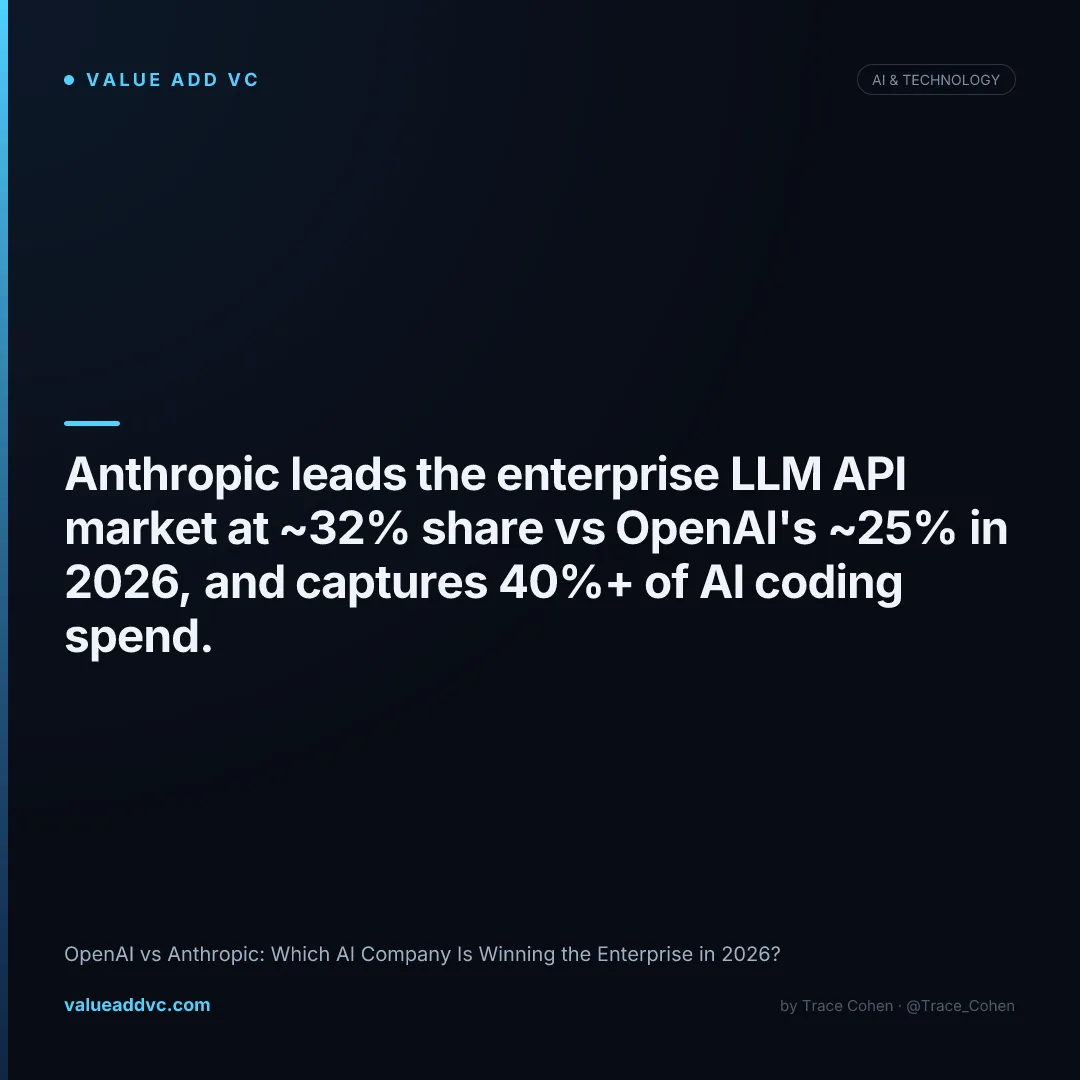
Anthropic now holds roughly 54% of the enterprise AI-coding market versus OpenAI's ~21% — and its total ARR hit $74.1B in July 2026, ahead of OpenAI's $41.3B. That's the short answer. The longer answer is more interesting.
Eighteen months ago this comparison went the other way on almost every axis. Anthropic has since pulled ahead on enterprise API share, coding-market share, and now total revenue too — though OpenAI still has roughly 30 times more weekly users. Here is the full breakdown, layer by layer.
What Is Anthropic's Market Share in 2026?
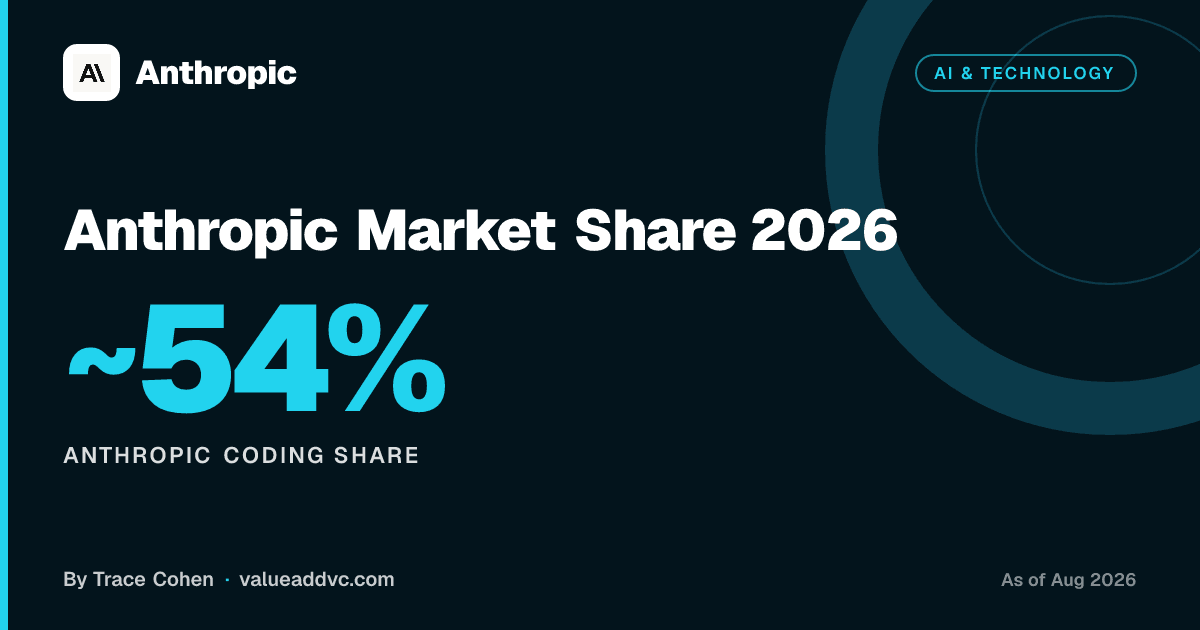
Anthropic holds an estimated 54% of the enterprise AI-coding market as of mid-2026, more than double OpenAI's roughly 21%, and about 40% of overall enterprise LLM API spend versus OpenAI's 27%. Combined with Anthropic's $74.1B ARR overtaking OpenAI's $41.3B in July 2026, it's the first time Anthropic has led on every commercial metric except users.
| Metric | OpenAI | Anthropic | Edge |
|---|---|---|---|
| Total Revenue (ARR, July 2026) | ~$41.3B | ~$74.1B | Anthropic |
| Enterprise LLM API Market Share | ~27% | ~40% | Anthropic |
| AI-Coding Market Share | ~21% (Codex) | ~54% (Claude Code) | Anthropic |
| Coding-Tool Standalone ARR | Undisclosed | ~$2.5B (Claude Code) | Anthropic |
| Weekly Active Users | ~900M (ChatGPT) | ~30M (Claude) | OpenAI |
| Last Private Valuation | ~$852B | ~$965B | Anthropic |
| Cloud Distribution | Azure (near-exclusive) | AWS + Google Cloud | Anthropic |
| Flagship Input Price (per 1M tokens) | $10–15 | ~$15 (Opus) | Comparable |
| Mid-tier Input Price (per 1M tokens) | $2–3 | ~$3 (Sonnet) | Comparable |
| IPO Path | No confirmed date | Targeting Nasdaq, ~Oct 2026 | Anthropic |
Figures are 2026 estimates blended from The Information, Menlo Ventures' enterprise AI survey, and provider pricing pages. Private-company revenue and valuation figures are directional, not audited.
How Anthropic Took Coding Market Share From OpenAI
The coding layer is where the crossover is starkest. In 2023, OpenAI controlled more than 50% of enterprise LLM API spend and Anthropic sat around 12%. By 2026 those numbers had flipped in coding specifically: Claude Code alone crossed 10% of all public GitHub commits, is tracking toward 20%-plus by year-end, and its GitHub star count grew from 71,000 to 132,000 between roughly December and June. Claude Code's standalone run-rate revenue went from about $500M in September 2025 to $2.5B by February 2026 — a 5x jump in five months.
Three forces drove it. First, coding became the highest-value, stickiest API workload, and Claude models were simply better at it. Second, a safety-and-reliability brand that shortened enterprise procurement cycles. Third, multi-cloud distribution — Claude is available through both AWS Bedrock and Google Cloud — that avoided locking buyers into one vendor relationship.
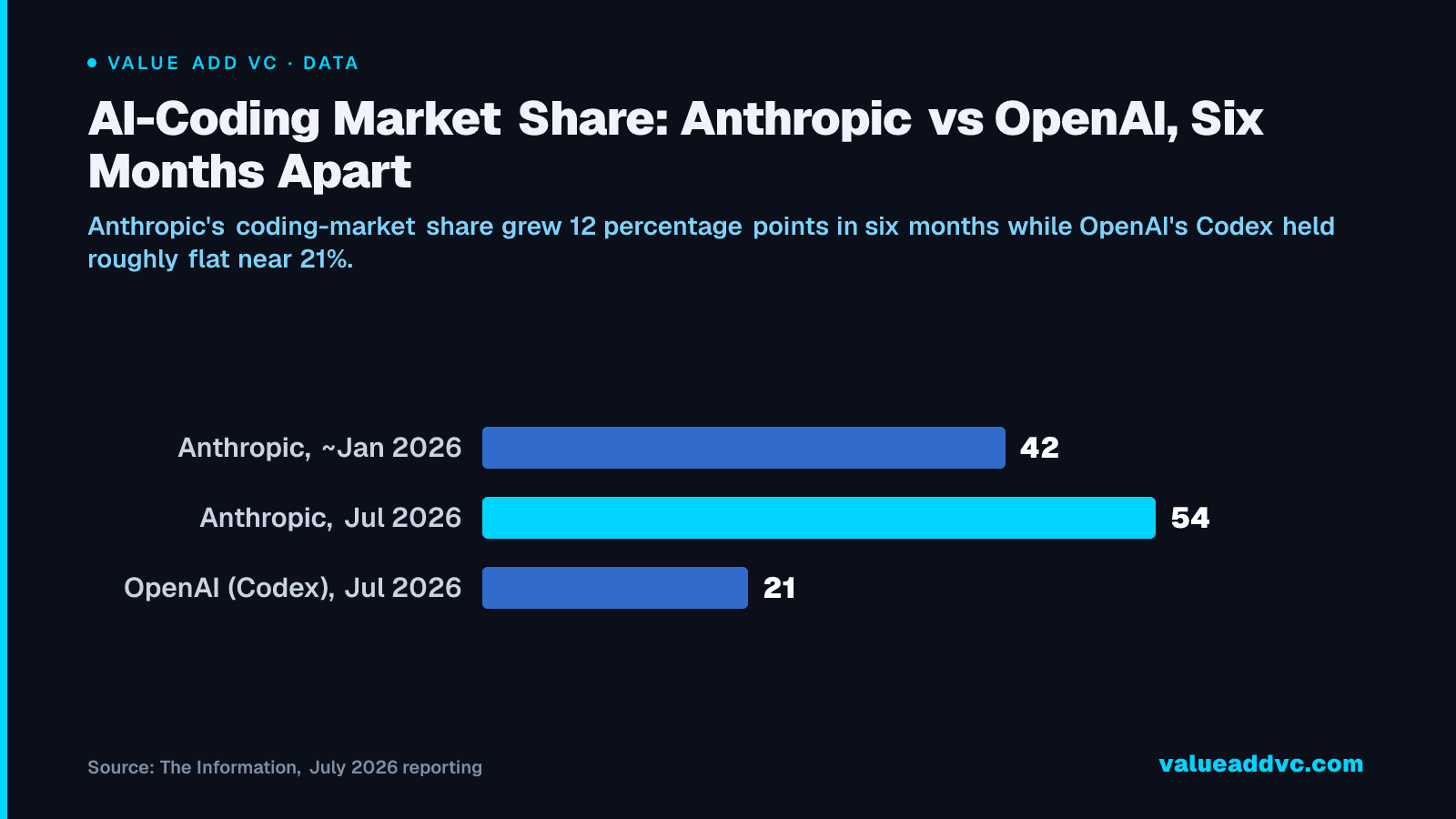
AI-Coding Market Share: Anthropic vs OpenAI, Six Months Apart
Anthropic's coding-market share grew 12 percentage points in six months while OpenAI's Codex held roughly flat near 21%.
The Information, July 2026 reporting
Data
| Item | Value |
|---|---|
| Anthropic, ~Jan 2026 | 42 |
| Anthropic, Jul 2026 | 54 |
| OpenAI (Codex), Jul 2026 | 21 |
Where OpenAI Still Wins in 2026
Don't mistake coding-market share for total dominance. ChatGPT's roughly 900 million weekly active users, versus an estimated 30 million or so for Claude, feed a consumer and prosumer subscription business Anthropic simply doesn't have. On the enterprise side, OpenAI's deep integration with Microsoft — Azure OpenAI Service, Copilot across Office, and Microsoft's multi-billion-dollar investment — puts GPT models inside thousands of companies by default.
OpenAI also leads on breadth of product surface: a mature Assistants and Responses API, the widest set of multimodal capabilities, voice, image generation, and a developer ecosystem that's years deep. And OpenAI isn't standing still on coding — it fully open-sourced Codex CLI under an Apache-2.0 license, which has already drawn more than 91,000 GitHub stars, while the independent tool OpenCode grew from 112,000 stars in February to 161,000 by May.
OpenAI's Strengths
- ✓ ~900M weekly ChatGPT users vs ~30M for Claude
- ✓ Native Microsoft Azure + Copilot distribution
- ✓ Broadest multimodal + voice product surface
- ✓ Codex CLI now open-source, 91,000+ stars
Anthropic's Strengths
- ✓ ~54% coding share, ~40% enterprise API share
- ✓ $74.1B ARR now ahead of OpenAI's $41.3B
- ✓ Multi-cloud (AWS + Google Cloud) distribution
- ✓ Claude Code: $2.5B run-rate revenue alone
Weekly Active Users: ChatGPT vs Claude
Company disclosures, mid-2026
Data
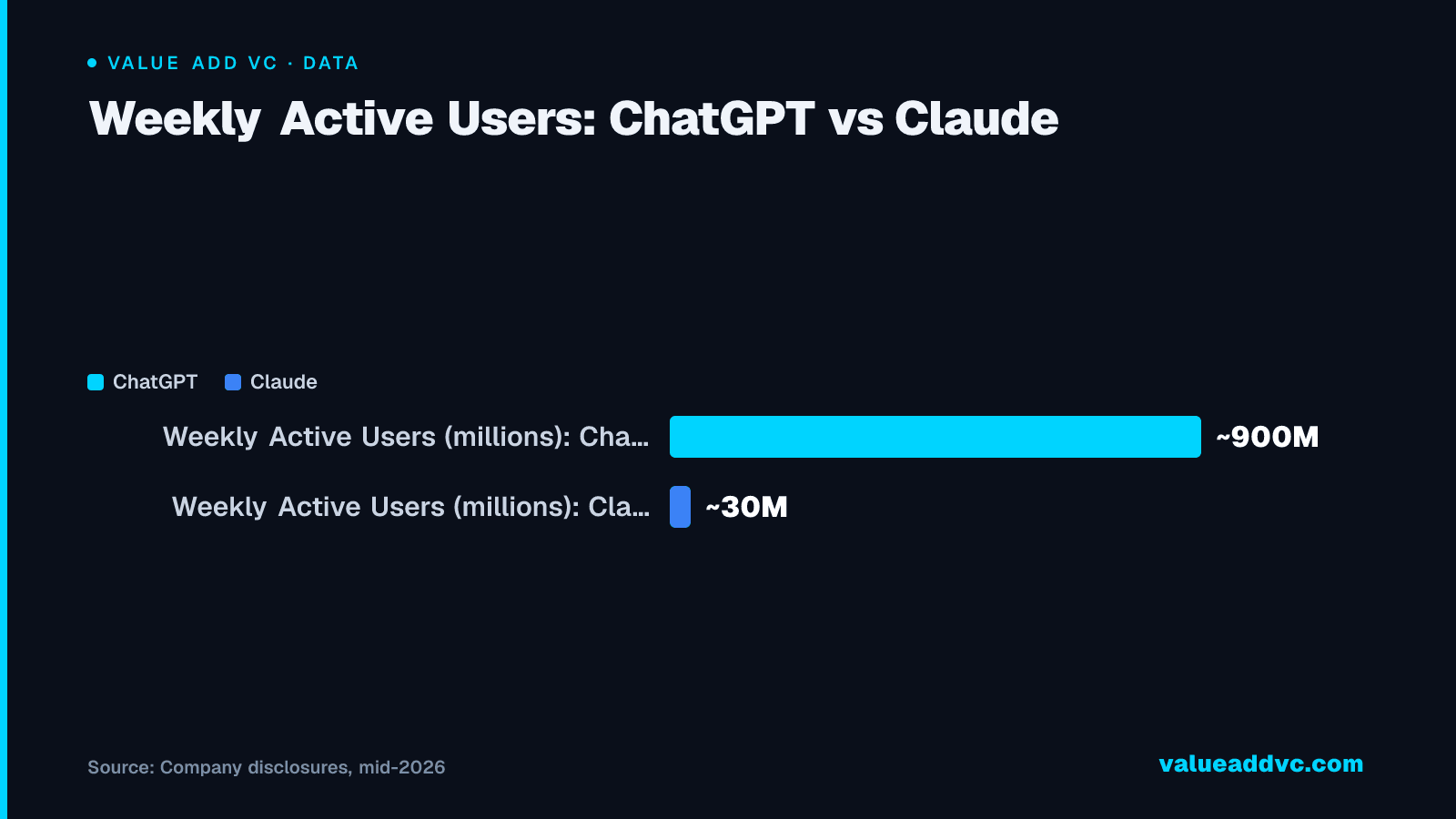
OpenAI still commands roughly 30x the weekly user base — the two companies are winning fundamentally different layers of the market.
Claude vs GPT Pricing and Performance for Enterprise Buyers
On pricing, the two are closer than the market-share gap suggests. Anthropic's flagship Claude Opus lists around $15 per million input tokens and $75 per million output, while its workhorse Sonnet runs ~$3 input and ~$15 output. OpenAI's flagship sits in a comparable $10-15 input band, with mid-tier models around $2-3 input and $10-15 output. For most production workloads, enterprises run the mid-tier models on both sides — which is where the bulk of token volume actually lands. Track the full spending breakdown on the AI Spending dashboard.
On performance, the split is still workload-specific: Anthropic edges OpenAI on coding and long-horizon agentic tasks, while OpenAI tends to lead on multimodal reasoning, voice, and the broadest general-knowledge benchmarks. That's a big part of why roughly 60% of enterprises now run two or more model vendors instead of single-sourcing. You can track how these valuations and funding rounds are moving on the AI Valuations dashboard.
What the headline misses
The $74.1B-vs-$41.3B ARR gap is not a clean apples-to-apples number. Anthropic books its Claude sales through AWS and Google Cloud on a gross basis, while OpenAI reports ChatGPT and API revenue through Microsoft on a net basis — OpenAI disputes the comparison, arguing the accounting difference overstates Anthropic's lead by roughly $8B. And Anthropic's 54% coding-market share is a snapshot, not a moat: a fully open-source Codex CLI already has more than 91,000 GitHub stars within months of release, and independent tools like OpenCode are growing faster in raw star count than either incumbent's official product. Anthropic's lead is real, but it is being actively contested from multiple directions at once.
What the Market-Share Shift Means for Founders and Investors
For founders building on top of these models, the practical lesson is to architect for portability rather than pick a permanent side. Teams that abstract their model layer and route requests between Claude and GPT by task and by price are the ones best positioned if either company changes pricing or has an outage — and with roughly 60% of enterprises already running two or more model vendors, that flexibility is becoming table stakes rather than a hedge. For investors, the coding-market-share shift is the more durable signal than headline ARR: engineering workflows are sticky, expensive to re-platform, and where switching costs actually compound.
Anthropic's last private mark was $965B (Series H, May 2026) versus OpenAI's $852B, and Anthropic is reportedly targeting a Nasdaq listing around October 2026 that could push its valuation past $1 trillion. If that IPO lands while Anthropic still leads on ARR and coding share, it would be the first time a company has gone public from the #2 consumer-mindshare position while holding the #1 revenue and enterprise-share position — an unusual setup that public-market investors haven't had to price before. See the full private AI revenue rankings for how the rest of the field compares.
Which One Should You Actually Build On?
Coding-heavy engineering teams: Claude Code's 54% share and $2.5B run-rate revenue reflect a real product edge — default to Anthropic unless you have a specific reason not to. Consumer or prosumer products: OpenAI's ~900M weekly ChatGPT users and mature multimodal stack (voice, image, video) still make it the safer default for anything consumer-facing. Regulated enterprises (finance, healthcare, legal): Anthropic's safety brand and 40% enterprise API share generally shorten procurement cycles. Anyone shipping production AI at scale: run both. Roughly 60% of enterprises already do, mainly for pricing leverage and resilience against a single provider's outage or capability regression.
So what is Anthropic's market share in 2026?
~54% of AI coding, ~40% of enterprise API spend, and $74.1B in ARR — ahead of OpenAI on every commercial metric except weekly users, where OpenAI still leads by roughly 30x.
Track AI company valuations and funding on the AI Valuations dashboard at Value Add VC. Originally published in the Trace Cohen newsletter.
Latest from the Pulse
Get VC data most people never see
— free to subscribe
Trace's notes on venture, AI and startups, a few times a week. Join 5,000+ subscribers. No spam.
No spam, unsubscribe anytime. Sent via Substack · Privacy · or subscribe on Substack ↗