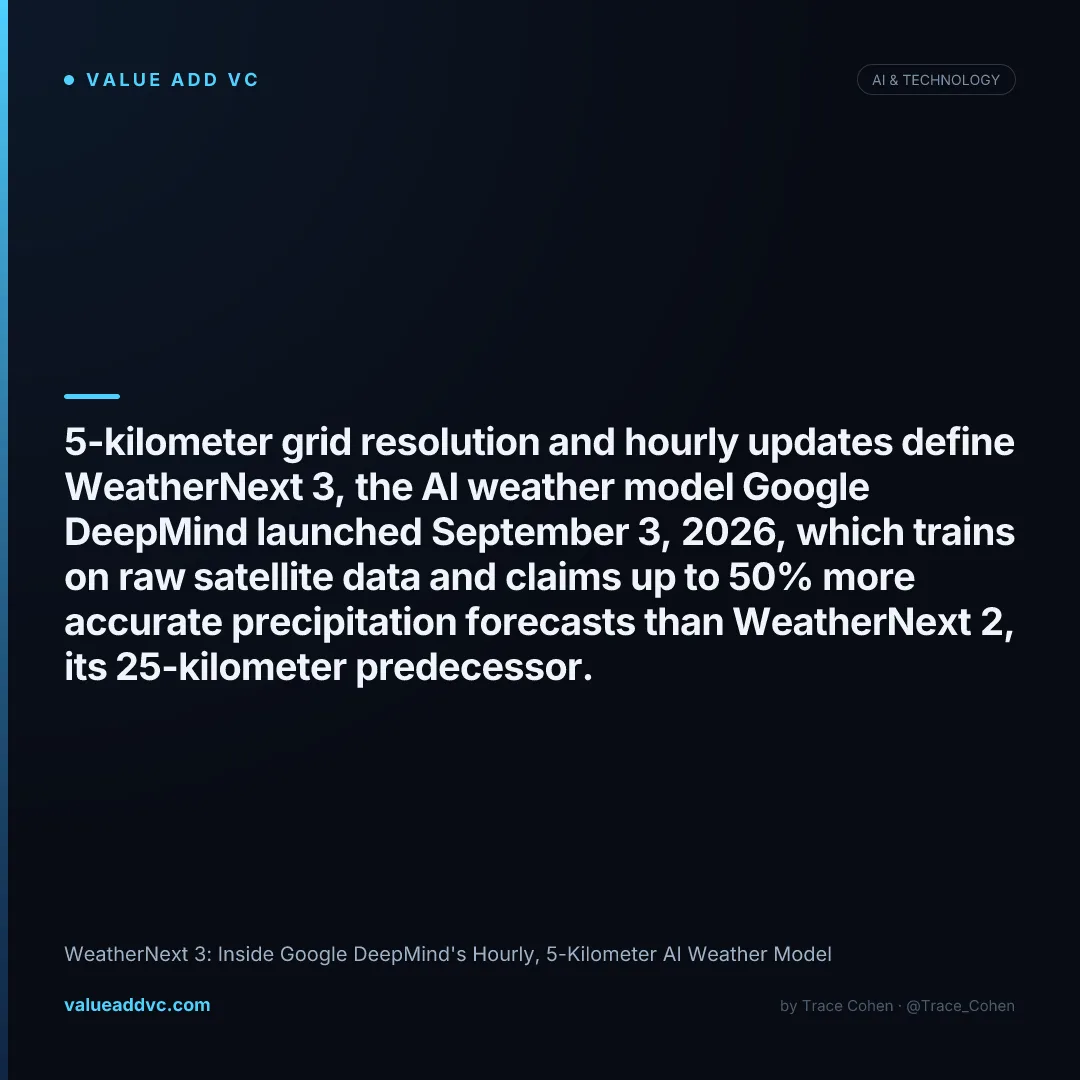
5 kilometers and every hour: that's the new resolution and cadence of WeatherNext 3, the AI weather model Google DeepMind launched September 3, 2026 — a five-times sharper grid than its predecessor, paired with a claimed 50% jump in precipitation accuracy.
Some searchers type the product name as two words — "weather next 3" — without realizing WeatherNext 3 is a single branded model name, not a forecast for three days out. Here's what Google actually shipped, what the accuracy claim does and doesn't mean, and why the model's new wind and solar forecasts matter more commercially than the consumer weather-app upgrade.
Figures from Google's WeatherNext 3 announcement and TechCrunch, September 3, 2026.
WeatherNext 3 explained: what Google's "weather next 3" model actually does
WeatherNext 3 is a global AI weather model from Google DeepMind and Google Research that generates forecasts every hour on a 5-kilometer grid, a five-times improvement over WeatherNext 2's 25-kilometer resolution and periodic refresh cycle. Google calls it the company's most advanced and accurate weather model yet, and it began feeding live weather results in Google Search, Gemini, Google Maps, and the Maps Platform Weather API as soon as it launched.
The technical shift behind the accuracy claim is training methodology, not just added compute: WeatherNext 3 trains directly on raw satellite observations rather than the processed output of traditional numerical weather models, according to Google's own announcement. That removes a roughly six-hour data-refresh lag baked into conventional forecasting pipelines, a constraint that has limited accuracy for decades regardless of how much compute gets thrown at the problem.
WeatherNext 3 vs WeatherNext 2: what actually changed
The headline upgrade is resolution and speed, but WeatherNext 3 also adds forecast variables its predecessor didn't cover. The table below compiles every figure Google and 9to5Google have disclosed on the model as of its September 3, 2026 launch.
| Spec | Value | Context |
|---|---|---|
| Grid resolution | 5km | Down from WeatherNext 2's 25km |
| Forecast cadence | Hourly | First global model to update every hour, per Google |
| Precipitation accuracy claim | Up to 50% more accurate | A day or more in advance; DeepMind's internal testing |
| Training data | Raw satellite observations | Replaces 6-hour-lag numerical model output |
| New forecast variables | Wind at 100m, cloud cover, solar radiation | Aimed at renewable-energy grid operators |
| Products powered | Search, Maps, Gemini, Weather API, BigQuery, Earth Engine | Live at launch |
| Launch date | September 3, 2026 | Second Google DeepMind weather model in about a year |
Compiled from Google's announcement, TechCrunch, and 9to5Google reporting, September 2026.
The energy angle: why grid operators matter more than umbrellas
WeatherNext 3's most commercially interesting expansion isn't the consumer accuracy bump — it's the new wind-speed forecast at 100 meters, roughly turbine height, plus cloud cover and solar radiation data. Accurate wind and solar output prediction is a real, persistent pain point for grid operators managing intermittent renewable capacity, and this puts Google in loose competition with specialized energy-forecasting vendors, not just consumer weather apps like AccuWeather or Apple Weather.
Grid capacity already limits how fast new AI data centers can come online, so a model that helps operators time renewable output more precisely has an obvious adjacent use case: matching AI compute demand to periods of high wind or solar generation. Whether Google turns this into a distinct enterprise product, separate from the free consumer integrations in Search and Maps, is the detail worth watching — that's the difference between a research showcase and a new revenue line.
What the 50% accuracy claim misses
Google has not published independent, third-party validation of the 50% precipitation-accuracy claim against a standardized benchmark such as the European Centre for Medium-Range Weather Forecasts' own verification metrics. The number comes from DeepMind's internal testing — the same caveat that applies industry-wide to competing AI weather models, including Nvidia's FourCastNet and Huawei's Pangu-Weather, none of which have submitted results to a shared, independently run leaderboard that would let buyers compare claims directly.
That doesn't make the claim false — DeepMind has a credible track record on weather modeling, including the earlier GraphCast and WeatherNext 2 releases — but it does mean the 50% figure should be read as a vendor's self-reported benchmark until meteorologists outside Google run their own comparisons. Whether WeatherNext 3's advantage holds up under independent scrutiny is the open question before it becomes the industry's new baseline rather than a marketing number.
Bottom line: WeatherNext 3 is a genuine architectural upgrade — training on raw satellite data instead of six-hour-old model output is what unlocks hourly, 5-kilometer forecasts — and its new wind, cloud, and solar variables point at a real commercial opportunity in renewable-energy forecasting beyond the free consumer integrations in Search, Maps, and Gemini. The 50% accuracy claim, though, is still DeepMind's own number until an independent benchmark confirms it, which is worth remembering the next time "weathernext 3" shows up as the source behind a forecast.
Latest from the Pulse
Get VC data most people never see
— 100% free
Weekly benchmarks, valuations, and fund data. Join 5,000+ investors. No spam.