
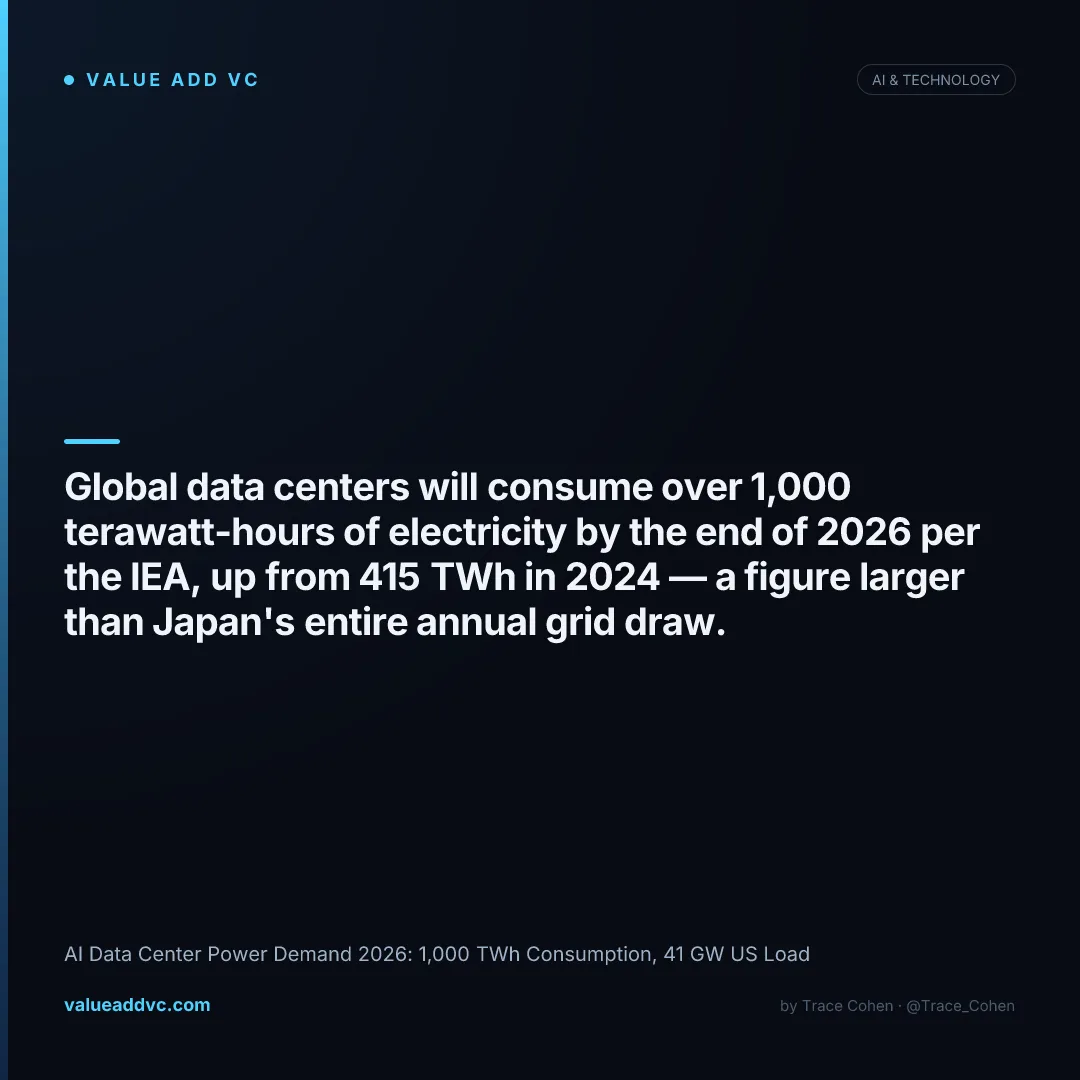
Global data centers will burn through more than 1,000 terawatt-hours of electricity by the end of 2026, per the IEA — a load bigger than Japan's entire national grid. A single computing category outdrawing Japan deserves to be taken apart line by line.
Power, not chips, is now the binding constraint on how fast AI can scale. Nvidia can ship GPUs faster than utilities can permit substations, and the gap between those two curves is reshaping where data centers get built, who owns the power plants next to them, and how much every AI query actually costs in electrons.
How Much Electricity Does AI Data Center Power Demand Actually Represent in 2026?
Global data center electricity consumption is projected to exceed 1,000 TWh by the end of 2026, according to the International Energy Agency — up from roughly 415 TWh in 2024 and about 485 TWh in 2025. AI-focused facilities are the reason: their electricity draw surged approximately 50% in 2025 alone, and the IEA expects AI-driven consumption to roughly triple its share of total data center power between 2025 and 2030, even as overall data center demand merely doubles over the same window, from 485 TWh to 950 TWh.
To put 1,000 TWh in context: that's more electricity than Japan, the world's fourth-largest economy, consumes in an entire year across every home, factory, and office combined. And it's happening inside a single global industry segment that barely registered as a power-planning concern a decade ago. Notably, this updated 2026 estimate already exceeds the IEA's own earlier base-case forecast of 950 TWh for 2030 — a sign of how quickly the agency has had to revise its models upward as AI buildout accelerates faster than prior projections assumed.
US Data Center Power Demand: 31 GW to 41 GW in One Year
Goldman Sachs Research puts US data center power demand at 31 GW in 2025, climbing to 41 GW in 2026 — a 32% jump in twelve months, with 13.6 GW of new capacity additions scheduled for this year alone. That pushes data centers from 4.1% to 5.3% of total US peak summer power demand in a single planning cycle, a pace utilities have never had to absorb before.
| Metric | 2024 | 2025 | 2026 | 2030 (projected) |
|---|---|---|---|---|
| Global DC electricity use (TWh) | ~415 | ~485 | 1,000+ | 950 (IEA base case) |
| US DC power demand (GW) | ~26 | 31 | 41 | 67-98 |
| US DC share of peak summer power | ~3.5% | 4.1% | 5.3% | 6.7%-12% |
| AI DC electricity YoY growth | baseline | +50% | accelerating | 3x 2025 AI share |
| Nvidia flagship rack power draw | ~40 kW (Hopper) | 120-130 kW (Blackwell) | 190-230 kW (Vera Rubin) | ~600 kW (Rubin Ultra, 2027) |
| New US DC capacity additions (GW/yr) | ~6 | ~9 | 13.6 | 20+ |
| Global IPO-scale AI capex commitments | ~$200B | ~$380B | $500B+ | n/a |
Figures are 2026 estimates blended from the IEA (Energy and AI report), Goldman Sachs Research, Lawrence Berkeley National Laboratory, and Nvidia data center specifications. GW figures reflect peak demand capacity, not average draw.
Why Nvidia's Newest GPUs Are the Real Power Problem
The AI data center power demand story is less about more data centers than about each rack drawing dramatically more power than the last generation. Hopper-generation racks pulled roughly 40 kW. Standard Blackwell racks jumped to 120-130 kW. The Vera Rubin VR200 racks shipping in the second half of 2026 will draw 190-230 kW, and Nvidia's already-specified 2027 Rubin Ultra ("Kyber") generation is rated at approximately 600 kW per rack — a 15x increase over Hopper in roughly three years.
That density curve is why air cooling is disappearing from new-build AI data centers. VR200 racks are fanless and rely entirely on direct-to-chip liquid cooling, with coolant flow roughly doubling per rack even as airflow requirements drop about 80%. For operators, that means every new facility now needs a warm-water cooling loop and a coolant distribution unit sized as a first-order design constraint — not an afterthought bolted on later. This is directly relevant to AI infrastructure spending trackers: cooling and power delivery now account for a rising share of every dollar of AI capex, not just the chips themselves.
Which US Grid Regions Are Under the Most AI Data Center Strain?
Not all grids are equally exposed. Reliability risk is most elevated in three regions where data center interconnection requests are outpacing planned generation additions:
PJM (Mid-Atlantic)
Largest concentration of data center interconnection requests in the US; capacity auction prices have already spiked on projected AI demand
MISO (Mid-Continent)
Generation retirements are outpacing new capacity while data center load requests accelerate across the region
Pacific Northwest
Hydro-heavy grid with limited headroom now facing new hyperscale campus proposals from multiple operators
ERCOT (Texas)
Fastest-growing data center pipeline in the country, partially offset by aggressive new gas and battery storage buildout
Former Google CEO Eric Schmidt testified before Congress that US data centers will need 29 GW of additional power by 2027, and 67 GW more by 2030 — numbers that track closely with Goldman Sachs' own capacity forecasts. That gap is why hyperscalers are increasingly signing direct power purchase agreements, co-locating with nuclear plants, and in some cases building their own gas peaker plants rather than waiting on utility interconnection queues that can take three to five years — the same logic behind the on-site gas generation built into OpenAI's Stargate campuses.
What This Means for AI Infrastructure Investors
For VCs and infrastructure investors tracking the AI valuations landscape, power is quietly becoming the moat. A handful of observations from the data above:
- Sites with existing interconnection agreements or behind-the-meter generation are trading at a premium over raw land, because the 3-5 year utility queue is now the slowest part of building a data center — slower than construction itself.
- Liquid cooling infrastructure providers are becoming a distinct, investable category as air cooling becomes obsolete above roughly 130 kW per rack.
- Grid-adjacent power generation — gas turbines, small modular reactors, and battery storage paired directly with data center campuses — is attracting the kind of capital that used to go exclusively to compute.
- The 2026 gap between 1,000 TWh of demand and available clean generation is a direct tailwind for both nuclear restart deals (Three Mile Island, Palisades) and new gas turbine orders, both of which are multi-year lead-time bottlenecks in their own right.
The AI industry stopped being chip-constrained sometime in 2025.
In 2026, it's power-constrained — and the winners will be whoever locked up gigawatts first, not whoever ordered the most GPUs.
Track AI infrastructure spending on the AI Spending Dashboard at Value Add VC. Originally published in the Trace Cohen newsletter.
Latest from the Pulse
Get VC data most people never see
— free to subscribe
Trace's notes on venture, AI and startups, a few times a week. Join 5,000+ subscribers. No spam.
No spam, unsubscribe anytime. Sent via Substack · Privacy · or subscribe on Substack ↗