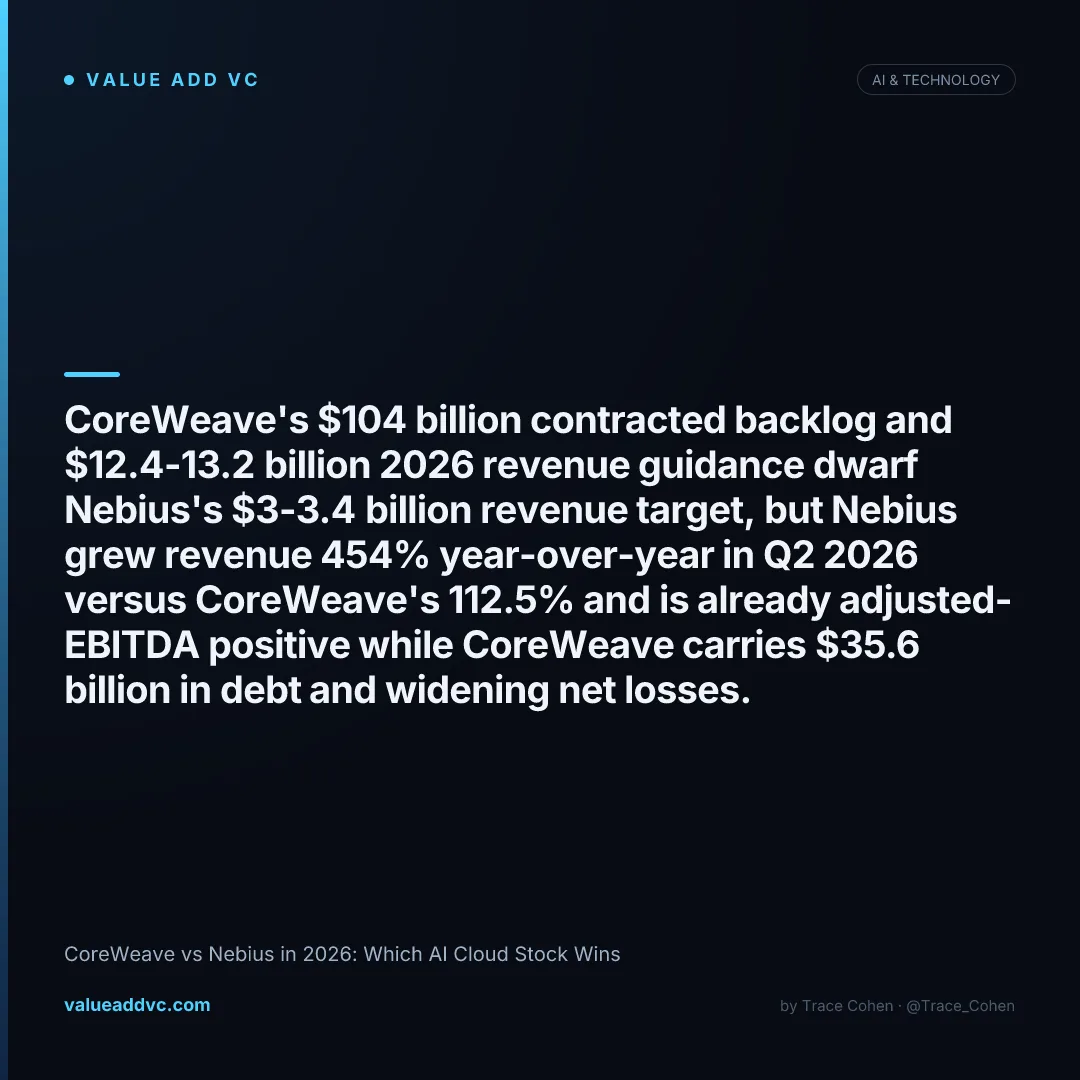
CoreWeave wins on scale — a $104 billion backlog and $12.4-13.2 billion in 2026 revenue guidance — while Nebius wins on growth rate and balance-sheet discipline, growing revenue 454% year-over-year and posting positive adjusted EBITDA in Q2 2026.
Both companies rent Nvidia GPU capacity to the same handful of AI labs and hyperscalers, both went public within the last two years, and both have become the two most-watched pure-play "neocloud" stocks on Nasdaq. CoreWeave got there first and got there bigger, converting a crypto-mining GPU fleet into a $12 billion-plus revenue AI infrastructure business backed by Nvidia and anchored by Microsoft, Meta, and OpenAI contracts. Nebius got there from a stranger starting point — spun out of Russia's Yandex, relisted on Nasdaq in October 2024 after founder Arkady Volozh's EU sanctions were lifted — and is now the smaller but faster-compounding of the two, anchored by a $17.4 billion Microsoft chip-access deal.
Figures from CoreWeave Q2 2026 earnings (August 11, 2026) and Nebius Q2 2026 earnings (August 13, 2026), as of August 27, 2026.
CoreWeave vs Nebius: how the two AI cloud stocks compare in 2026
For AI cloud infrastructure exposure in 2026, CoreWeave offers the larger, more established revenue base and the deepest hyperscaler relationships, while Nebius offers the higher growth rate, a cleaner balance sheet, and a lower entry valuation relative to its trajectory. The right pick depends on whether an investor or enterprise buyer is optimizing for proven scale or for growth runway.
| Attribute | CoreWeave (CRWV) | Nebius (NBIS) |
|---|---|---|
| Listing / IPO date | IPO March 28, 2025 at $40/share | Nasdaq relisting October 2024 |
| Stock price (Aug 2026) | ~$89.76 (down ~51% from June 2025 peak) | ~$227.00 |
| Market cap (Aug 2026) | ~$49B | ~$56B |
| 2026 revenue guidance | $12.4B-$13.2B | $3.0B-$3.4B, targeting $7-9B ARR by year-end |
| Q2 2026 revenue growth | +112.5% YoY to $2.58B | +454% YoY to $582M |
| Q2 2026 profitability | Net loss $626M; adj. EBITDA $1.51B (59% margin) | Adj. EBITDA $236.2M, up from -$21M a year ago |
| Debt / capex load | $35.6B total principal debt as of June 30, 2026 | $20-25B planned 2026 capex |
| Anchor mega-contract | $21B Meta deal through 2032 | $17.4B Microsoft deal, 100,000+ GB300 chips |
| Key strategic backer | Nvidia (~7% stake, ~$2B) | Nvidia ($2B investment, March 2026) |
| Founder / leadership | Michael Intrator, CEO | Arkady Volozh, founder (ex-Yandex CEO) |
Source: CoreWeave Q2 2026 10-Q and earnings call (August 11, 2026), Nebius Q2 2026 earnings call (August 13, 2026), stockanalysis.com and companiesmarketcap.com share-price data as of August 20-27, 2026.
CoreWeave vs Nebius: 2026 Revenue Guidance Midpoint ($B)
Company Q2 2026 earnings guidance
Nebius trades at a higher market cap than CoreWeave despite roughly a quarter of the revenue — the market is pricing its 454% growth rate and positive EBITDA more richly per dollar of sales.
Where CoreWeave wins the AI cloud stock comparison
CoreWeave wins on sheer scale. Its $104 billion contracted backlog — up from $25.9 billion added in the first six weeks of Q3 alone — includes multi-year commitments from Meta ($21 billion through 2032), Jane Street ($6 billion), OpenAI (up to $11.9 billion in compute over five years), and Anthropic. Revenue of $2.58 billion in a single quarter is roughly 4.4 times Nebius's entire Q2 2026 revenue, and CoreWeave's FY2026 guidance of $12.4-13.2 billion puts it in a different revenue class entirely.
Contracted revenue depth
$104B backlog spans multiple AI labs and hyperscalers through 2032
Existing operating scale
Q2 2026 revenue of $2.58B vs Nebius's $582M
Hyperscaler relationships
Microsoft, Meta, and OpenAI all among its largest customers
Operating leverage on GPUs
Adjusted EBITDA margin of 59% in Q2 2026
The trade-off is leverage. CoreWeave financed its GPU buildout with debt, and that debt is now $35.6 billion in total principal as of June 30, 2026 — up sharply from the year prior — and interest expense of $985 million in the first half of 2026 alone pushed its net loss to $1.37 billion year-to-date. Scale bought CoreWeave the biggest contracts in the industry; it also bought a balance sheet that has to keep growing into its obligations or the debt service becomes the story.
Where Nebius wins the AI cloud stock comparison
Nebius wins on growth rate and near-term financial discipline. Its Q2 2026 revenue of $582 million grew 454% year-over-year, and first-half 2026 revenue of $981.3 million was up 529% from the first half of 2025 — a pace no large-scale cloud provider, CoreWeave included, is currently matching. Unlike CoreWeave, Nebius is already adjusted-EBITDA positive: $236.2 million in Q2 2026 at a roughly 50% margin within its core AI infrastructure segment, a swing from a $21 million loss the year before.
Pick Nebius when
- ✓ You want exposure to the fastest growth rate in the sector
- ✓ You prioritize positive adjusted EBITDA over raw revenue size
- ✓ You value diversified backers beyond a single hyperscaler
- ✓ You want lower reported debt relative to revenue today
Pick CoreWeave when
- ✓ You want the biggest, most liquid pure-play AI cloud stock
- ✓ You value contracted backlog depth over growth percentage
- ✓ You're an enterprise buyer needing proven capacity at scale
- ✓ You want the closest public proxy to Nvidia's own GPU demand
Nebius's honest limitation is that its growth is still off a small base and its own capex plan — $20-25 billion for 2026 — is enormous relative to its balance sheet, meaning the company will need continued capital markets access, not just Microsoft and Nvidia goodwill, to fund the buildout its backlog implies. Fast growth from $582 million a quarter is a different risk profile than fast growth from $2.58 billion a quarter.
CoreWeave vs Nebius: what Q2 2026 earnings changed
Both companies reported Q2 2026 results within two days of each other in August, and the results sharpened rather than resolved the debate. CoreWeave's August 11 report showed revenue doubling and backlog surging past $104 billion, but also showed net losses widening as interest costs climbed — the stock still traded down roughly 51% from its June 2025 peak even after the beat, evidence that investors are weighing the debt load as heavily as the growth. Nebius's August 13 report, by contrast, beat both revenue and EBITDA estimates and reaffirmed its full-year targets, including the $7-9 billion annualized run-rate goal for year-end 2026 — a number that would represent roughly 6-7x its 2025 exit ARR of just over $1.2 billion.
What the headline growth numbers miss
A 454% growth rate sounds like it settles the comparison, but Nebius's Q2 2026 revenue of $582 million is still less than a quarter of CoreWeave's $2.58 billion in the same quarter — the percentage gap is real, but it's also partly an artifact of comparing against a small prior-year base. The more useful signal is the profitability gap: Nebius is adjusted-EBITDA positive at its current, smaller scale, while CoreWeave's adjusted EBITDA margin is strong (59%) but is being consumed by nearly $1 billion in half-year interest expense on $35.6 billion of debt. Neither company is GAAP profitable, and both are still years from proving whether AI infrastructure demand at today's pricing can sustainably service the capital each has raised to build it. That same demand curve is pulling private capital into adjacent inference plays too — Gimlet Labs tripled its valuation to $3 billion on a16z-led Series B funding for multi-silicon inference software just months after CoreWeave and Nebius reported these numbers.
The verdict: CoreWeave vs Nebius in 2026
There is no single winner, but there is a clear answer by use case. For an investor or enterprise buyer who wants the largest, most contracted, most liquid AI cloud name, CoreWeave wins on scale and backlog depth. For an investor who wants exposure to the fastest-growing, least-leveraged neocloud with a shorter runway to sustained profitability, Nebius wins on growth rate and balance-sheet discipline.
If forced to name one pick for the median investor weighing risk against growth in 2026, it's Nebius — its combination of 454% growth and positive adjusted EBITDA at current scale is a rarer setup than CoreWeave's larger but more debt-financed story. But CoreWeave remains the more important company to AI infrastructure economics overall: its $104 billion backlog is the single best public proxy for how much compute Microsoft, Meta, and OpenAI have actually committed to buying. Track how both trade alongside the rest of AI infrastructure on the Big Tech Earnings dashboard and the Tech IPO tracker.
$104 billion in backlog versus 454% growth — both are bets on the same GPU demand curve.
CoreWeave wins on scale, Nebius wins on growth and leverage — pick the risk profile you actually want.
Track AI infrastructure earnings and neocloud valuations on the Big Tech Earnings Dashboard at Value Add VC. Originally published in the Trace Cohen newsletter.
Latest from the Pulse
Get VC data most people never see
— free to subscribe
Trace's notes on venture, AI and startups, a few times a week. Join 5,000+ subscribers. No spam.