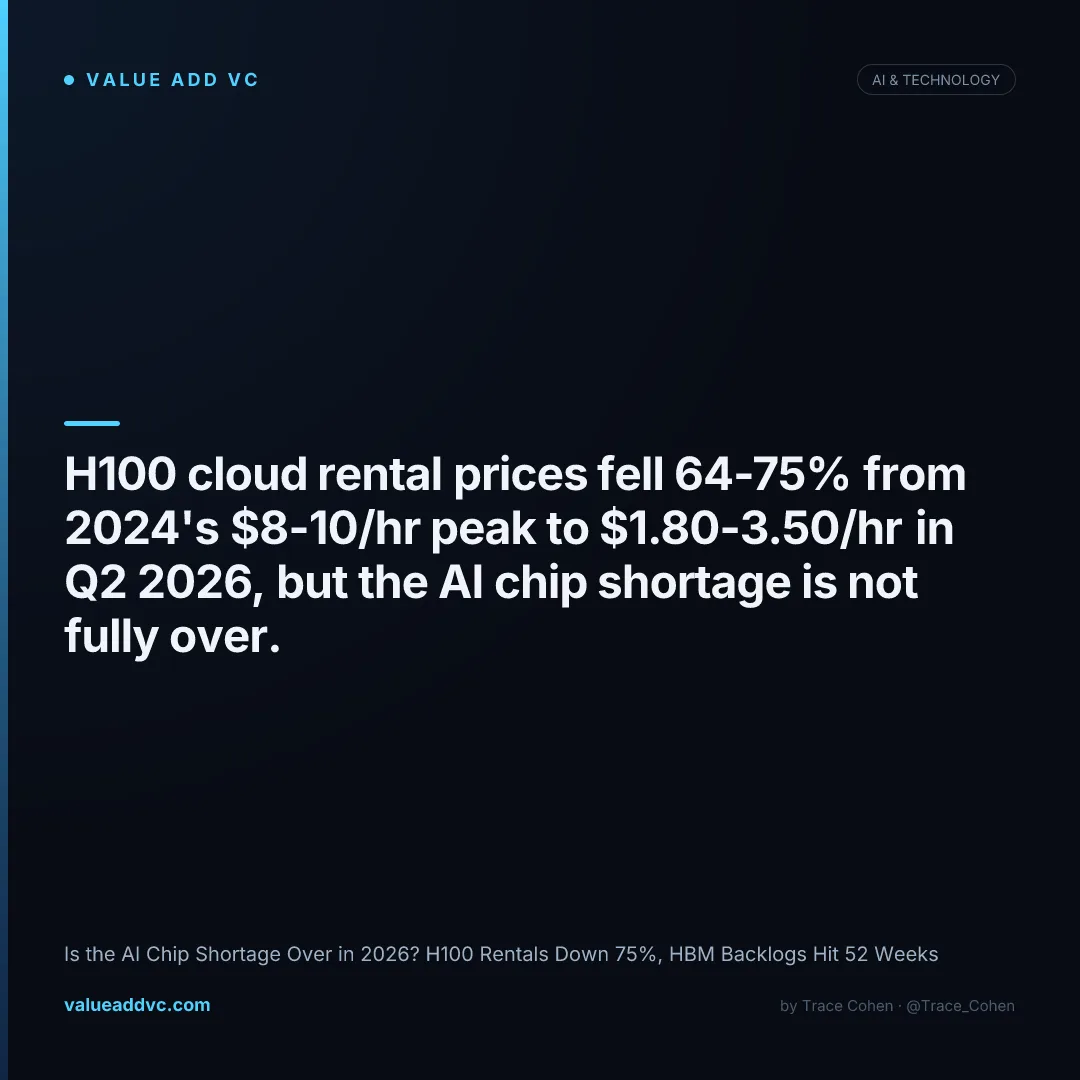
H100 cloud rental prices have fallen 64-75% from their 2024 peak of $8-10/hr to just $1.80-3.50/hr in Q2 2026 — but a 3.6 million unit GPU backlog and 36-52 week lead times mean the shortage didn't end, it moved.
The trouble is that everyone asking "is the chip shortage over" is really asking two different questions at once: can you rent compute cheaply today, and can you buy hardware on a reasonable timeline. The answer to the first is increasingly yes. The answer to the second is still no, and the reason why is a memory chip most founders have never heard of. Here's the actual 2026 data on both sides of that split.
Is the AI chip shortage over in 2026?
No — the AI chip shortage in 2026 is not over, it has split into two separate markets. GPU compute rental has gotten dramatically cheaper as new capacity and over 300 new cloud providers entered the market in 2025, but buying new hardware outright still means a 36-52 week wait and a roughly 3.6 million unit industry backlog, because the constraint moved from chip fabrication to HBM memory supply.
Track how this compute crunch is showing up in hyperscaler spending on the Big Tech Earnings dashboard and see how it's flowing into private AI company valuations on the AI Valuations dashboard.
How the AI chip shortage started, and why 2026 looks different from 2023
The original AI chip shortage began in late 2022, when ChatGPT's launch set off a scramble for H100 GPUs that Nvidia simply couldn't fabricate fast enough — wait times stretched past a year, and cloud rental rates hit $8/hr and above because demand vastly outstripped every hyperscaler's allocation. That was a pure fabrication-capacity problem: not enough TSMC wafer starts, not enough CoWoS advanced packaging capacity, and a Nvidia order book that ballooned overnight.
Nvidia's Q3 fiscal 2026 results (reported November 2025) showed data center compute revenue still growing 56% year-over-year, with every GPU generation — new and previous — running fully utilized. That demand never went away; what changed is that the fabrication side scaled up enough, aided by TSMC packaging expansion and Blackwell's ramp, that the bottleneck could finally move downstream to memory instead of staying stuck at the processor. In other words: 2023's shortage was "we can't make enough chips." 2026's shortage is "we can make enough chips, but not enough memory to put on them." That sustained data-center demand is also the core driver behind Nvidia's remarkable multi-year share price climb, and it's the assumption most at risk if the memory bottleneck eases faster than expected.
2026 GPU pricing by chip tier: rental vs purchase cost
Here's how the three most-deployed AI chip tiers compare on price and availability right now.
| Chip | Cloud Rental (Q2 2026) | Direct Purchase Cost | Lead Time |
|---|---|---|---|
| H100 | $1.80-3.50/hr (spot as low as $1.20/hr) | $25,000-$40,000/unit | 36-52 weeks for volume orders |
| H200 | Premium over H100, limited availability | ~$315,000 per 8-GPU system | Constrained — HBM-bound |
| B200 / Blackwell | $4.50-7.00/hr | $300,000-$350,000 (8x DGX B300) | Supply constrained, not fully allocated |
| H100 (2024 baseline) | $8-10/hr | Higher due to acute shortage pricing | Multi-quarter waitlists |
| H100 1-year contract | $1.70/hr (Oct 2025 low) → $2.35/hr (Mar 2026) | N/A — reserved capacity pricing | Repriced up ~40% amid renewed tightness |
| A100 (prior gen) | $1.09-1.99/hr | Legacy pricing, wide availability | In stock at most providers |
Figures are Q1-Q2 2026 estimates blended from SemiAnalysis, IntuitionLabs, Spheron, Thunder Compute, and Silicon Analysts cloud GPU pricing trackers. Rental rates vary by provider, region, and commitment length.
Why GPU rental prices crashed while the AI chip shortage 2026 backlog stayed put
H100 cloud rental rates fell from $8-10/hr in early 2024 to $1.80-3.50/hr in Q2 2026 — a 64-75% decline — mostly because more than 300 new GPU cloud providers (neoclouds) entered the market in 2025, fragmenting demand across a much larger pool of available capacity — the two largest public names in that pool, CoreWeave and Nebius, took very different paths to scale. That's a genuine supply story: raw GPU chip fabrication capacity, the original 2023 bottleneck, has scaled enough that spot and on-demand pricing now behaves like a normal, if volatile, commodity market.
But that 1-year reserved H100 contract pricing tells a more honest story: it bottomed at $1.70/hr in October 2025 and has since climbed back up nearly 40% to $2.35/hr by March 2026, because reserved capacity is exactly where the real supply constraint — hardware you can actually buy and keep — still bites. Spot pricing looks cheap because it's the leftover capacity nobody has locked up yet.
The real 2026 AI chip shortage bottleneck: HBM memory, not GPU dies
The chip that's actually constrained in 2026 isn't the GPU processor itself — it's the High Bandwidth Memory (HBM) stacked onto every H200 and Blackwell package. HBM costs rose roughly 30% in Q4 2025 alone as suppliers couldn't keep pace with demand, and the shortage is now described by industry analysts as the most prolonged memory shortage on record. Because HBM production shares fabrication capacity with consumer memory (GDDR7), Nvidia reportedly cut its RTX 50-series consumer GPU production by 30-40% in the first half of 2026 just to free up memory manufacturing lines for data-center chips.
That's why lead times for data-center GPUs still run 36-52 weeks even as rental prices fall — you can rent someone else's already-installed GPU cheaply, but if you want to buy and install your own cluster, you're waiting on memory fabs, not GPU dies. The industry-wide GPU order backlog stood at approximately 3.6 million units as of April 2026, and Microsoft, Google, Meta, and Amazon have already placed forward orders that consume most of Nvidia's available Blackwell allocation through the end of 2026 and into 2027.
AMD and custom silicon are chipping away at the 2026 AI chip shortage too
Nvidia still controls roughly 80% of the AI accelerator market in 2026, but AMD has grown from a rounding error to a real release valve on demand. AMD's Instinct GPU revenue is forecast to grow 114% to $15 billion in 2026, and its MI325X platform actually outperformed six OEM submissions running Nvidia's H200 by up to 8% on MLPerf Training v5.0 benchmarks. AMD signed deals to deploy 6 gigawatts of Instinct GPUs for OpenAI and 50,000 MI450 chips for Oracle's AI supercluster — real hyperscaler commitments, not pilot programs.
Custom silicon is doing similar work: Google's TPUs and Amazon's Trainium chips let both companies route a meaningful share of their own internal AI training and inference off the Nvidia queue entirely, which is part of why hyperscaler capex keeps climbing even as Nvidia allocation stays tight — they're buying compute capacity everywhere at once. None of this breaks Nvidia's dominance in the near term, but it's the reason GPU rental prices could keep falling even while HBM-bound purchase lead times stay stuck at 36-52 weeks: competitive supply is finally showing up on the rental side of the market. China's chipmakers are running the same playbook with their own silicon — Alibaba's Zhenwu V900 accelerator and Huawei's Ascend line are both scaling specifically because Nvidia's export-restricted parts aren't an option there at all.
What the AI chip shortage 2026 split means for founders and investors
The Big Five hyperscalers — Amazon, Google, Meta, Microsoft, and Oracle — have committed a combined $600-630 billion in 2026 capex, with roughly 75% of that (about $450-470 billion) targeting AI infrastructure directly. That level of forward-ordering is exactly why founders trying to buy and own their own GPU clusters face 36-52 week waits, while founders willing to rent from a neocloud can spin up compute within days at prices down 64-75% from two years ago.
Buy vs Rent: The 2026 AI Chip Shortage Split
Source: SemiAnalysis, IntuitionLabs, and Silicon Analysts 2026 GPU market data.
For most venture-backed AI startups, that split makes the decision easy: rent compute from a neocloud or hyperscaler rather than trying to own hardware, since the price crash has made renting both cheaper and far faster than fighting for allocation. The exception is any company whose unit economics depend on locking in multi-year reserved pricing before the next HBM-driven price spike — and the 40% jump in 1-year contract pricing since October 2025 suggests that spike may already be underway.
For investors, the split changes how you underwrite AI infrastructure bets. A company whose pitch depends on cheap, abundant GPU rental is riding a genuine tailwind — that part of the market really has gotten 64-75% cheaper and will likely keep loosening as AMD's 114% GPU revenue growth and custom silicon add real alternative supply. A company whose pitch depends on owning proprietary hardware at scale, or on locking in reserved capacity ahead of competitors, is still fighting the same 36-52 week, HBM-constrained supply chain that's driven every AI infrastructure valuation debate since 2023. Diligence on any AI infrastructure or compute-heavy startup should now include a specific question: is this business exposed to the loosening rental market, or the still-tight purchase and reservation market? The answer changes the entire risk profile of the deal, and it's the single most useful question I ask founders pitching an AI infrastructure round in 2026. GPU supply is only half the bottleneck, too — Emerald AI's $1.05B Series A is betting the grid itself is now the binding constraint on getting those chips powered up.
The scoreboard on the AI chip shortage in 2026:
Rental prices: down 64-75% since 2024. Purchase lead times: still 36-52 weeks with a 3.6M unit backlog. The shortage didn't end — it moved from GPU dies to HBM memory.
Track how AI infrastructure spending is showing up in earnings on the Big Tech Earnings dashboard and in private company pricing on the AI Valuations dashboard at Value Add VC. Originally published in the Trace Cohen newsletter.
Latest from the Pulse
Get VC data most people never see
— free to subscribe
Trace's notes on venture, AI and startups, a few times a week. Join 5,000+ subscribers. No spam.