
Jane Street has committed roughly $21.5 billion to AI infrastructure in 2026 — split between cloud-capacity contracts and direct equity stakes in CoreWeave, Crusoe, and Fluidstack.
A quantitative trading firm best known for options market-making and ETF liquidity has become one of the largest private backers of the AI data center build-out — not by launching a venture fund, but by writing checks directly from its own trading profits. Across four disclosed deals in 2026, Jane Street committed roughly $6 billion to CoreWeave cloud capacity plus a $1 billion equity stake, a $13 billion five-year contract with Crusoe, and a $1.5 billion equity check leading Fluidstack's $18 billion round — a combined figure larger than the entire disclosed AI-infrastructure spend of most venture firms.
Jane Street's AI Infrastructure Investments: The $21.5B Tally
Jane Street Group, founded in New York in 1999 by Tim Reynolds, Robert Granieri, Marc Gerstein, and Michael Jenkins, is an employee-owned market maker with no public CEO and roughly 3,500 staff. It posted a record $39.6 billion in trading revenue in 2025 and followed that with $16.1 billion in a single quarter — Q1 2026 — according to Bloomberg's reporting on the quarter. That scale of profit is what's funding the AI-infrastructure push: unlike a venture fund raising from limited partners, Jane Street is deploying its own balance sheet.
Figures per Bloomberg, CoreWeave, Crusoe, and Forbes reporting, 2025-2026.
Who Is Jane Street, and Why Does It Have This Much to Spend?
Jane Street built its business as a market maker and authorized participant in exchange-traded funds, becoming one of the most active ETF liquidity providers on Wall Street by the mid-2000s. Every employee is paid out of the firm's collective results rather than individual trading gains, and roughly 80% of the firm's assets under management — about $140 billion as of 2024 — are held by the firm's own members rather than outside limited partners. There's no CEO; the firm is informally run by a group of 30 to 40 senior partners functioning more like a council than a corporate hierarchy.
That compensation structure produced a record payout in 2025: roughly $9.38 billion distributed firm-wide, an average of about $2.68 million per employee — nearly seven times the average payout at a rival like Goldman Sachs, by one comparison. It's this internal cash-generation machine, not outside fundraising, that lets Jane Street write billion-dollar checks into AI infrastructure without a single LP call.
Buyer and Investor at the Same Time
The unusual part isn't that Jane Street needs GPU compute — plenty of finance firms are buying AI capacity for research and pricing models. It's that Jane Street is taking equity in its own suppliers at the same time it signs the contracts to buy their capacity. In CoreWeave's case, that meant a roughly $6 billion cloud-capacity commitment announced alongside a separate $1 billion purchase of CoreWeave Class A stock at $109 per share in April 2026. With Crusoe, Jane Street signed a $13 billion five-year cloud contract — reported alongside Crusoe's own $3 billion funding round that tripled its valuation to $30 billion — without disclosed equity attached. With Fluidstack, Jane Street flipped the structure again, leading the $1.5 billion equity round that doubled Fluidstack's valuation to $18 billion.
Not every AI-infrastructure raise this cycle looks like Jane Street's private equity checks, either. SWI Group's $900 million capital increase funded the same kind of power-and-land land-grab — converting a former bitcoin-mining operation into AI data-center sites — but through a public-company stock issuance on Euronext Amsterdam rather than a private venture round.
One read on this: a firm that needs guaranteed, priced-in-advance compute capacity for years can hedge against a future supply crunch by owning a slice of the supplier — if capacity gets scarcer and prices rise, the equity stake offsets some of what Jane Street would otherwise overpay for compute later. It's a structure that borrows from both commodities hedging and classic venture investing without being purely either one.
This isn't Jane Street's first startup check, either. In late November 2025, Jane Street and CoreWeave jointly announced a seed investment in Numerata, a startup building AI-powered software-development tools — a smaller, conventional venture-style check that predates the multi-billion-dollar infrastructure deals and shows the compute investing isn't Jane Street's only point of contact with the startup world.
Jane Street's Trading Revenue Is Funding the Buildout
Jane Street Trading Revenue, 2024–Q1 2026
2025's $39.6B nearly doubled 2024, and Q1 2026 alone delivered 40%+ of the prior full year
Bloomberg reporting, 2025-2026
Data
| Item | Trading Revenue ($B) |
|---|---|
| 2024 (Full Year) | 20.5 |
| 2025 (Full Year) | 39.6 |
| Q1 2026 | 16.1 |
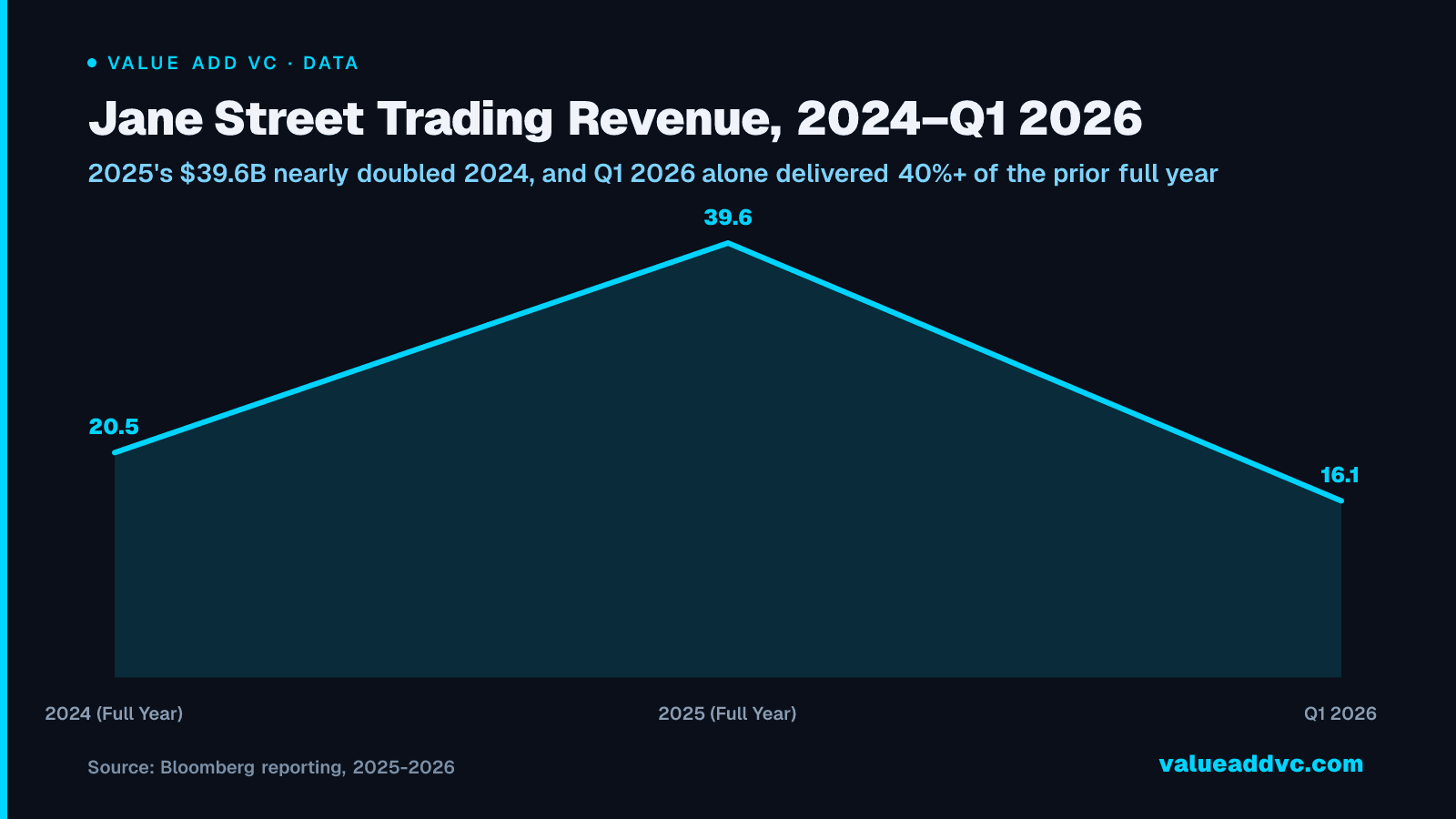
2024 and 2025 figures are full-year trading revenue; Q1 2026 is a single quarter, shown for scale. Source: Bloomberg, reporting April-May 2026.
Where the $21.5 Billion Is Going
Crusoe alone accounts for more than half of Jane Street's disclosed AI-infrastructure commitment — a five-year cloud contract, not an equity check, which means it shows up as a customer obligation rather than an investment on Jane Street's books even though it's comparable in scale to the equity positions.
Jane Street's $21.5B AI Infrastructure Commitment, by Recipient
Crusoe's cloud contract alone is larger than Jane Street's combined CoreWeave and Fluidstack positions
CoreWeave, Crusoe, Forbes, Bloomberg reporting, 2026
Data
| Item | Value |
|---|---|
| Crusoe (cloud contract) | 13000 |
| CoreWeave (cloud contract) | 6000 |
| Fluidstack (equity) | 1500 |
| CoreWeave (equity) | 1000 |
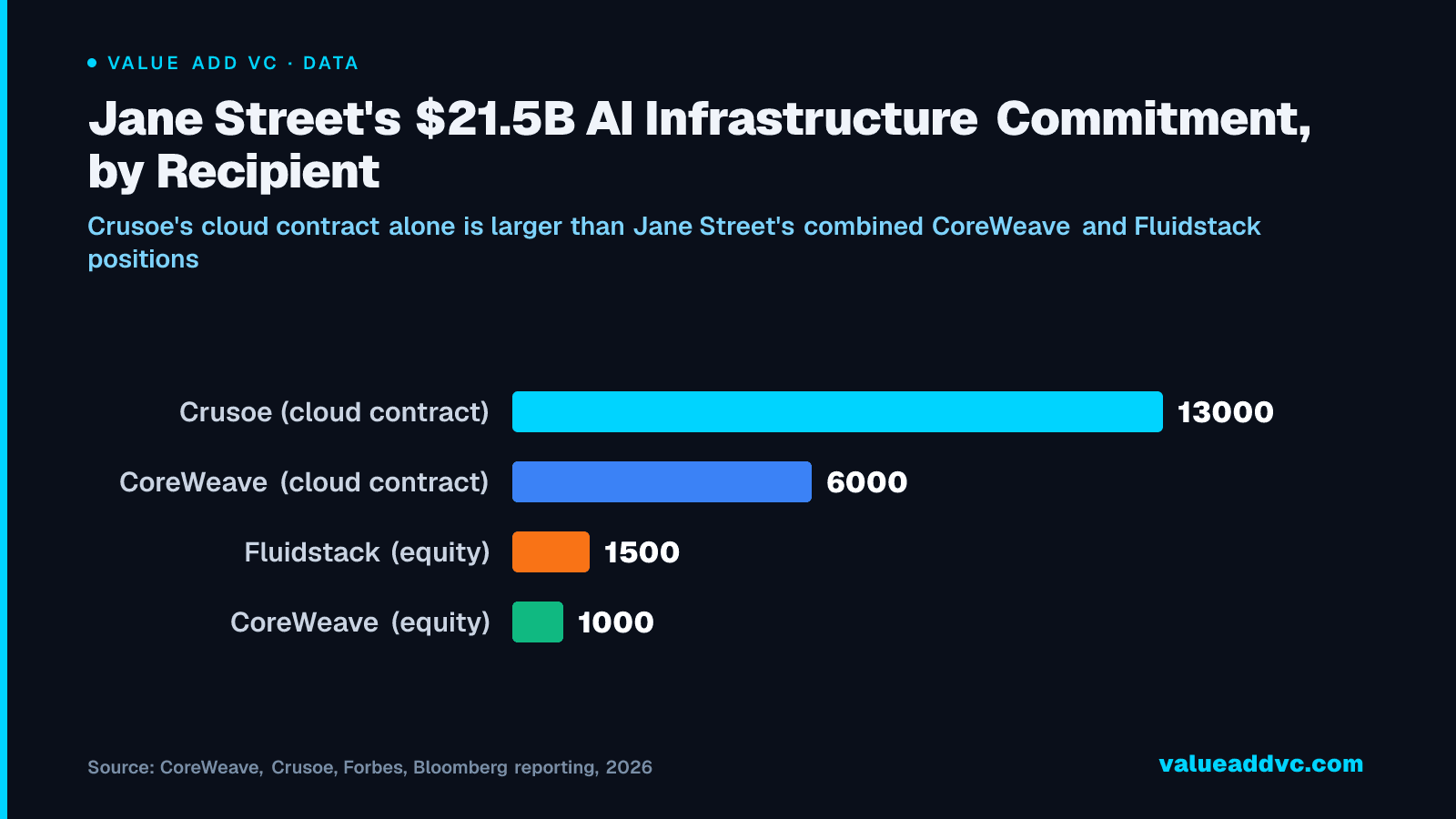
Figures in millions of dollars aggregated to billions. Source: CoreWeave and Crusoe company disclosures, Forbes and Bloomberg reporting, compiled September 2026.
How Jane Street's Approach Differs From Its Trading Rivals
Jane Street's willingness to take direct equity stakes stands out even among a peer group that's unusually flush with cash. Citadel Securities, the largest US equity market maker, has instead taken a more cautious public posture: the firm's 2026 macro outlook warned of what it called a "Global Intelligence Crisis", describing the scale of capital expenditure required for AI data centers, chips, and power infrastructure as a systemic risk rather than framing it as an investment opportunity to chase directly. Susquehanna, another options-trading powerhouse and a longtime Jane Street rival, has instead put its capital into adjacent markets — partnering with Robinhood on the MIAXdx prediction-markets exchange rather than buying equity in AI compute builders.
One read on this: Jane Street's options and ETF market-making business generates enormous, relatively predictable cash flow, which gives it more flexibility to make illiquid, long-duration bets than firms whose capital is more actively deployed in trading positions day to day. Whether that flexibility turns into an advantage depends entirely on how AI infrastructure valuations hold up over the next several years — a bet none of the other major quant shops has been willing to make at this scale yet.
What This Means for Traditional VC Firms
Non-traditional capital showing up in late-stage AI rounds isn't new — sovereign wealth funds, hedge funds, and crossover investors have been doing it for a couple of years. What's different about Jane Street's entries is the direct pairing of a commercial contract with an equity check, structured by a firm with no fund to raise, no LP reporting cycle, and no fixed investment horizon to manage around. A traditional growth-equity or venture fund competing for an allocation in a deal like Fluidstack's has to justify the position against a fund thesis, a target return, and eventually a distribution timeline; Jane Street answers to none of that, which lets it move faster and potentially accept a longer, less certain payback period than a fund with LPs expecting a return within a fund's typical life.
For VCs already active in AI infrastructure — firms like Menlo Ventures building large positions in AI labs — the practical effect is a wider and less predictable set of competitors for large late-stage rounds, some of whom aren't optimizing for the same fund-return math a limited partnership has to answer to.
What the Headline Misses
A $21.5 billion tally reads as an aggressive, deliberate strategy, but a few caveats matter. First, three of Jane Street's four disclosed AI-infrastructure moves rest on reporting from Bloomberg, Forbes, and company press releases rather than a single unified disclosure from Jane Street itself — the firm, true to its historically secretive posture, has not published its own accounting of the combined figure. Second, cloud-capacity contracts and equity stakes are fundamentally different kinds of exposure: the $19 billion in CoreWeave and Crusoe cloud contracts is a spending commitment Jane Street owes regardless of how those companies perform. For context on Crusoe's evolution from bitcoin mining to AI infrastructure, that commitment is now anchoring one of the fastest-scaling data center platforms. Meanwhile the $2.5 billion in CoreWeave and Fluidstack equity is a bet that could go to zero if AI infrastructure valuations correct. Collapsing both into one headline number overstates how much of this is genuinely "investment" in the venture sense. Third, Jane Street has faced its own volatility — one analysis cited a roughly $15 billion trading loss in a single month of 2026 even amid the record year — a reminder that the same profits funding this buildout can also swing sharply against the firm.
Jane Street's 2026 AI Infrastructure Deals
| Company | Date | Type | Amount | Notes |
|---|---|---|---|---|
| Numerata | Nov 2025 | Seed equity (co-led with CoreWeave) | Undisclosed | AI-powered software dev tools startup |
| CoreWeave | Apr 2026 | Cloud capacity contract | ~$6B | Multi-year AI cloud commitment |
| CoreWeave | Apr 2026 | Public equity | $1B | Class A common stock at $109/share |
| Crusoe | Sept 3, 2026 | Cloud capacity contract | ~$13B | Five-year deal; no disclosed equity |
| Fluidstack | Sept 3, 2026 | Private equity (led round) | ~$1.5B | Valued Fluidstack at ~$18B |
Sources: BusinessWire, CoreWeave newsroom, Crusoe/Bloomberg reporting, Forbes. Compiled September 10, 2026.
What to Watch Next
A unified disclosure
Jane Street has never published its own consolidated figure for these commitments — all four deals come from the counterparties or press reporting.
Workload transparency
Neither Jane Street nor its infrastructure partners have said what the contracted compute actually runs, beyond general references to trading and research models.
More equity stakes
Fluidstack marks Jane Street's second direct equity position in an AI-infrastructure company this year, after CoreWeave. A third would confirm a deliberate strategy rather than opportunistic one-offs.
How other trading firms respond
If rivals like Citadel Securities or Hudson River Trading start making similar direct infrastructure bets, that would signal the pattern is industry-wide rather than Jane Street-specific.
Trading performance vs. infrastructure bets
A firm funding illiquid, multi-year infrastructure positions from trading profits has more cushion than a typical LP-backed fund — but also more exposure if a rough trading stretch and a compute-valuation correction land in the same window.
For the companies on the other side of these deals, see Crusoe's $3B Round at a $30B Valuation and Fluidstack's $1.5B Round at an $18B Valuation. Track private AI company valuations on the AI Valuations dashboard at Value Add VC.
Latest from the Pulse
Get VC data most people never see
— free to subscribe
Trace's notes on venture, AI and startups, a few times a week. Join 5,000+ subscribers. No spam.
No spam, unsubscribe anytime. Sent via Substack · Privacy · or subscribe on Substack ↗