

Updated Oct 1, 2026
Re-checked the funding figures against freshly fetched sources. Still matches the sources: the $1.5B round at an $18B valuation led by Jane Street (reported by Forbes on Sept 3 and Crunchbase News on Sept 4, 2026; Fluidstack has not announced it), the $830M Series A at $7.5B led by Situational Awareness (per Fluidstack's own announcement, which says it was raised in January), and the revenue figures (per Tech Times). Corrected Google's lease backstop to Tech Times' figures ($3.2B at TeraWulf, $1.73B at Cipher), credited the ~$2.6B total-funding figure to Crunchbase News, rebuilt the funding-history table with linked sources (adding a reported $200M February 2025 round whose type is unconfirmed, and noting Fluidstack's $1.5B SEC Form D), and added an FAQ on IPO status: Fluidstack has not publicly announced an IPO.
Fluidstack is valued at $18 billion after a $1.5 billion round reported September 3, 2026 — 2.4x the valuation of its Series A earlier in the year, without owning a single GPU outright, and still a private company with no IPO announced.
Forbes reported on September 3, 2026 that Fluidstack, the London-founded AI data center builder, raised roughly $1.5 billion led by quantitative trading firm Jane Street at an $18 billion valuation — more than double the $7.5 billion valuation of its $830 million Series A, which Fluidstack announced in July. Crunchbase News reported the same figures on September 4, 2026, saying Fluidstack "raised $1.5 billion in a private equity round led by Jane Street Capital, bringing the AI infrastructure company's total funding to just over $2.6 billion," at an $18 billion valuation. Fluidstack has not issued its own press release on this round, so the numbers still rest on reporting rather than an audited term sheet — but two outlets now report the same terms. See the company's full data on the Fluidstack Pulse hub.
Fluidstack Valuation 2026: The $1.5B Round at $18B
The new round brings Fluidstack's total funding to just over $2.6 billion, according to Crunchbase News; Tracxn's funding history for the company counts $2.55 billion across four rounds, starting with a $3 million seed round in 2019. The valuation curve since then has been almost entirely compressed into 2026: Fluidstack was valued at $7.5 billion in an $830 million Series A that the company says it raised in January and announced in July, led by Situational Awareness — the AI-focused investment fund founded by former OpenAI researcher Leopold Aschenbrenner. Less than two months after that announcement, Forbes reported that a Jane Street-led round had priced the company at $18 billion.
Round figures from Forbes (Sept 3) and Crunchbase News (Sept 4, 2026) reporting; Series A per Fluidstack; total funding per Crunchbase News (Tracxn counts $2.55B).
Why a Trading Firm Is Writing the Check
Jane Street isn't a venture fund. It's a quantitative trading firm that posted a record $39.6 billion in trading revenue in 2025 and has spent 2026 turning some of that into direct AI-infrastructure exposure — not just buying compute, but taking equity in the companies that build it. Leading Fluidstack's round is its third major move of the year: Jane Street has also committed roughly $6 billion to lease CoreWeave capacity plus a $1 billion equity stake in CoreWeave's public stock, and signed a $13 billion five-year cloud contract with Crusoe, the AI data center builder that just tripled its own valuation to $30 billion.
One read on this: when the buyer of a scarce resource (GPU compute) also becomes an equity investor in the seller, it can lock in favorable long-term pricing and access ahead of a supply crunch — a hedge that looks more like a commodities trading desk securing forward supply than a classic venture bet on a 10x return. Neither Jane Street nor Fluidstack has said publicly whether the $1.5 billion is structured as pure equity or tied to a parallel compute-purchase commitment.
From a London Seed Round to an $18B Neocloud
Fluidstack was founded in London in 2017 by Gary Wu, James Cox, and Cesar Maklary, and started raising outside capital in 2019 with a $3 million seed round backed by Seedcamp and other early European investors. The company's model is distinct from CoreWeave or Crusoe in one respect: it doesn't own the chips it rents out. Fluidstack sources Nvidia GPUs and the data center shells, power, and cooling to run them, then leases that capacity under long-term contracts — an asset-light structure that Tech Times' review of the round credits for the company's revenue climbing from $1.8 million in 2022 to $66.2 million in 2024 and an estimated $200 million in 2025, with $660 million projected for full-year 2026.
The anchor contract behind that growth: Anthropic signed a roughly $50 billion multi-year compute deal with Fluidstack in November 2025 to build custom data centers in Texas and New York — the kind of single-customer commitment that, as with Crusoe's Jane Street contract, does more to justify a step-change valuation than any trailing revenue multiple could. Google has also backstopped part of Fluidstack's data center leases — $3.2 billion of its obligations at TeraWulf's Lake Mariner campus and $1.73 billion at Cipher Mining's Barber Lake site, according to Tech Times (Sept 5, 2026) — and The Wall Street Journal reported that Google was considering a $100 million investment in the Series A round while talks were ongoing in February 2026 (per TechCrunch), though no Google equity stake in Fluidstack has been confirmed.
The Other New Investor: Situational Awareness
Jane Street has company as an unconventional backer in Fluidstack's cap table. Situational Awareness, the AI-focused investment fund founded by former OpenAI researcher Leopold Aschenbrenner, led Fluidstack's $830 million Series A (raised in January 2026, announced in July) and has grown from roughly $225 million under management at its late-2024 launch to about $45 billion by July 2026, run by a team of around a dozen people. That growth rate — from a few hundred million to tens of billions in under two years — mirrors the compressed timeline of Fluidstack's own valuation curve, and reflects the same underlying bet: that AI infrastructure ownership, not just model development, is where the durable value sits.
Why investors are pricing deals like this on contracted capacity rather than trailing revenue comes down to a few overlapping dynamics:
AI labs are signing multi-year, multi-billion-dollar compute contracts faster than any single builder can physically stand up the data centers to fill them, so capacity itself — not current earnings — becomes the scarce, priceable asset
A signed anchor contract from a customer as large as Anthropic functions as forward-looking proof of revenue durability that a backward-looking income statement can't show for a company scaling this fast
Asset-light operators like Fluidstack can grow revenue without matching capex, since the physical build is financed by landlords, lenders, and project-finance partners rather than the company's own balance sheet
Strategic investors — a quant fund locking in compute, an AI researcher's fund betting on infrastructure over models — bring pricing power and information that a generalist growth investor doesn't have in this specific market
Fluidstack's Valuation Curve, 2019–2026
Fluidstack Disclosed Valuations, 2026
Fluidstack's disclosed valuations: $7.5B at its January 2026 Series A, then $18B in September 2026
Fluidstack (Series A announcement), Forbes (Sept 2026)
Data
| Item | Valuation ($B) |
|---|---|
| Jan 2026 (Series A) | 7.5 |
| Sept 2026 | 18 |
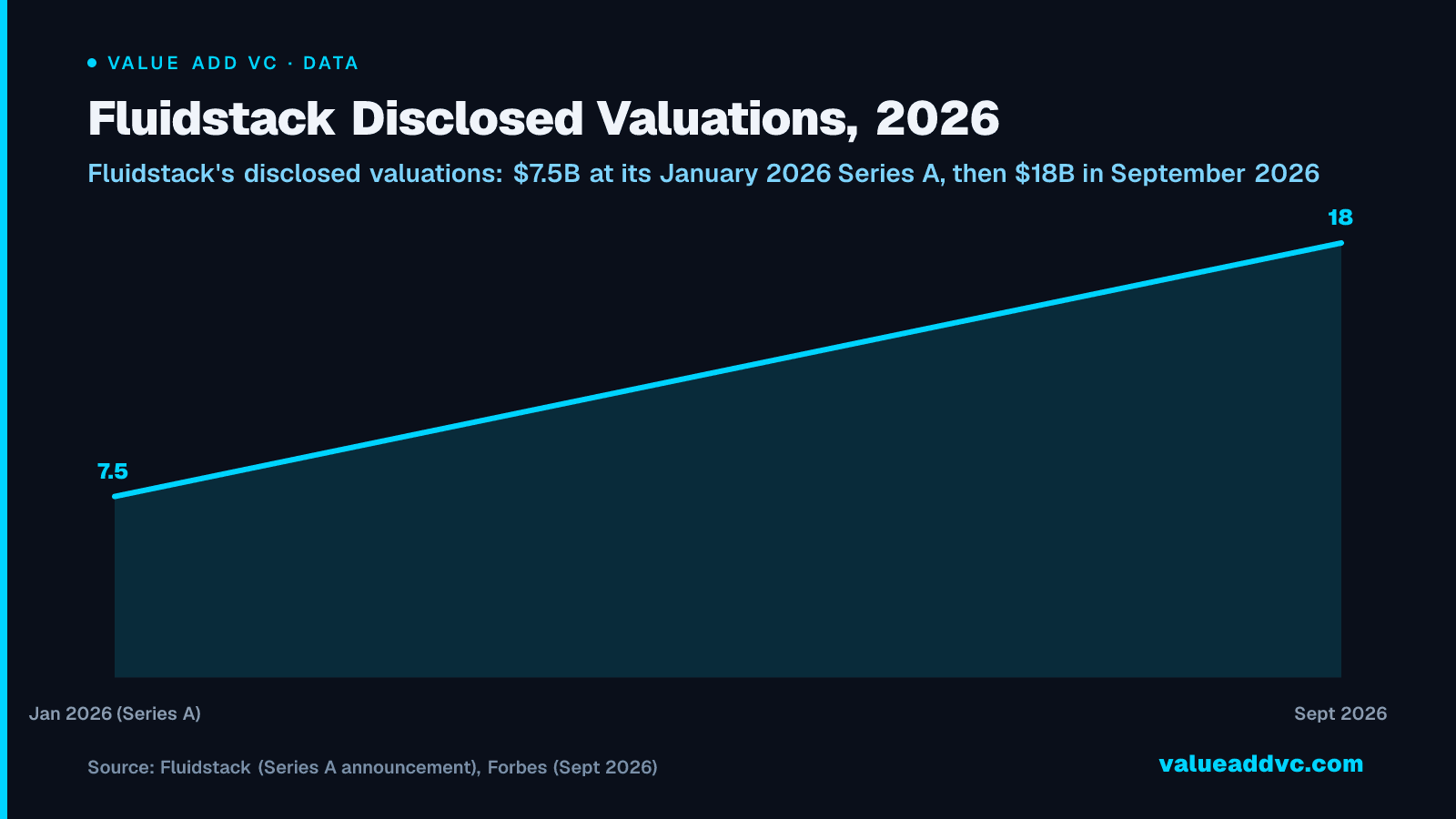
Source: Fluidstack's Series A announcement (July 2026) and Forbes reporting on the September 2026 round. The 2019 seed valuation was not disclosed, so it is not plotted.
Fluidstack vs. the Rest of the Neocloud Pack
At $18 billion, Fluidstack now sits in the middle of the private neocloud tier — bigger than Firmus and Lambda, but still well below Crusoe and public CoreWeave. The asset-light, no-owned-chips model is the real differentiator: where Crusoe and Firmus fund physical construction directly, Fluidstack leases the shell and the silicon, which is part of why it can post a nine-figure-to-eleven-figure revenue jump in two years without the capex load its physical-infrastructure peers carry.
Neocloud Valuations, September 2026
Fluidstack's $18B trails only Crusoe among private GPU-cloud builders
Bloomberg, Forbes, Crunchbase News, company disclosures, September 2026
Data
| Item | Value |
|---|---|
| CoreWeave (public) | $46.6B mkt cap |
| Crusoe | $30.0B |
| Fluidstack | $18.0B |
| Firmus | $10.5B |
| Together AI | $8.3B |
| Lambda | $5.9B |
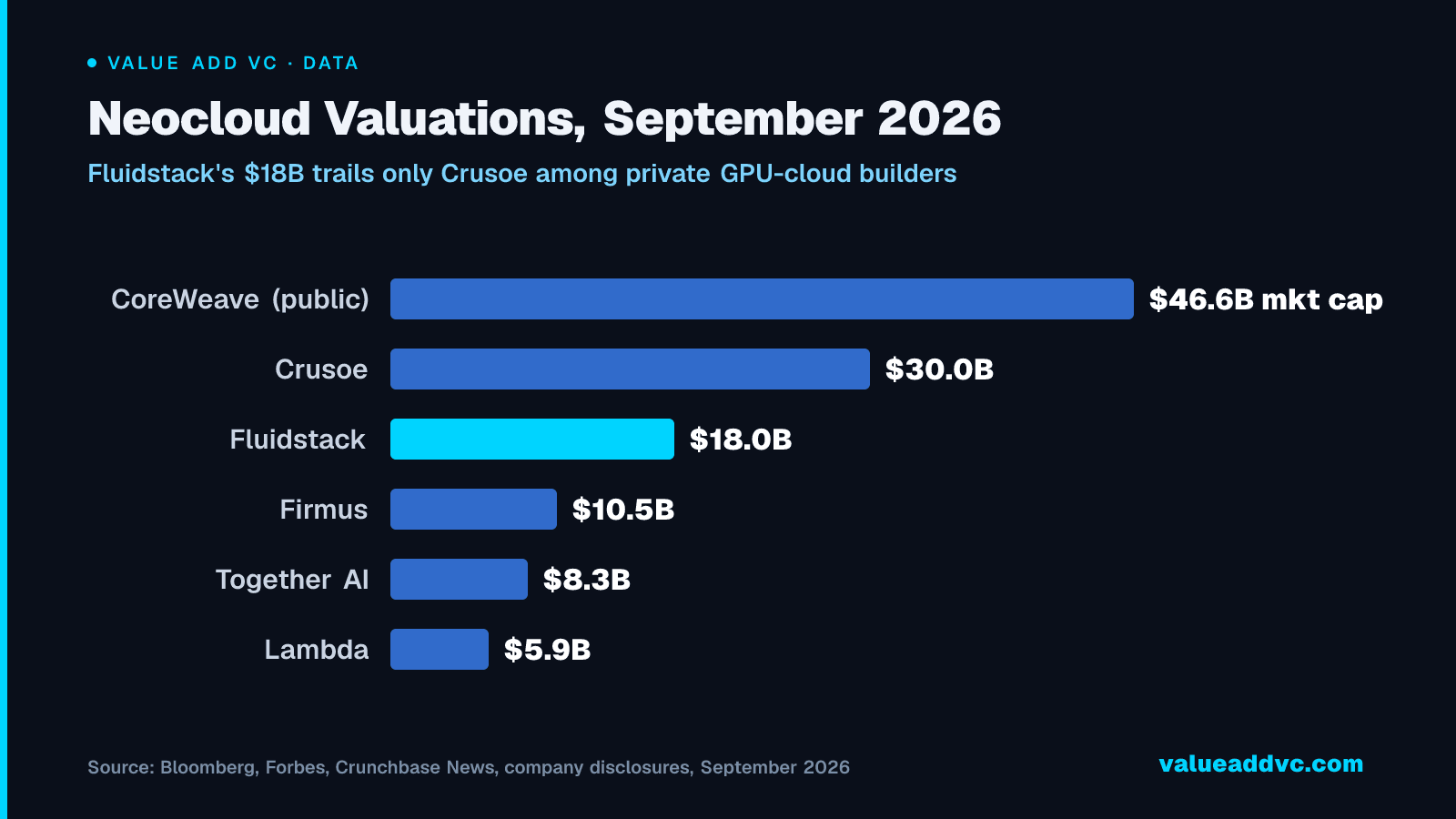
Source: company disclosures and press reporting compiled September 2026; CoreWeave figure is public market cap.
Nvidia sits on the other side of nearly every one of these deals as the chip supplier, and it has developed its own pattern of taking equity stakes in the neoclouds that buy from it. That circularity — a chipmaker investing in the companies that buy its chips, which then use investor capital in part to buy more chips — is one reason some analysts flag the neocloud financing wave as harder to value on standard multiples than a typical infrastructure business. It's also why Jane Street's approach differs in kind: it isn't selling GPUs to Fluidstack, so its equity stake and compute purchases sit on opposite sides of a straightforward buyer-investor relationship rather than a supplier-financier one.
The Asset-Light Model, in Plain Terms
Fluidstack's pitch to customers and investors rests on a structural choice most of its neocloud peers didn't make: it doesn't build or own the data center shell, the power infrastructure, or, in many cases, the GPUs themselves. Instead, Fluidstack arranges the real estate, power contracts, and hardware leases, then bundles them into a turnkey compute product for AI labs — collecting a margin on orchestration and contract structuring rather than on owning depreciating hardware. That's a meaningfully different bet than Crusoe's, which increasingly self-funds physical construction using its own captured-energy expertise, or Firmus, which is tying its build-out directly to a specific country's power grid.
The tradeoff cuts both ways. Fluidstack can scale contracted capacity faster and with less capital tied up than a builder that has to pour concrete and lay power lines itself. But it also means Fluidstack has less direct control over the supply it depends on: if GPU allocation or grid interconnection queues tighten further, an asset-light lessor is competing for the same scarce inputs as the landlords and hardware suppliers it depends on, rather than controlling them outright the way a vertically integrated builder does.
What the Headline Misses
A 2.4x step-up from the Series A price reads as pure momentum, but three things complicate it. First, none of the figures in this round come from an official Fluidstack press release — Forbes, which broke the story, cited people familiar with the deal (as VnExpress's write-up of the Forbes report notes), and Crunchbase News and Tech Times state the same figures without naming their sources, so the final structure and price could still be revised before any public confirmation. Second, Fluidstack's revenue growth is concentrated almost entirely in a handful of anchor contracts — Anthropic's roughly $50 billion commitment above all — meaning a renegotiation or delay from one customer would disproportionately affect the assumptions behind an $18 billion price tag. Third, the asset-light model that makes Fluidstack's margins look attractive also means it doesn't control the underlying data center capacity the way Crusoe or Firmus do — if GPU or power supply tightens further, Fluidstack is a lessee competing with its own landlords and hyperscaler customers for the same scarce inputs.
Fluidstack Valuation History
| Date | Round | Amount | Post-money valuation | Lead(s) | Source |
|---|---|---|---|---|---|
| Sept 2026 | Growth (unconfirmed by company) | $1.5B | $18B | Jane Street | Forbes |
| Jan 2026 (announced Jul 20, 2026) | Series A | $830M | $7.5B | Situational Awareness | Fluidstack |
| Feb 2025 | Earlier round, type unconfirmed (Tracxn and Tech Times label it Series A) | $200M | — | — | Tracxn |
| 2019 | Seed | $3M | — | — | Tracxn |
The September 2026 round has not been confirmed by Fluidstack's own announcements; Crunchbase News (Sept 4, 2026) reported the same $1.5B/$18B figures. Fluidstack filed an SEC Form D for a $1.5B equity offering (first sale June 15, 2026; about $730M sold as of its June 30 filing), likely this round; it confirms the offering size, not the valuation or lead. Fluidstack calls its January 2026 raise its Series A; Tracxn and Tech Times also list a $200M February 2025 round as a Series A, but SiliconANGLE (Feb 20, 2026), citing Forbes, said Fluidstack had previously raised about $25M in equity funding over two rounds, so the $200M may not be equity. Tracxn totals these four rounds at $2.55B (it counts the January round at $842M, the amount sold in Fluidstack's amended SEC Form D); Crunchbase News puts total funding at just over $2.6B. A dash means not disclosed. Compiled October 1, 2026.
Neocloud Comparables, September 2026
| Company | Date | Amount | Valuation | Lead(s) | Notes |
|---|---|---|---|---|---|
| CoreWeave (comp) | Sept 3, 2026 | — | $46.6B mkt cap | Public markets | Q2 2026 revenue $2.6B, +112% YoY |
| Crusoe (comp) | Sept 3, 2026 | $3B | $30B | Atreides, Valor Equity | Also backed by Jane Street's $13B contract |
| Firmus (comp) | Aug 2026 | $2B | $10.5B | Nvidia, Blackstone | Australia-focused capacity build |
Sources: company disclosures, Forbes, Crunchbase News, Dealroom.co, Bloomberg. Compiled September 10, 2026.
What to Watch Next
Official confirmation
Fluidstack has not issued its own release on the $1.5 billion round — watch for the company or Jane Street to confirm final terms.
Google's equity stake
Google backstops some of Fluidstack's lease obligations, and The Wall Street Journal reported it was weighing a $100 million investment in the Series A while talks were ongoing in February 2026; whether that becomes a disclosed equity stake is still open.
Structure of the Jane Street check
Whether the $1.5 billion is pure equity, tied to a parallel compute-purchase agreement (as with Crusoe), or some mix hasn't been disclosed.
Anthropic contract execution
The roughly $50 billion Texas and New York build-out is the single largest assumption behind the $18 billion price tag — delivery timelines are the thing to track.
For more on who's funding the AI data center build-out, see Crusoe's $3B Round at a $30B Valuation and Jane Street's $21.5B AI Infrastructure Bet, and for the same build-out reaching public markets, see DayOne Data Centers' $5B Nasdaq IPO filing. Track private AI company valuations on the AI Valuations dashboard at Value Add VC.
Latest from the Pulse
Get VC data most people never see
— free to subscribe
Trace's notes on venture, AI and startups, a few times a week. Join 5,000+ subscribers. No spam.
No spam, unsubscribe anytime. Sent via Substack · Privacy · or subscribe on Substack ↗