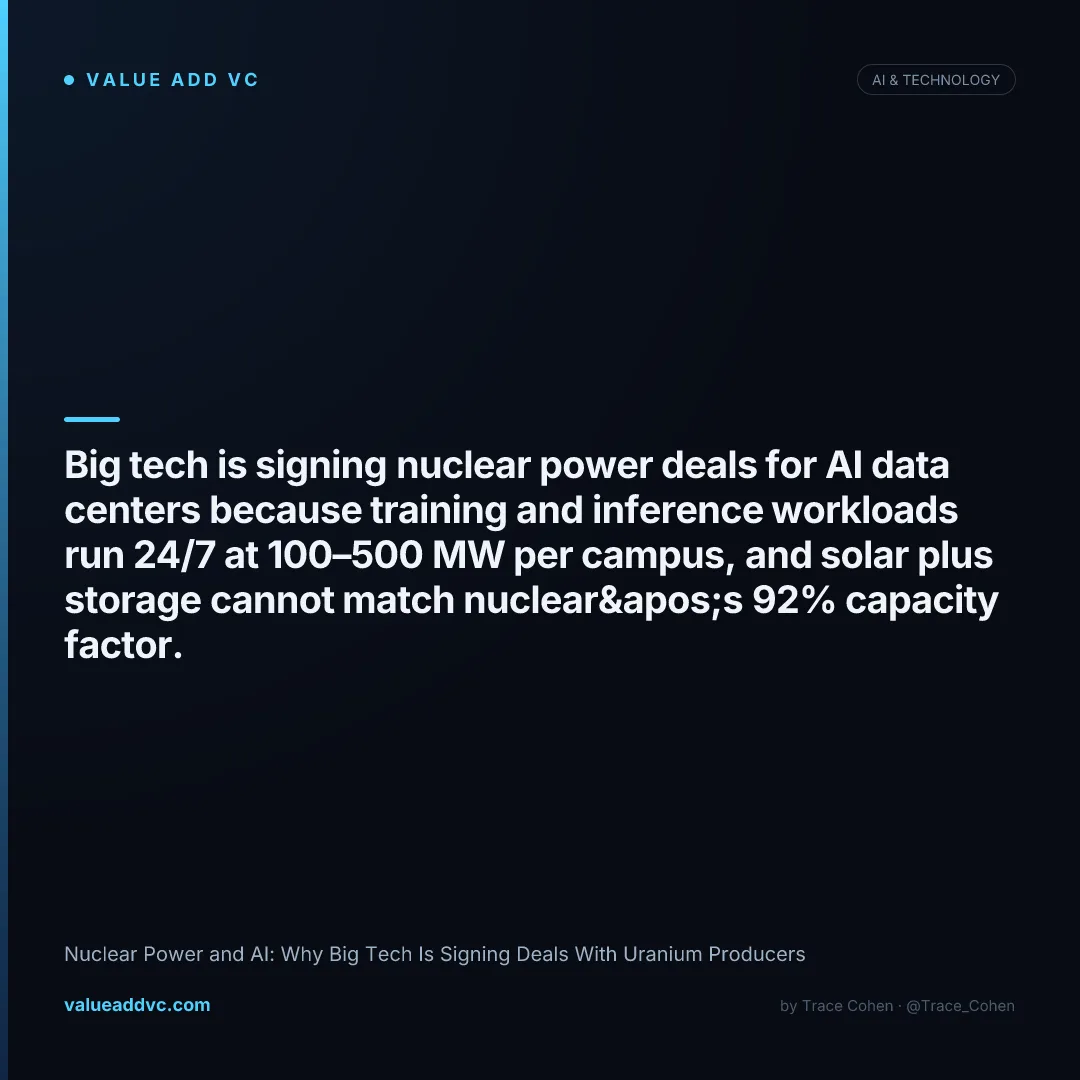
The AI buildout has a power problem. Nuclear power for AI data centers is the only credible solution — and the three largest cloud providers have already started acting on it.
Microsoft signed a 20-year deal to restart Three Mile Island. Amazon paid $650M for a nuclear-powered data center campus. Google contracted with a small modular reactor startup. These are not sustainability PR moves. They are procurement decisions driven by a hard constraint: AI workloads run at full load around the clock, and the grid cannot reliably supply carbon-free power at that scale without nuclear.
Uranium miners, nuclear operators, and SMR developers are now infrastructure vendors in the AI stack. That is a structural shift worth understanding.
The Power Math That Explains Everything
A single hyperscale AI training cluster — the kind used to train frontier models — draws 100 to 500 megawatts continuously, 24 hours a day, 365 days a year. To put that in perspective, a large city hospital uses about 10 MW. A cluster training the next generation of large language models consumes the equivalent of a small town.
| Power Source | Capacity Factor | Carbon-Free? | 24/7 Reliable? |
|---|---|---|---|
| Nuclear | ~92% | Yes | Yes |
| Natural Gas (CCGT) | ~55% | No | Yes |
| Solar (utility) | ~25% | Yes | No |
| Wind (onshore) | ~30–35% | Yes | No |
| Hydro | ~40% | Yes | Regionally limited |
Capacity factor measures what percentage of theoretical maximum output is actually delivered over a year. Nuclear's 92% capacity factor is the highest of any generation source.
Why Nuclear Power for AI Data Centers Makes Structural Sense
The fundamental problem is simultaneity. AI model training cannot pause because the sun set. Inference serving for millions of enterprise users cannot throttle at night. These workloads demand continuous full-load power. Solar and wind deliver power intermittently and cannot be dispatched on demand without storage — and building battery storage at gigawatt scale for data center campuses is neither economically viable nor physically practical at the timelines AI infrastructure requires.
Nuclear solves this with a 92% capacity factor. A 1 GW nuclear plant actually delivers roughly 920 MW on average across the year — a guarantee no other carbon-free source can match at scale.
Power intensity vs. traditional servers
10–100x more per GPU rack
US data center demand by 2030
50+ GW (Goldman Sachs)
Nuclear capacity factor
~92% (vs. 25% solar)
Uranium price surge 2022–2024
$49/lb → $106/lb peak
The Deals That Signal a Structural Shift
Microsoft + Constellation Energy
20-year PPA to restart Three Mile Island Unit 1
Announced September 2023. Microsoft agreed to purchase 100% of the output from TMI Unit 1, which was shut in 2019 for economic reasons. Constellation is investing to bring the 835 MW plant back online around 2028. This is the first US nuclear plant to be restarted for a single corporate buyer.
Amazon Web Services + Talen Energy
Campus acquisition for ~$650M
Amazon acquired the Susquehanna Steam Electric Station nuclear campus from Talen Energy, gaining rights to build a 960 MW hyperscale data center campus collocated with the nuclear plant. This provides direct grid interconnect to carbon-free baseload without relying on transmission capacity that may not exist.
Google + Kairos Power
Purchase agreement for multiple SMRs
Google signed an agreement in October 2023 to purchase power from a series of Kairos Power fluoride salt-cooled high-temperature reactors, with first delivery targeted for 2030 and full deployment by 2035. Google also holds an option to expand the agreement based on capacity availability.
Small Modular Reactors: The Real Long-Term Bet
The Three Mile Island restart and nuclear campus acquisitions are near-term solutions using existing plants. The longer game is small modular reactors — factory-built nuclear units under 300 MW that can be deployed modularly near data center campuses.
The appeal for tech companies is obvious: SMRs can be sited adjacent to a campus, eliminating long-distance transmission, and can be added in increments as compute capacity expands. The DOE has invested over $3.4B in SMR development through its Advanced Reactor Demonstration Program. NuScale received NRC approval for its design in 2022 (though its first project was later cancelled on economics), and multiple competitors — Kairos, TerraPower, X-energy, Oklo — are in various stages of licensing and construction.
Microsoft has invested in TerraPower (Bill Gates' nuclear company) and has signed an agreement with Helion Energy for fusion power, though fusion remains commercially unproven. The serious near-term bets are on fission SMRs. Google's Kairos deal and Amazon's campus acquisition represent the two current viable paths: contracted SMR output or co-located existing nuclear. Kairos Power's own valuation trajectory since that Google deal is a useful proxy for how investors are pricing offtake-backed SMR developers more broadly. The broader venture bet behind Gates, Altman, and fusion-adjacent startups extends well past the hyperscalers' own procurement deals.
What This Means for Investors and Founders
Venture capital is chasing the same shortage from the supply side: Sequoia just backed a factory-built reactor startup at a $6B valuation, betting on manufacturing speed rather than existing plant output. The AI capex supercycle — Microsoft at $80B, Google at $75B, Meta at $65B, Amazon at $80B annually — is not just a GPU and networking story. Roughly 30–40% of data center build cost is power infrastructure: grid interconnect, substations, cooling, and increasingly, power purchase agreements. Firms tracking AI valuations should treat energy procurement as a tier-1 competitive variable — see the AI Valuations dashboard for how this plays into frontier model company pricing, and our AI Spending tracker for the full capex breakdown.
Who Benefits
- ✓ Existing nuclear operators (Constellation, Talen, Vistra)
- ✓ Uranium miners and enrichers (supply chain tightening)
- ✓ SMR developers with late-stage licensing (Kairos, TerraPower)
- ✓ Nuclear engineering and construction firms
- ✓ Grid interconnect and high-voltage infrastructure
The Real Risks
- ✕ SMR timelines routinely slip 3–5 years
- ✕ Regulatory risk is higher than solar/wind
- ✕ Nuclear construction cost overruns are historic
- ✕ Grid interconnect queues already backed up 5+ years
- ✕ Fusion hype vs. fission reality gap remains wide
The AI buildout does not run on solar panels and battery packs.
It runs on 92% capacity factor, 24/7 carbon-free baseload. The only scalable source of that is nuclear — which is why every major AI infrastructure buyer is now a nuclear energy customer.
Track AI infrastructure spending and valuations on the AI Valuations Dashboard at Value Add VC. Originally published in the Trace Cohen newsletter.
Latest from the Pulse
Get VC data most people never see
— free to subscribe
Trace's notes on venture, AI and startups, a few times a week. Join 5,000+ subscribers. No spam.
No spam, unsubscribe anytime. Sent via Substack · Privacy · or subscribe on Substack ↗