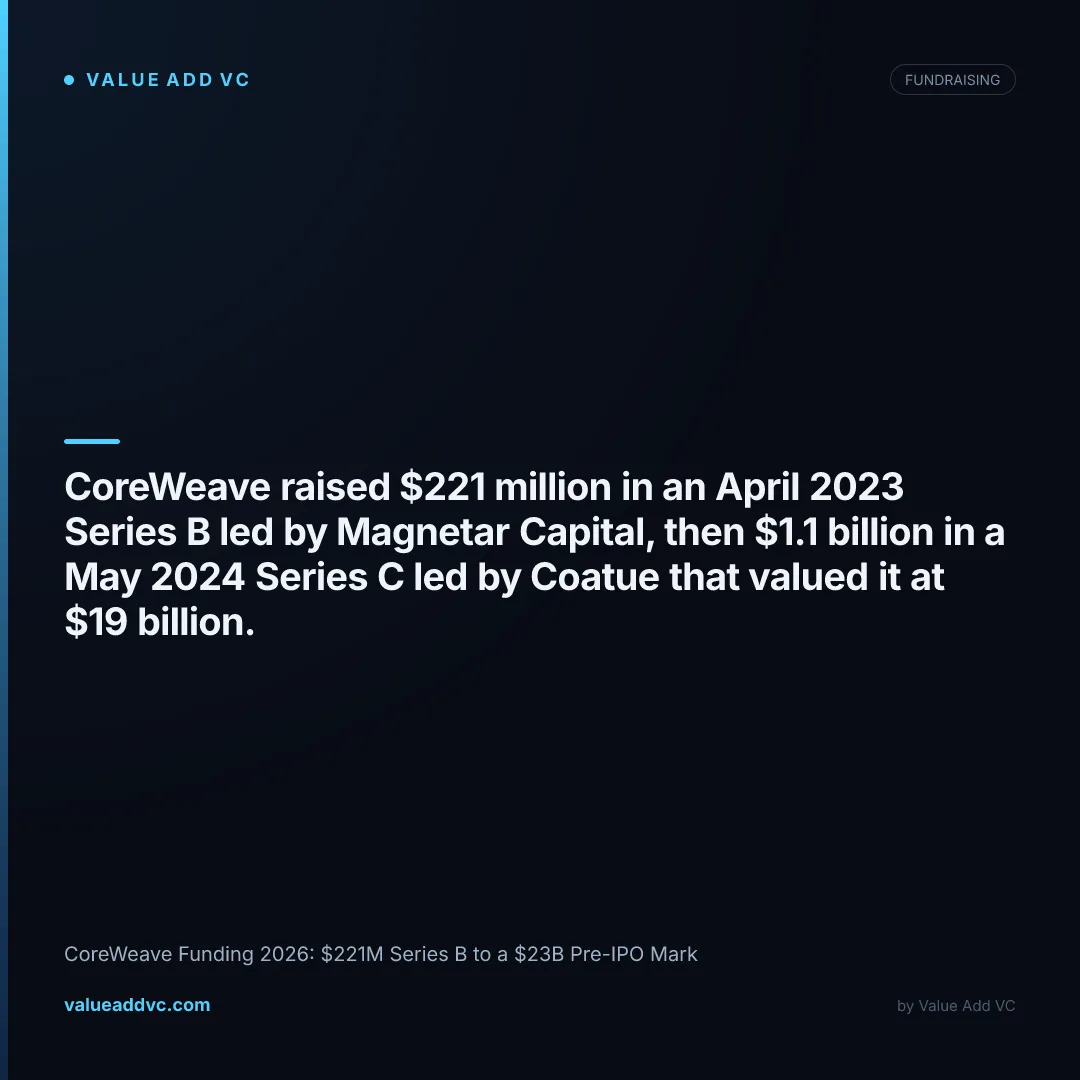
CoreWeave raised $221 million in an April 2023 Series B, then $1.1 billion in a May 2024 Series C that valued it at $19 billion, before a November 2024 secondary sale pushed its mark to $23 billion ahead of its March 2025 IPO at $40 a share.
CoreWeave's path from a Series B startup to a Nasdaq-listed neocloud took less than two years and ran through five distinct financing events — two primary rounds that put new capital on its balance sheet, and two secondary sales that didn't. Pulse has covered CoreWeave's public-market run extensively since its IPO; this is the funding history that got it there.
Sources: TelecomTV, Verdict, Crunchbase News, The Register, MarketScreener (Reuters), CoreWeave, as of October 17, 2026.
CoreWeave's Funding History: From Series B to IPO
CoreWeave's valuation grew roughly 11.5x in 18 months — from about $2 billion after its May 2023 Series B extension to a $23 billion secondary mark in November 2024 — before it priced its IPO the following March. Two of the five events below were secondary sales between shareholders rather than new financing, which matters for anyone trying to add up how much capital the company actually raised versus how its valuation climbed.
| Round | Date | Amount | Lead Investor(s) | Valuation |
|---|---|---|---|---|
| Series B | Apr 18, 2023 | $221M | Magnetar Capital | n/a (unpriced) |
| Series B extension | May 31, 2023 | +$200M ($421M total) | Magnetar Capital | $2.0B |
| Secondary sale | Dec 4, 2023 | $642M (no new capital) | Fidelity Management & Research | $7.0B |
| Series C | Reported May 1, 2024 | $1.1B | Coatue | $19.0B |
| Secondary sale | Nov 13, 2024 | $650M (no new capital) | Jane Street, Magnetar, Fidelity, Macquarie | $23.0B |
| IPO (Nasdaq: CRWV) | Mar 27, 2025 | $40.00/share, 37.59M shares | Morgan Stanley, JPMorgan, Goldman Sachs (bookrunners) | ~$23B (implied) |
Sources, in order: TelecomTV, Verdict, Crunchbase News, The Register, MarketScreener (Reuters), CoreWeave. How we counted: every disclosed CoreWeave financing event from its April 2023 Series B through its March 2025 IPO pricing; 6 events; as of October 17, 2026.
Primary vs. Secondary: What Actually Raised New Capital?
Only two of CoreWeave's five pre-IPO financing events put new money on the company's own balance sheet: the $421 million Series B (initial close plus extension) and the $1.1 billion Series C, for roughly $1.5 billion in disclosed primary capital. The December 2023 sale ($642 million) and the November 2024 sale ($650 million) were secondary transactions — existing shareholders, including early investors and employees, sold stock directly to new buyers like Nvidia-adjacent and institutional investors, with none of that cash reaching CoreWeave's own accounts, per Crunchbase News and MarketScreener's Reuters-sourced report.
Separately from equity, CoreWeave also announced a $2.3 billion debt financing facility in August 2023 led by Magnetar Capital and Blackstone, used to fund the GPU and data-center buildout that its equity rounds alone didn't cover. That debt line doesn't show up in the equity-funding totals above, but it was arguably as important to CoreWeave's 2023-2024 scale-up as any of the five rounds in the table.
Who Backed CoreWeave, and What Happened at the IPO?
Magnetar Capital was CoreWeave's earliest and most consistent backer, leading the Series B and its extension in 2023 and co-leading the November 2024 secondary sale alongside Jane Street, Fidelity Management and Macquarie Capital. Coatue stepped in to lead the Series C in May 2024, and Nvidia, Nat Friedman and Daniel Gross participated in the original Series B.
CoreWeave priced its IPO at $40 a share on March 27, 2025, selling 37.59 million Class A shares combined — 36.59 million of them new shares sold by the company, raising roughly $1.46 billion in gross proceeds, and 910,000 sold by existing stockholders, per CoreWeave's own pricing announcement. The deal was led by Morgan Stanley, J.P. Morgan and Goldman Sachs as joint bookrunners, and the stock began trading on the Nasdaq Global Select Market under ticker CRWV the next day. For how that public-market story has unfolded since, see our CoreWeave stock deep dive.
What the headline misses
A valuation climbing from $2 billion to $23 billion in 18 months looks like unambiguous good news, but two of those four markups came from secondary sales, not fresh validation of the business by a new primary investor pricing a round from scratch. One read on this: secondary sales let early backers and insiders cash out while signaling demand, but they're priced by whoever is willing to buy a specific block of stock at a specific moment — not by a lead investor doing full diligence on a new primary check, the way the Series C was. The $2.3 billion debt facility is also easy to leave out of a funding story focused on equity rounds, even though debt-funded GPU purchases were central to how CoreWeave scaled capacity fast enough to land the hyperscaler contracts its IPO pitch leaned on.
The Bottom Line
CoreWeave raised about $1.5 billion in disclosed primary equity capital before its IPO — a $421 million Series B and a $1.1 billion Series C — while two secondary sales pushed its headline valuation from $7 billion to $23 billion without adding to that primary total. It priced its Nasdaq debut at $40 a share in March 2025, a number that, by the IPO, was already a known quantity against the $23 billion secondary mark set four months earlier.
Track CoreWeave's public-market performance in our CoreWeave stock deep dive, compare it to rivals in CoreWeave vs Nebius, and see every new private round on the funding tracker.
Latest from the Pulse
Get VC data most people never see
— free to subscribe
Trace's notes on venture, AI and startups, a few times a week. Join 5,000+ subscribers. No spam.
No spam, unsubscribe anytime. Sent via Substack · Privacy · or subscribe on Substack ↗