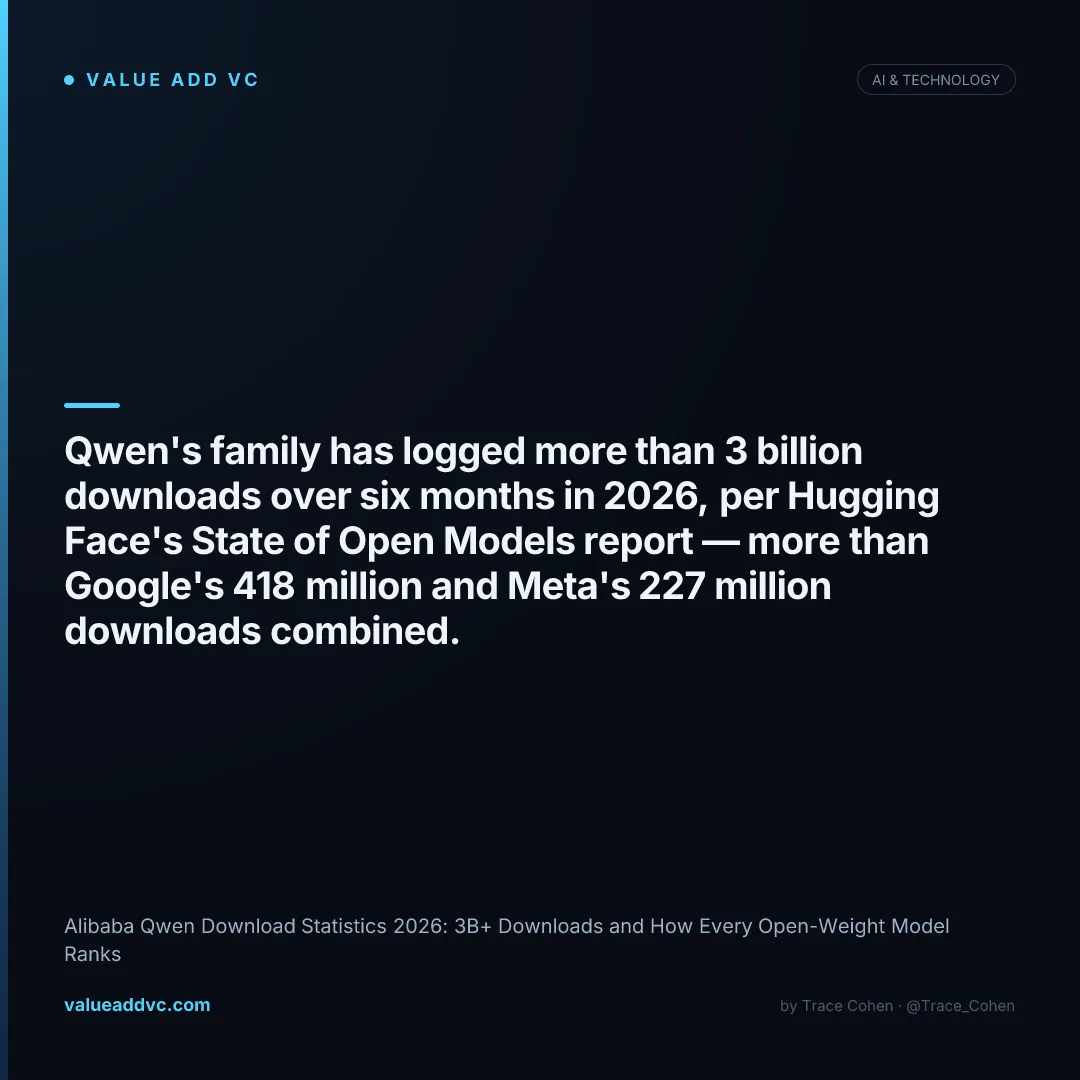
Alibaba's Qwen models have logged more than 3 billion downloads in six months in 2026 — more than Google and Meta's entire 2026 download totals combined.
That's the short answer. The longer answer is that a download isn't a benchmark win, and the gap between those two things is where the real story sits. I track capital flows into AI labs for a living, and this is the first time I've seen a Chinese open-weight family lap the two biggest Western AI companies on raw distribution — not by a little, by 4-13x. Here's the full ranking, the numbers behind it, and what it actually means.
Alibaba Qwen download statistics: what the 2026 numbers actually show
Alibaba's open-weight Qwen models passed 3 billion cumulative downloads over the six months ending August 14, 2026, according to Hugging Face's State of Open Models report and Fortune's reporting on it. That total exceeds Google's 418 million and Meta's 227 million downloads for all of 2026 combined. Among repositories that declare a parameter count specifically, Qwen accounted for 2.05 billion downloads — about 55 times more than Moonshot AI's Kimi family, the next-closest measured the same way.
Every open-weight model family, ranked by 2026 downloads
Downloads aren't measured identically across every lab — Hugging Face repository counts and platform-specific trackers like Ollama use different methodologies — so treat this as directional, not a photo finish. Still, the gaps here are large enough that methodology differences don't change the ranking.
DeepSeek's figure is R1 downloads via Ollama specifically, a different distribution channel than the Hugging Face repository counts used for the other four rows — it understates DeepSeek's total footprint across all of its models and channels.
Qwen download statistics compared: full data table
The table below adds license terms and flagship models to the ranking above, since download volume alone doesn't tell you which model a team should actually deploy.
| Rank | Model family | 2026 downloads | License | Flagship model | Lab HQ |
|---|---|---|---|---|---|
| 1 | Qwen | 3B+ (6mo) | Apache 2.0 (most) | Qwen3.8-Max | China (Alibaba) |
| 2 | Gemma / Google | 418M (2026) | Gemma custom terms | Gemma 4 | United States |
| 3 | Llama | 227M (2026) | Llama community license | Llama 4.5 | United States (Meta) |
| 4 | DeepSeek | 88M+ (R1, Ollama) | MIT (open) | DeepSeek V4.1 | China |
| 5 | Kimi / Moonshot AI | 37M (lifetime) | Modified MIT | Kimi K3 | China |
Figures are 2026 estimates blended from Hugging Face's State of Open Models: Summer 2026 report, Fortune, Bloomberg, and deepseekmodel.com's Ollama download tracker. Download windows differ by source (six-month vs. full-year vs. lifetime) and are noted per row; treat cross-row comparisons as directional given differing methodologies.
How We Ranked These
The ranking above is ordered by measured 2026 download volume, primarily sourced from Hugging Face's State of Open Models: Summer 2026 report, which tracks public model repository pulls across its platform from January through August 2026. Where Hugging Face didn't break out a clean per-family total — DeepSeek's footprint spans multiple distribution channels — we supplemented with the largest single verifiable figure from a named tracker (Ollama's public download counter, via deepseekmodel.com) rather than estimate a blended total ourselves. We did not weight by benchmark score, revenue, or valuation — this is a distribution ranking, not a capability ranking, and the two are explicitly not the same measure, as the section below covers.
Why Qwen's download lead matters for the AI price war
Qwen's download dominance isn't happening in isolation. The same week Hugging Face published its report, OpenAI cut the price of its fastest model, GPT-5.6 Luna, by 80%, and Anthropic introduced a cheaper Claude Opus 5 tier at $5 per million input tokens and $25 per million output tokens, according to Ars Technica. Chinese open-weight models — DeepSeek, Zhipu's GLM-5.2, and Moonshot's Kimi K3 — are priced 60-90% below comparable US frontier models on a per-token basis, and by May 2026 they accounted for roughly 61% of all tokens consumed on the OpenRouter marketplace, with four of the five most-used models built in China.
Qwen's 3 billion downloads are the adoption-side mirror of that same price pressure: developers choosing free, locally-runnable weights over metered API access for workloads where frontier-grade quality isn't strictly required. Every derivative fine-tune, every startup that builds on Qwen's base weights instead of a closed API, deepens an ecosystem lock-in that a single API relationship never creates. Track how that capex and revenue pressure is showing up across the sector on our AI Valuations dashboard and Big Tech Earnings tracker.
What the headline misses
A download is not a benchmark win, and it's not enterprise revenue either. Hugging Face's own report frames Qwen's lead carefully: the family has "become part of the default workflow for developers deciding what models to fine-tune and deploy" — a claim about ecosystem gravity, not a statement that Qwen beats GPT-5.6 Sol or Claude Opus 5 on hard reasoning benchmarks. A developer downloading a 7B-parameter Qwen checkpoint once to experiment is a categorically different signal than an enterprise signing a multi-year API contract with OpenAI or Anthropic, and Alibaba hasn't disclosed what share of its 3 billion downloads convert into production deployments versus one-off experiments that get abandoned.
There's also a data-quality wrinkle worth naming: roughly 85.6% of all models on Hugging Face have fewer than 200 lifetime downloads, and just 1.5% of repositories account for 99.2% of all downloads on the platform. Qwen's number is real and it's dominant, but it's also concentrated in a platform where the download metric itself is famously top-heavy — a handful of flagship checkpoints, not the full 460-model catalog, are almost certainly doing most of the work.
What Qwen's download statistics mean for AI investors and buyers
For anyone underwriting AI infrastructure or model-layer startups right now, the practical read is this: open-weight distribution is a real moat-building mechanism, but it's a different moat than the one closed-API labs are building. Meta effectively invented this playbook with Llama in 2023 and has now been out-executed on it by four separate Chinese labs simultaneously — Alibaba, DeepSeek, Zhipu, and Moonshot — inside of two years. That's a faster reversal than most Western labs priced into their 2024-era competitive assumptions.
It also changes what "winning" looks like in AI. A closed lab like Anthropic or OpenAI wins by converting usage into metered revenue, which is why both are reporting record enterprise revenue in the same week they cut prices — usage growth is outrunning the margin they're giving up per token, for now. An open-weight lab like Alibaba wins differently: it doesn't monetize the download directly, it wins by making Qwen the default substrate other companies build products on top of, which pays off later through cloud consumption, enterprise services, or geopolitical AI-standard-setting rather than a per-token invoice. Both are legitimate strategies. They just aren't measured by the same number, which is the mistake to avoid when a 3-billion-download headline lands next to a $25-per-million-token pricing announcement in the same news cycle.
The scoreboard on open-weight AI downloads in 2026:
Qwen's 3 billion downloads beat Google and Meta combined — but distribution isn't capability, and it isn't revenue. Track the number that actually matters next.
Track how AI capex and model-layer competition are showing up in valuations on the AI Valuations dashboard at Value Add VC. Originally published in the Trace Cohen newsletter.
Latest from the Pulse
Get VC data most people never see
— free to subscribe
Trace's notes on venture, AI and startups, a few times a week. Join 5,000+ subscribers. No spam.