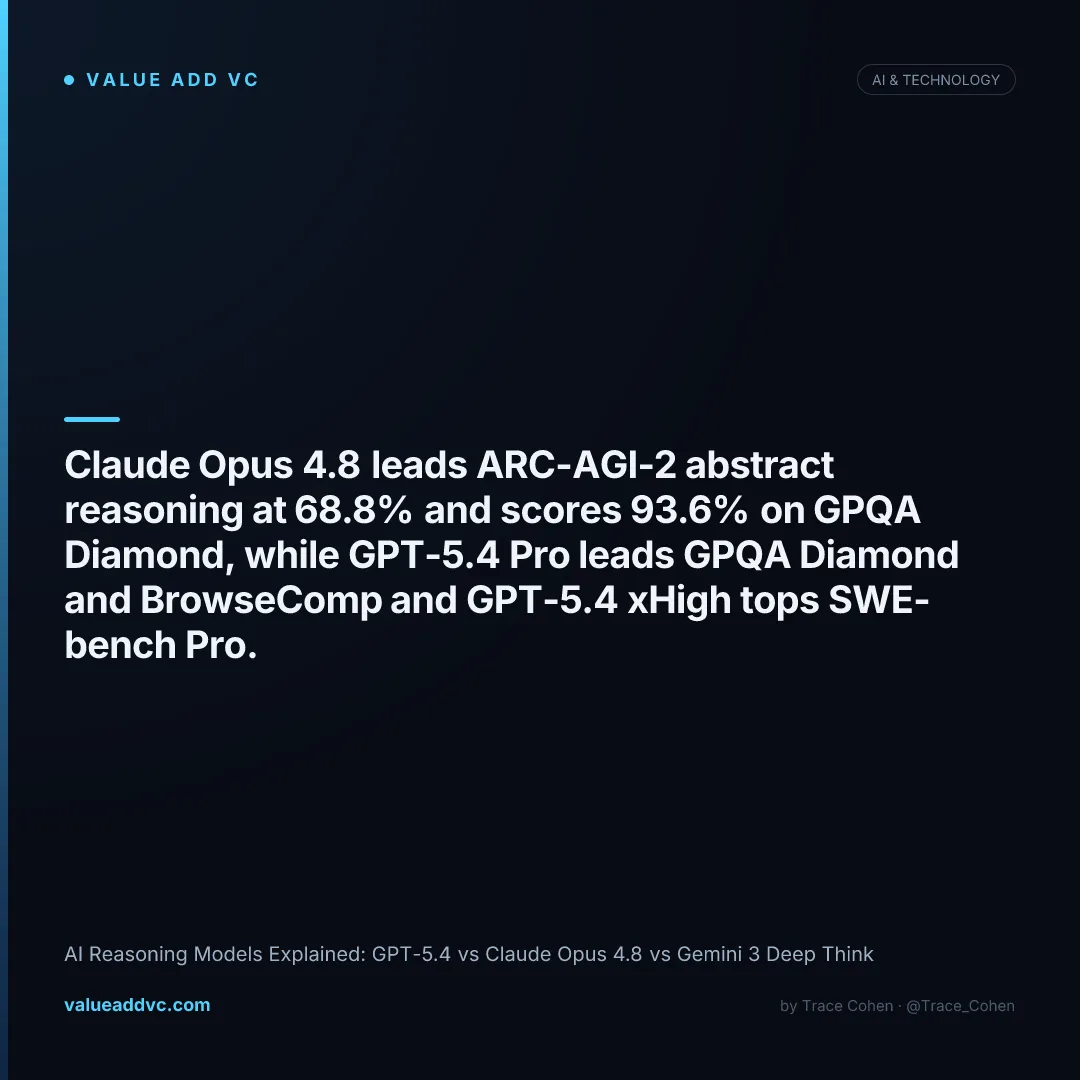
Claude Opus 4.8 scores 68.8% on ARC-AGI-2 and 93.6% on GPQA Diamond, GPT-5.4 Pro leads GPQA Diamond and BrowseComp, and GPT-5.4 xHigh tops the live SWE-bench Pro leaderboard. The catch is that "best reasoning model" now depends entirely on which task you're asking about.
Eighteen months ago, "reasoning model" meant one thing: OpenAI's o1 and o3, which introduced extended test-time compute as a distinct product tier. By mid-2026, every frontier lab ships one — Anthropic's Claude Opus 4.8 with extended thinking, Google's Gemini 3 Pro Deep Think, and OpenAI's GPT-5.4 across low/medium/high/xHigh effort settings. The benchmarks have gotten harder to read, not easier, because no single model wins across the board anymore.
Figures are 2026 estimates blended from BenchLM.ai model benchmarks, Anthropic's Claude Opus 4.6/4.8 system cards, Artificial Analysis, and Google's Gemini pricing pages. Benchmark scores reflect provider-reported and third-party leaderboard results as of Q2 2026 and shift with each model update.
What Are AI Reasoning Models Explained in Plain Terms
AI reasoning models are large language models trained to spend extra computation working through a problem — generating an internal chain of intermediate steps, checking its own logic, and backtracking when an approach fails — before producing a final answer. This is different from a standard chat model, which generates its response token-by-token in a single forward pass with no deliberation step.
The category started with OpenAI's o1 in late 2024 and o3 in 2025, followed quickly by Anthropic's Claude 3.7 Sonnet — the first Claude model to offer a visible, user-adjustable "extended thinking" budget — and Google's Gemini 2.5 Pro with a built-in Thinking mode. By 2026, reasoning is no longer a separate model line; it's an effort dial. GPT-5.4 ships with low, medium, high, and xHigh reasoning settings on the same base model, and Claude Opus 4.8 and Gemini 3 Pro both expose a thinking-token budget developers can tune per request. These are all closed, metered models — a very different competitive lane from the open-weight side of the market, where Alibaba's Qwen has out-downloaded every other model family in 2026.
GPT-5.4 vs Claude Opus 4.8 vs Gemini 3 Deep Think: Benchmark Comparison
| Model | Lab | GPQA Diamond | ARC-AGI-2 | Strongest At |
|---|---|---|---|---|
| GPT-5.4 Pro | OpenAI | ~93%+ (leader) | Leads ARC-AGI-2 Verified | GPQA Diamond, BrowseComp |
| GPT-5.4 xHigh | OpenAI | High 80s-90s | Strong, not top | SWE-bench Pro (live leaderboard) |
| Claude Opus 4.8 | Anthropic | 93.6% | 68.8% (category leader) | Abstract/novel reasoning, agentic coding |
| Claude Opus 4.6 | Anthropic | ~93% | Below Opus 4.8 | Long-context reasoning, SWE-bench Verified |
| Gemini 3 Pro Deep Think | Low-to-mid 90s | 45.1% | 1M-token context, scientific research | |
| Gemini 3.1 Pro (standard) | High 80s | Mid-30s to 40s | Coding-arena head-to-head play | |
| Qwen3.7 Max | Alibaba | High 80s | Mid-tier | Cost efficiency ($1.25/M tokens) |
Figures are Q2 2026 estimates blended from BenchLM.ai, Artificial Analysis, Anthropic's Claude Opus 4.6 and 4.8 system cards, and public leaderboard trackers including llm-stats.com. GPQA Diamond scores are rounded ranges where exact provider figures weren't independently confirmed; benchmark leaderboards update monthly as labs ship new checkpoints.
Reasoning Model Pricing: What Extended Thinking Actually Costs
Reasoning tokens are the hidden cost line in AI reasoning models explained for a developer audience: the model's internal chain-of-thought consumes billable tokens even though the user never sees them. A query that costs a few cents on a fast, non-reasoning model can run into dollars once you dial reasoning effort up to "high" or "xHigh." Google's Gemini 2.5 Pro prices at $1.25 per million input tokens and $10 per million output tokens at standard tiers, while budget-frontier options like Qwen3.7 Max come in around $1.25 per million tokens blended — the cheapest model inside the top 10 on aggregate leaderboards.
Google took a different approach with Gemini 3 Deep Think specifically: instead of metered API pricing for consumers, Deep Think access is bundled into the Google AI Ultra subscription, which the company cut from $249.99 per month to $99.99 per month in 2026 to widen adoption. That's a meaningfully different go-to-market decision than OpenAI's and Anthropic's per-token effort-tier pricing, and it signals Google is betting more on subscription bundling (Deep Think plus expanded Gemini app usage plus early access to features like Gemini Spark) than on API-first reasoning monetization.
Frontier vs Budget Reasoning Model Pricing (Approx. $/M Tokens Blended)
Artificial Analysis, provider pricing pages, Q2 2026
Why No Single Reasoning Model Wins Every Benchmark
The clearest 2026 pattern is benchmark specialization, not benchmark dominance. GPT-5.4 Pro leads GPQA Diamond, ARC-AGI-2 Verified, and BrowseComp — a mix of graduate-level science, abstract reasoning, and autonomous web research. GPT-5.4 xHigh separately tops the live SWE-bench Pro leaderboard for coding, which is a distinct effort configuration from GPT-5.4 Pro. Claude Opus 4.8 leads plain ARC-AGI-2 (as opposed to the "Verified" variant) at 68.8% and edges out competitors on agentic, tool-using coding tasks. Gemini 3 Pro Deep Think doesn't top any single headline benchmark but ranks around #5 of 115+ tracked models on aggregate reasoning leaderboards while offering the largest usable context window at 1 million tokens.
That fragmentation is a genuine shift from 2024, when a single model (usually GPT-4-class) topped nearly every public leaderboard simultaneously. Three labs shipping frontier-competitive reasoning within months of each other — and taking turns leading different benchmark families — means procurement decisions for AI-native startups now have to be task-specific rather than "just use whichever model is #1."
How Reasoning Effort Tiers Work: Low, Medium, High, and xHigh
The biggest practical change in 2026 is that reasoning is now a dial, not a separate model. GPT-5.4 exposes low, medium, high, and xHigh reasoning-effort settings on the same underlying model, and Claude Opus 4.8 and Gemini 3 Pro both expose a configurable thinking-token budget instead of a fixed on/off toggle. That matters because effort level, not model choice, is often the bigger swing factor in both accuracy and cost. GPT-5.4 xHigh — the setting that tops the live SWE-bench Pro leaderboard — is a materially different (and more expensive) product than GPT-5.4 at low effort, even though both share the same base weights.
This effort-tier model changes how founders should think about API costs. A support chatbot answering FAQ-style questions gains almost nothing from xHigh reasoning and should run at low or medium effort, where latency is faster and cost per query is a fraction of the high-effort price. A coding agent debugging a multi-file regression, or a research tool synthesizing conflicting sources, is exactly the workload where paying for high or xHigh effort earns back its cost in fewer failed attempts and less human review. Teams that route every request through the most expensive reasoning tier by default are typically overpaying by 3-10x for tasks that don't need it.
Anthropic and Google have converged on a similar philosophy with extended thinking budgets: developers set a maximum token allowance for the model's internal reasoning, and the model uses however much of that budget the problem actually requires, capped rather than fixed. That's a meaningful shift from the early 2025 reasoning models, which mostly ran a single fixed reasoning depth regardless of task difficulty and left significant compute — and cost — on the table for easy queries while sometimes under-thinking genuinely hard ones.
What This Means for AI Startups and Investors
For founders building on top of these APIs, the benchmark fragmentation is a real product decision, not trivia. A coding-agent startup should default to GPT-5.4 xHigh or Claude Opus 4.8 for agentic, tool-heavy workflows; a research or deep-analysis product benefits more from Gemini 3 Pro Deep Think's 1M-token context; and a cost-sensitive consumer app at scale should be benchmarking Qwen3.7 Max or mid-tier effort settings before defaulting to the most expensive frontier tier for every single call. We track how this pricing and capability layering feeds into AI company valuations on our AI valuations dashboard, and the multiple compression happening at the application layer is directly tied to how commoditized reasoning-model access has become.
For investors, the bigger signal is that reasoning capability is no longer a durable moat for a foundation-model company by itself — it's a rapidly depreciating asset that resets every few months as labs leapfrog each other on ARC-AGI-2, GPQA, and SWE-bench. The startups capturing durable value increasingly sit at the application and workflow layer, where they can route between GPT-5.4, Claude Opus 4.8, and Gemini 3 Pro Deep Think based on task, not lock into a single lab's reasoning tier and hope it stays #1. Our big tech earnings tracker shows how much of Microsoft, Google, and Amazon's AI capex is being justified specifically by this reasoning-model arms race, which is why the pace of benchmark leapfrogging shows no sign of slowing in the second half of 2026.
Bottom line: There is no single best AI reasoning model in 2026 — Claude Opus 4.8 leads abstract reasoning at 68.8% on ARC-AGI-2, GPT-5.4 Pro leads GPQA Diamond and BrowseComp, GPT-5.4 xHigh tops SWE-bench Pro, and Gemini 3 Pro Deep Think wins on context length and subscription-bundled pricing at $99.99/month. Pick your reasoning model by task, not by leaderboard rank, and budget for the fact that high-effort reasoning tokens can cost 10x or more than a standard chat response.
Latest from the Pulse
Get VC data most people never see
— free to subscribe
Trace's notes on venture, AI and startups, a few times a week. Join 5,000+ subscribers. No spam.