
$71 billion is the valuation DeepSeek is reportedly targeting in a new $1.5 billion raise, according to a Bloomberg report dated July 14, 2026. DeepSeek hit $50 billion just one month earlier — a 42% jump in roughly four weeks that's forcing every China AI investor to reprice the field.
Tencent and a Beijing state AI fund are reportedly backing the new round, which lands alongside preparations for a mainland China IPO. We track how AI companies get priced relative to revenue on our AI valuations dashboard, and DeepSeek's trajectory this year is one of the sharpest repricings we've seen — up from a company that shook global markets with a cheap open-weight model in January 2025 to a $71 billion pre-IPO target 18 months later. See how DeepSeek's downloads stack up against Qwen, Llama, and every other open-weight model family for the full 2026 distribution picture.
Figures are July 2026 estimates from Bloomberg, TechCrunch, and Cryptobriefing reporting on DeepSeek's funding talks and revenue run rate.
DeepSeek's $1.5B Raise at a $71B Valuation: What Happened
DeepSeek entered talks for a roughly $1.5 billion funding round at a $71 billion valuation, Bloomberg reported on July 14, 2026, citing people familiar with the discussions. The proposed round comes just weeks after DeepSeek closed a $7-7.4 billion raise at approximately $50 billion in June 2026 — meaning the Hangzhou-based company's valuation climbed nearly 40-42% in a little more than a month, an unusually fast repricing even by 2026 AI-funding standards.
Tencent and a state-backed Beijing AI fund are reportedly among the investors in the new round, underscoring how central DeepSeek has become to China's national AI strategy since its R1 model triggered a global market selloff in January 2025 by matching frontier-lab performance at a fraction of the reported training cost. The company is simultaneously preparing IPO paperwork, with a filing targeted for late 2026 or early 2027 and a public listing expected sometime in 2027.
Why DeepSeek's Valuation Jumped 42% in a Month
Three things are driving the repricing. First, DeepSeek's R2 model, launched earlier in 2026, added agentic and workflow-automation capabilities that DeepSeek now monetizes directly, pricing autonomous-agent seats between $20 and $99 per month — a meaningfully higher-margin product than the free-tier chatbot access that made DeepSeek famous. Second, enterprise adoption has scaled fast: DeepSeek now counts more than 26,000 enterprises integrating its APIs and ranks third in overall enterprise AI market share, with an estimated 89% share of AI usage inside China specifically.
Third, and less about DeepSeek itself: China's AI funding market overall is running hot. Total China AI investment has reached roughly $125 billion in 2026, about 38% of global AI venture funding, and investors chasing exposure to a pre-IPO domestic AI leader have limited options. That scarcity is a big part of why DeepSeek can raise at $71 billion just a month after a $50 billion round without much apparent investor pushback.
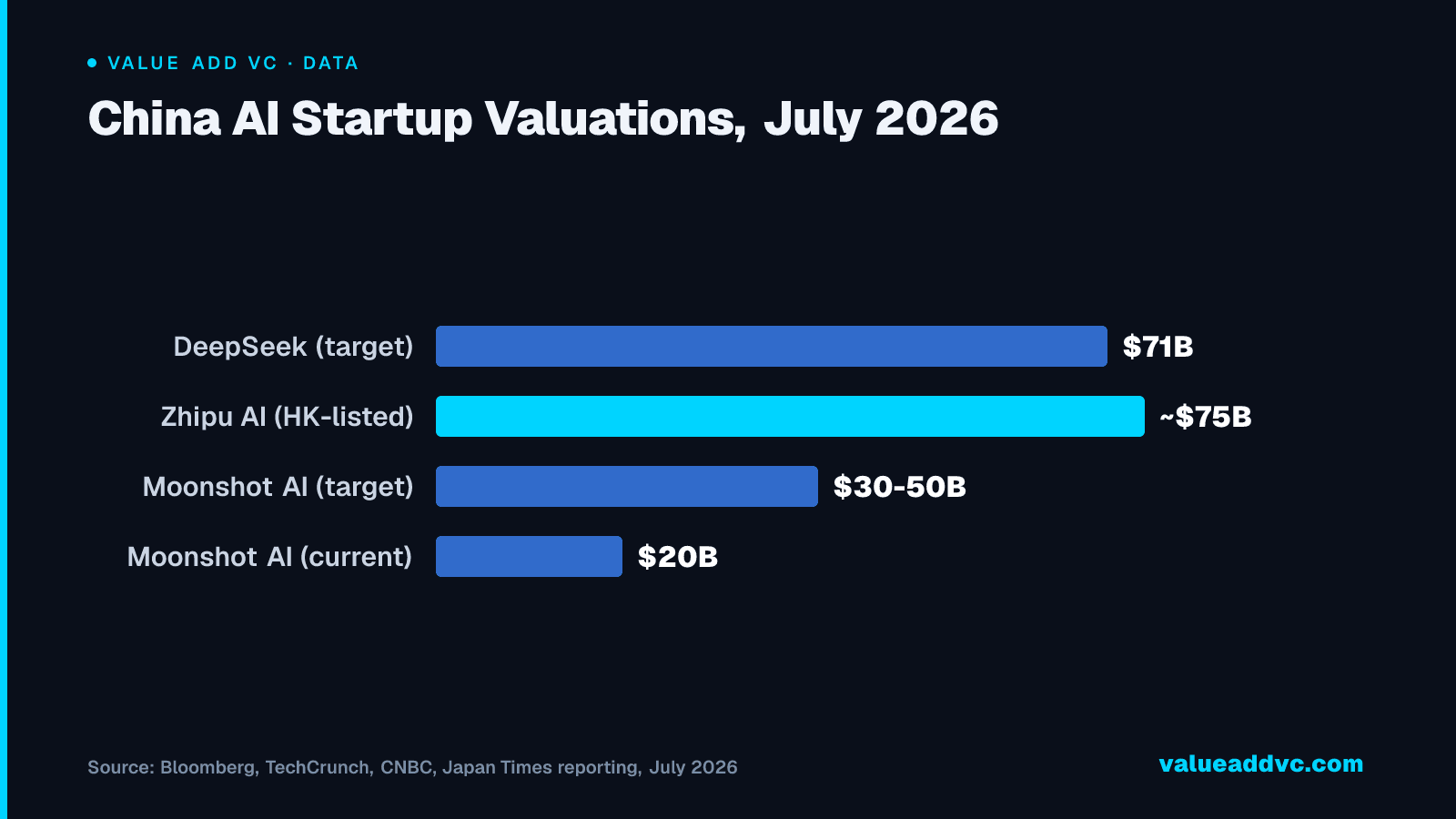
China AI Startup Valuations, July 2026
DeepSeek's $71B target puts it roughly in line with Hong Kong-listed Zhipu AI and nearly double Moonshot AI's current $20B mark — though Moonshot is chasing a $30-50B pre-IPO round of its own.
Bloomberg, TechCrunch, CNBC, Japan Times reporting, July 2026
Data
| Item | Value |
|---|---|
| DeepSeek (target) | $71B |
| Zhipu AI (HK-listed) | ~$75B |
| Moonshot AI (target) | $30-50B |
| Moonshot AI (current) | $20B |
DeepSeek Revenue in 2026: How the Business Actually Makes Money
DeepSeek's annualized revenue run rate sits at an estimated $400-500 million as of mid-2026 — roughly double its 2025 run rate — though estimates vary; one industry tracker put DeepSeek's 2026 revenue crossing $1.1 billion, a gap that reflects how murky private Chinese AI-company financials remain ahead of an IPO filing. What's consistent across sources is the shift in revenue mix: R2's agent-monetization push is layered on top of DeepSeek's original API-access business, which itself scaled off the low-cost model architecture that made R1's January 2025 launch a genuine market shock.
At a $71 billion target valuation against a $400-500 million run rate, DeepSeek is trading at roughly 140-175x current annualized revenue — an aggressive multiple, though not out of step with the broader 2026 AI-lab repricing wave we've tracked across OpenAI and Anthropic on our AI valuations dashboard. The bet, as with those two companies, is that revenue triples or quadruples well before any IPO prices the company for public-market investors.
DeepSeek vs Zhipu AI vs Moonshot AI: The China AI IPO Race
DeepSeek isn't racing toward an IPO alone. Zhipu AI already listed in Hong Kong as Knowledge Atlas Technology and now carries a market cap in the $70-80 billion range, giving investors a live public comparable for how the market prices a Chinese frontier-model company once it's actually trading. Moonshot AI is earlier in the cycle — it raised $2 billion at a $20 billion valuation in a Meituan-led round in May 2026, more than quadrupling its $4.3 billion valuation from late 2025, and is now negotiating a final pre-IPO round targeting $30-50 billion.
Combined, the four largest independent Chinese AI companies — DeepSeek, Zhipu, Moonshot, and MiniMax — carry valuations exceeding 1 trillion yuan, or roughly $140 billion, as of early 2026. That's a meaningful domestic AI ecosystem forming almost entirely outside the OpenAI-Anthropic-xAI axis that dominates US headlines, and it's being built with heavy state-fund participation rather than pure venture capital.
The sequencing matters too. Zhipu went public first and is now the reference point every other Chinese AI IPO gets measured against, which is exactly why DeepSeek and Moonshot are both racing to lock in growth-stage capital before their own listings — a later filer with a worse growth story than Zhipu's live trading multiple risks a down-round IPO, something none of these three companies can afford given how much state and strategic capital is already embedded in their cap tables.
DeepSeek Valuation Timeline: June 2026 vs July 2026
Bloomberg, TechCrunch reporting, July 2026
Data
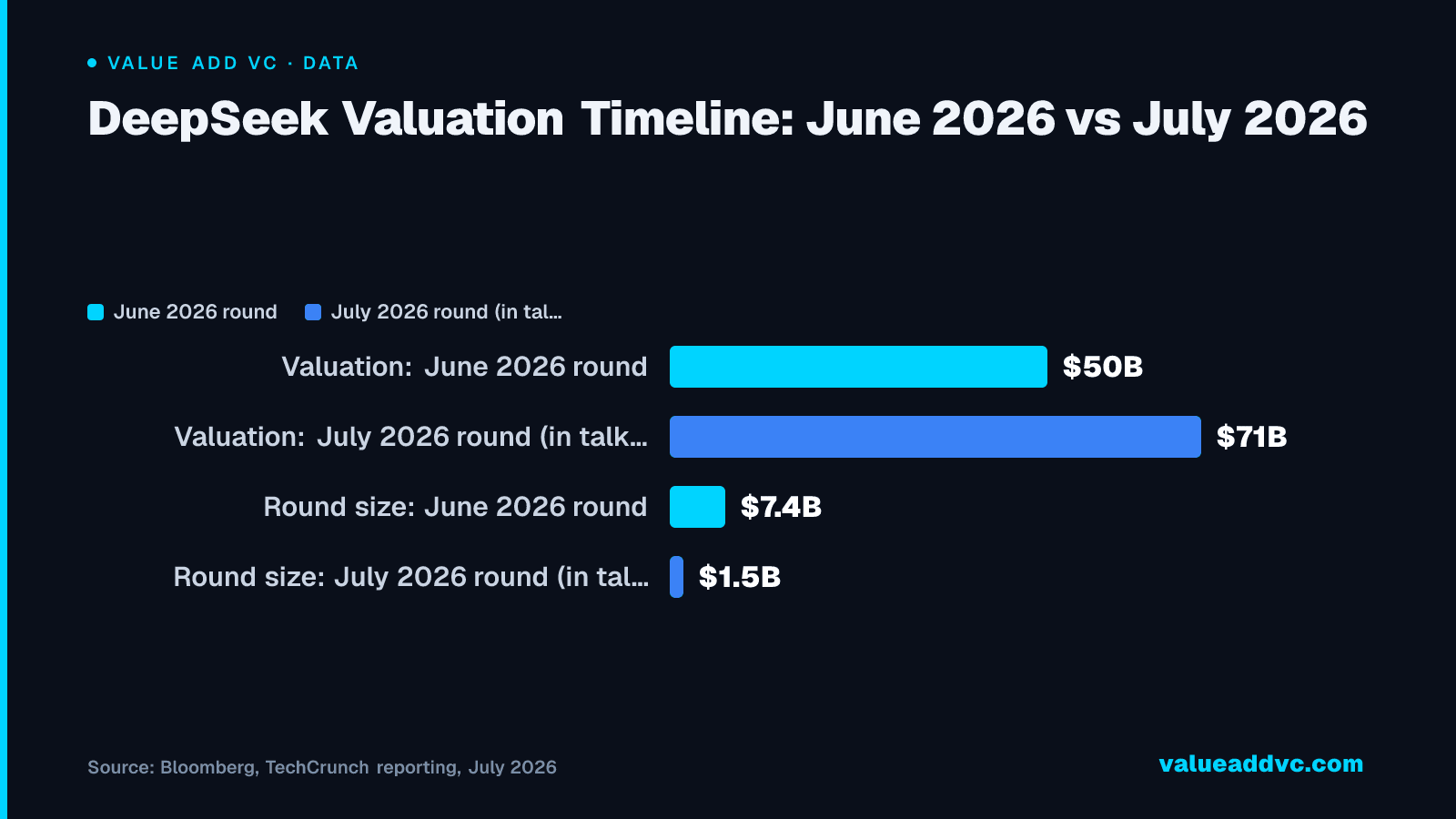
The July round is smaller in dollar terms but priced at a higher valuation — a sign investors are paying up for a smaller, more selective allocation ahead of DeepSeek's IPO.
Bottom line: DeepSeek's jump from a $50 billion valuation to a targeted $71 billion in about a month is less about a single breakthrough and more about scarcity — it's the most investable pre-IPO AI company in China, backed by Tencent and state capital, growing enterprise revenue toward $500 million annualized, and heading toward a 2027 mainland listing that will give public investors their first real read on how the market prices a DeepSeek-scale AI business next to Zhipu AI's live $70-80 billion trading comp. Watch the actual IPO filing, expected late 2026 or early 2027, for the audited numbers that finally settle the $400 million-to-$1.1 billion revenue question.
Latest from the Pulse
Get VC data most people never see
— free to subscribe
Trace's notes on venture, AI and startups, a few times a week. Join 5,000+ subscribers. No spam.
No spam, unsubscribe anytime. Sent via Substack · Privacy · or subscribe on Substack ↗