Alphabet will spend up to $205 billion on AI infrastructure in 2026, and it has never told investors how that number splits between its own Tensor Processing Units and the Nvidia GPUs it still buys.
That's not a gap in reporting so much as a genuinely hard number to isolate — capex line items don't come pre-sorted by chip vendor. This piece walks through every real, sourced proxy that exists for the split: how much AI compute capacity Google actually owns by chip type, how fast its TPU production is actually running, what Google's own chip-manufacturing partner is disclosing, and what Nvidia's customer-concentration filings imply. None of them is a clean answer on its own. Together they're the closest thing to one that currently exists.
Google TPU vs Nvidia Capex: How Much Goes to Each in 2026?
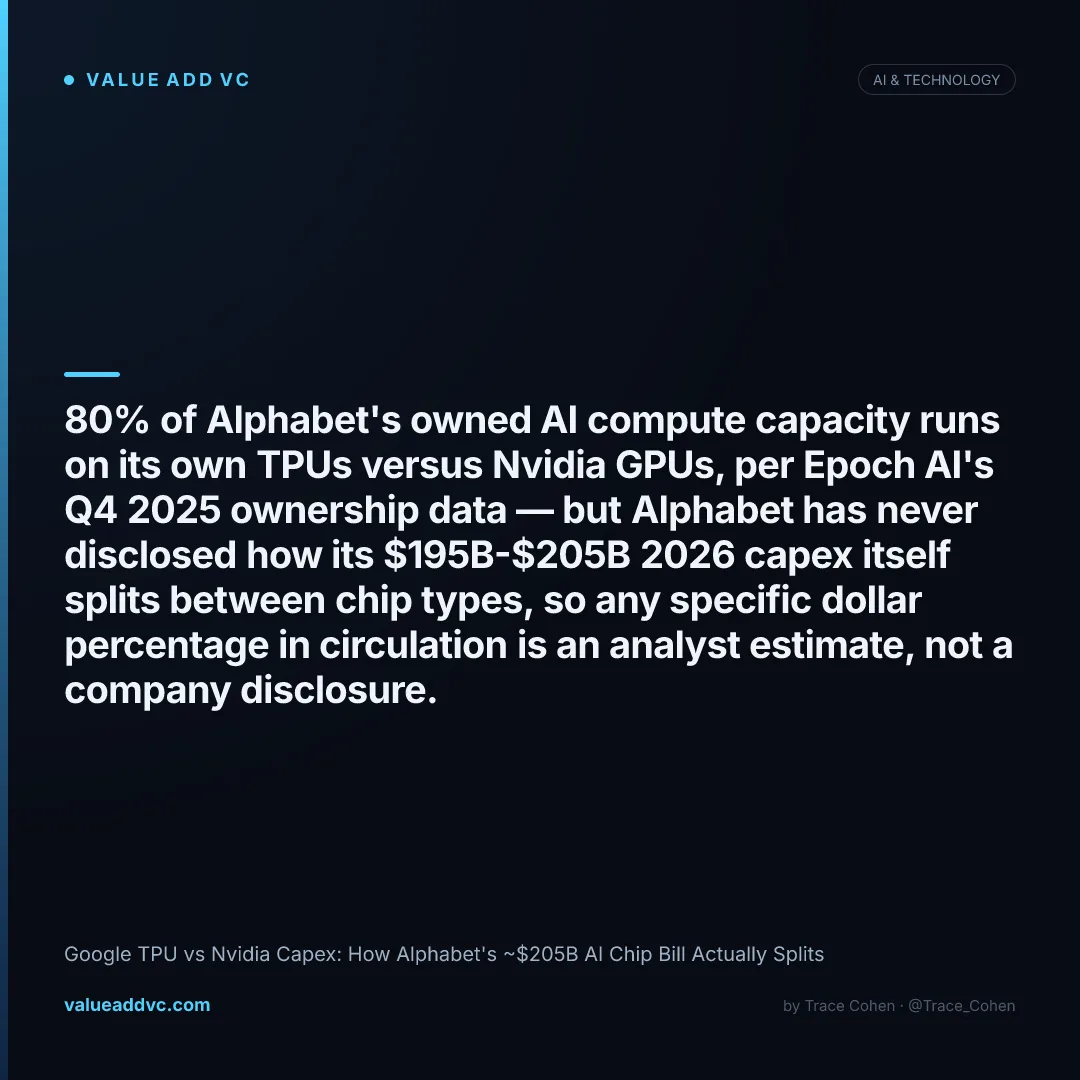
Alphabet doesn't publish a TPU-versus-Nvidia breakdown of its 2026 capex, and no clean percentage exists in its filings. The closest verified proxy is Epoch AI's compute-capacity estimate: of the roughly 5 million Nvidia-H100-equivalents Google owns, about 4 million run on its own TPUs and roughly 1 million on Nvidia GPUs — a capacity mix, not a capex-dollar mix.
The distinction matters because capacity and capex dollars aren't interchangeable. TPUs are compute Google has accumulated over roughly a decade of in-house chip generations; 2026 capex is a single year's spending flow that includes buildings, networking, and power infrastructure alongside chips. A capacity snapshot can be TPU-heavy even in a year where Google buys a disproportionate share of its new silicon from Nvidia to plug a supply gap — which, per Alphabet's own Q2 2026 comments, is close to what's actually happening.
What Alphabet Actually Discloses About Its Chip Spending
On its July 22, 2026 earnings call, Alphabet raised full-year 2026 capex guidance to $195 billion-$205 billion, up from $180 billion-$190 billion set just one quarter earlier. Q2 2026 capex alone came in at $44.9 billion, split roughly 60% servers and 40% data centers and networking — a category breakdown, not a chip-vendor one. Management's only forward-looking chip comment of note: it plans to expand use of third-party compute capacity in Q3 2026 as a bridging strategy while it builds out more internal TPU capacity, which is Alphabet's own admission that TPU supply alone isn't covering demand.
| Disclosed Figure | Value | What's Missing |
|---|---|---|
| FY2026 capex guidance | $195B-$205B | no chip-type breakdown |
| Q2 2026 actual capex | $44.9B | server vs. DC split only, not vendor |
| Q2 2026 infra mix | 60% servers / 40% DC & networking | servers not split TPU vs Nvidia |
| Q3 2026 bridging strategy | expand third-party capacity | no dollar figure given |
| TPU external sale revenue (2026) | small portion recognized | vast majority pushed to 2027 |
| FY2025 actual capex | $91.4B (per company) | no historical chip split either |
Alphabet Q2 2026 earnings call, reported by CNBC, July 22, 2026. FY2025 capex per Alphabet's own year-over-year comparison disclosed the same call.
The Only Real Proxy We Have: Compute Capacity, Not Capex Dollars
Epoch AI's research, published April 7, 2026 using Q4 2025 data, estimated Google as the largest single owner of AI compute in the world — about a quarter of global cumulative capacity, ahead of Microsoft and Amazon, according to Epoch AI's ownership model. Of Google's roughly 5 million Nvidia-H100-equivalents, Epoch AI puts the TPU-only share at 3.1 million to 4.5 million H100-equivalents, a range that centers on close to 80% of Google's total owned compute. That implies the remaining fifth, call it roughly 1 million H100-equivalents, runs on Nvidia silicon.
Two caveats matter here. First, this is a stock of accumulated hardware, not a 2026 spending flow — Google's TPU lead reflects roughly a decade of custom-silicon investment starting with TPU v1 in 2015, not this year's capex alone. Second, Epoch AI's own confidence interval (3.1M-4.5M H100e for TPUs) is wide enough that the true split could run anywhere from roughly 70/30 to 90/10 in TPU's favor. Nobody, including Epoch AI, claims precision down to the percentage point.
How Fast Google Is Actually Building TPUs
If capacity ownership is one proxy, production volume is another — and it's moving in a direction that argues against a widening TPU lead in the near term. SemiAnalysis cut its 2026 production forecast for TPU v7 ("Ironwood") from 3.2 million units to 2.7 million units in an August 2026 revision reported by BigGo Finance, attributing the roughly 500,000-unit cut to CoWoS-S advanced-packaging capacity constraints at Google's foundry partners, not to weaker demand.
The same supply constraint is why external demand for TPUs is already outrunning what Google can build. Anthropic has committed to deploying more than 1 million Ironwood chips starting in 2026, a commitment Google announced at Cloud Next in April 2026. Morgan Stanley analyst Brian Nowak's August 2026 note pegs that specific commitment at roughly $35 billion, implying an average system price north of $30,000 per TPU once packaging, networking, and cooling are bundled in — useful context for how expensive "just build more TPUs" actually is even when the packaging bottleneck eases.
Why Google Still Needs Nvidia GPUs at All
Gemini 3 Pro is widely reported to be the first frontier-class Google model trained entirely on TPUs rather than a mixed fleet that includes Nvidia hardware — a genuine milestone, and one Google has used to argue its infrastructure is insulated from the GPU supply constraints shaping capacity planning at OpenAI and Anthropic. But "trained on TPUs" and "capex-independent of Nvidia" are not the same claim. Google Cloud still sells Nvidia GPU instances to external customers who specifically want them, and Alphabet's own Q3 2026 bridging-capacity comment shows internal reliance on non-TPU compute hasn't gone to zero either.
Relative Cost per Useful Training FLOP: TPU v7 vs Nvidia GB300 NVL72 (Indexed)
SemiAnalysis newsletter analysis of Anthropic's tuned-kernel benchmarks, 2026 (GB300 NVL72 = 100).
Anthropic reportedly achieves roughly half the cost per useful training FLOP on tuned TPU v7 clusters versus a comparable GB300 NVL72 Nvidia system, per SemiAnalysis's TPU v7 analysis — one reason Google keeps investing in TPU capacity even where Nvidia GPUs remain available.
On the Nvidia side, the company's own SEC disclosures show revenue concentrated among a small number of unnamed buyers: two "direct customers" combined for roughly 39% of a recent quarterly total (23% and 16% individually), according to filings reported by DataCenterDynamics and corroborated by Tom's Hardware, which found three unnamed customers accounted for over 50% of a separate quarter's data-center revenue ($21.9 billion combined). Nvidia does not name Customer A, B, or C in its filings, and a company spokesperson has declined to confirm identities publicly. Reporters and analysts widely believe the concentrated buyers include some combination of Amazon, Microsoft, Google, and Meta — but that is an inference from circumstantial evidence (the big four's disclosed capex scale roughly matches the concentration Nvidia reports), not a confirmed fact, and this piece is not asserting Google is definitively one of Nvidia's largest named customers.
Broadcom's Numbers Are the Closest Thing to a Google TPU Spend Tracker
Broadcom has co-designed Google's TPUs since 2014, across seven chip generations, and its earnings are the most granular public window into how fast the TPU program is scaling in dollar terms — with a major caveat. Broadcom's fiscal Q3 2026 AI semiconductor revenue hit $16.7 billion, up 221% year-over-year and 54% quarter-over-quarter, CEO Hock Tan said on the company's September 2, 2026 earnings call, with Q4 guidance of $21.7 billion (up 236% year-over-year). Tan also said Broadcom is targeting $115 billion in AI chip revenue for fiscal 2027, doubling again to $230 billion in fiscal 2028.
The caveat: that revenue spans Broadcom's full custom-silicon customer list, reportedly including Google, Meta, and OpenAI, not Google's TPU program alone. Broadcom doesn't break out Google's specific share. Still, Google is Broadcom's oldest and largest custom-ASIC customer by tenure, so Broadcom's overall AI trajectory is a reasonable, if imprecise, directional signal for how aggressively Google is scaling TPU manufacturing spend — a spend that flows through Broadcom's income statement before it ever shows up as a line in Alphabet's own capex disclosures.
The $200 Billion Number That's Not About Capex
A Morgan Stanley note from analyst Brian Nowak in August 2026 modeled Google generating close to $200 billion in TPU system-sales revenue across 2027 and 2028 combined — reported by Yahoo Finance, the model specifically projects $84.3 billion in 2027 (on 3.2 gigawatts of TPU system sales) and $108.3 billion in 2028 (on 4.2 gigawatts), plus roughly $8.1 billion in the second half of 2026 alone. Nowak raised his per-gigawatt revenue assumption from about $20 billion to $27 billion and his gross-margin assumption from 20% to 30%, and maintained a Buy rating with a $400 price target.
That $200 billion figure gets cited constantly in the same breath as Alphabet's $205 billion capex guidance, and the two numbers sound almost identical — which is exactly the trap. One is money Google would spend building infrastructure (capex); the other is money Google would collect by selling TPU hardware to outside buyers like Anthropic (system-sales revenue). They sit on opposite sides of the ledger and cover different years. Treating them as the same "$200B-ish TPU number" is the single most common error in how this story gets summarized.
Every Public Data Point on Google's Chip Spend, Side by Side
No single row below answers "how much goes to Nvidia." Read together, they bound the question about as tightly as public information currently allows.
| Metric | Figure | What It Actually Measures |
|---|---|---|
| Google's owned AI compute (TPU + Nvidia) | ~5M H100e | Capacity stock, Q4 2025 — Epoch AI |
| Of that, TPU-only share | 3.1M-4.5M H100e (~80%) | Capacity, not capex dollars |
| 2026 TPU v7 production forecast | 2.7M units (cut from 3.2M) | Manufacturing volume — SemiAnalysis |
| Anthropic's TPU commitment | ~1M chips, ~$35B | One external buyer's contract value |
| Morgan Stanley TPU system-sales model | ~$192.6B, 2027-2028 | Revenue Google could collect, not spend |
| Nvidia unnamed customer concentration | ~39% of one recent quarter (2 buyers) | Nvidia-side; buyers not officially named |
| Broadcom AI semiconductor revenue, Q3 FY2026 | $16.7B (+221% YoY) | Spans Google, Meta, OpenAI combined |
| Alphabet 2026 capex guidance | $195B-$205B | Total capex; no chip-vendor split given |
Sources: Epoch AI (Apr 2026), SemiAnalysis via BigGo Finance (Aug 2026), Morgan Stanley via Yahoo Finance (Aug 2026), DataCenterDynamics and Tom's Hardware (Nvidia customer concentration), CNBC (Alphabet and Broadcom earnings calls, 2026).
Where the headline misses
Every version of "Google spends X% on TPUs vs Nvidia" that circulates online is quietly borrowing a number that measures something else — compute capacity Google has accumulated over a decade, TPU manufacturing volume, an external sales forecast, or Nvidia's own customer concentration — and presenting it as if it were a clean 2026 capex split. It isn't. Alphabet has had every opportunity to disclose that split on four consecutive earnings calls this year and has chosen not to, which is itself informative: a company happy to volunteer a 60/40 servers-versus-data-centers breakdown but silent on chip vendor either doesn't track the number cleanly (custom silicon and third-party GPU purchases likely run through different internal cost categories) or has a competitive reason to withhold it from both Nvidia and its own TPU customers.
The counterweight to the "TPUs are winning" framing this whole piece leans toward: Google is still capacity-constrained enough on TPUs that it explicitly told investors it would lean on third-party compute in Q3 2026, and SemiAnalysis's downward production revision means that constraint got tighter, not looser, over the course of the year. A company confident it had fully solved its own silicon supply wouldn't need a bridging strategy at all.
The Bottom Line on Google's Chip Spending Mix
The most defensible statement available today: Google's owned AI compute capacity leans roughly 80/20 toward its own TPUs over Nvidia GPUs, per Epoch AI, but that ratio describes accumulated hardware, not the 2026 capex flow, and Alphabet's own commentary about leaning on third-party capacity this year suggests the marginal dollar may be less TPU-skewed than the installed base. For the full picture of what's driving the $205 billion guidance itself — the Cloud backlog, the quarter-over-quarter raises, and how Alphabet stacks up against Amazon, Microsoft, and Meta — see our breakdown of Alphabet's $205B AI capex guidance.
For investors and founders pricing AI infrastructure exposure, the practical read is that "Google doesn't need Nvidia anymore" is an overstatement of what the public data actually shows. Google needs Nvidia less than Amazon or Microsoft does on a like-for-like basis, thanks to a decade-long TPU head start — but it still needed enough Nvidia-adjacent third-party capacity in Q3 2026 to say so on an earnings call, and Broadcom's own AI backlog growth suggests the TPU program itself is still capital-intensive rather than a cost-saving alternative that's fully displaced GPU spend. Track how this compares across the other hyperscalers on the Big Tech Earnings dashboard.
See the full picture on Alphabet's $205B 2026 capex guidance, or how the hyperscalers' custom-silicon strategies compare in our custom AI chips breakdown. Track live data on the AI Spending Tracker and Big Tech Earnings tracker at Value Add VC.
Latest from the Pulse
Get VC data most people never see
— 100% free
Weekly benchmarks, valuations, and fund data. Join 5,000+ investors. No spam.