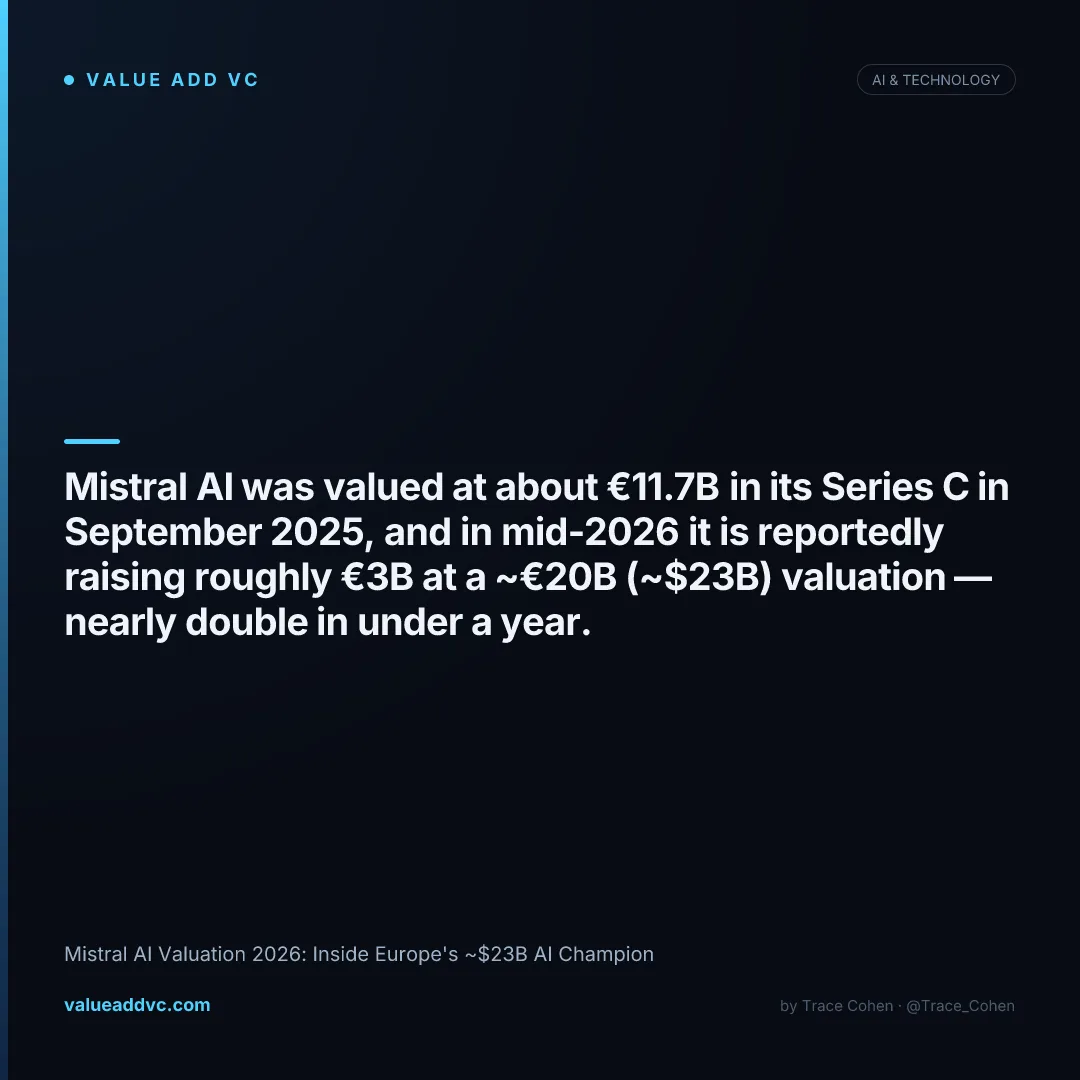
Mistral AI raised at €11.7B in September 2025 and is reportedly raising ~€3B at ~€20B (~$23B) in mid-2026 — nearly double — with ARR run-rate past $400M, a $1B target by year-end, and 13,800 Nvidia chips on order for a Paris data center.
The numbers only tell half of it, because Mistral carries a continent's ambitions. It's Europe's answer to OpenAI and Anthropic — built on open weights, sovereignty, and the bet that a smaller, leaner lab can stay on the frontier against rivals spending an order of magnitude more on compute.
Mistral Valuation 2026: The Headline Numbers
Mistral's reported ~€20B (~$23B) round in mid-2026 would nearly double its €11.7B Series C mark from September 2025 — a remarkable re-rating that puts it among the most valuable private AI companies outside the United States. See the company profile on the Mistral AI page.
Series C (Sep 2025)
€11.7B
prior valuation
2026 round (reported)
~€20B
~$23B, raising ~€3B
ARR run-rate
$400M+
2025
ARR target
$1B+
end of 2026
Figures per reported funding disclosures, 2025–2026. The ~€20B / ~€3B round is reported and not yet finalized.
How Mistral Became Europe's AI Champion
Mistral's rise has been fast and deliberate. Founded by ex-DeepMind and Meta researchers, it positioned itself from day one as Europe's sovereign alternative to US labs — open-weight models, a European base, and a pitch built around data control and regional independence. By its September 2025 Series C, it had reached €11.7B; the reported mid-2026 round would push it to ~€20B. On raw download volume, though, Mistral still trails the Chinese open-weight labs by a wide margin — see the full 2026 open-weight model download rankings for how every major lab compares.
| Event | Date | Detail |
|---|---|---|
| Series C | Sep 2025 | €11.7B valuation |
| Debt for compute | Mar 2026 | $830M / ~13,800 Nvidia chips |
| Reported new round | Mid-2026 | ~€3B at ~€20B (~$23B) |
The March 2026 debt raise is the tell. Taking on $830M to buy roughly 13,800 Nvidia chips for a Paris data center signals a company determined to control its own compute — and willing to use leverage rather than dilution to get there. Track the broader chip-and-compute spend on the AI Spending dashboard.
How Mistral Makes Money
Mistral monetizes a family of open-weight models — including Mistral Large — plus its Le Chat assistant, through a model that leans heavily on enterprise and sovereign customers rather than pure consumer subscriptions. A closer look at how Le Chat stacks up against ChatGPT and Claude shows why that consumer product still matters for enterprise top-of-funnel.
- Enterprise deployments: companies run Mistral models on their own infrastructure or in regional clouds — the core of its revenue.
- Sovereign & on-prem deals: governments and regulated industries that need data residency and control are a natural fit for an open-weight European lab.
- Le Chat & API: its assistant and API access provide additional revenue and a top-of-funnel for enterprise adoption.
That mix took ARR run-rate past $400M in 2025, with the company targeting more than $1B by the end of 2026. The open-weight approach is both the differentiator and the monetization puzzle — giving away the weights builds adoption but complicates capturing the value.
The Bull Case for Mistral
The bull case rests on a structural truth: Europe wants — and arguably needs — its own AI champion, and Mistral is the only credible candidate at frontier scale.
- Sovereignty tailwind: European governments and enterprises actively prefer a regional lab for data control and regulatory alignment.
- Open-weight adoption: open models drive developer mindshare and enterprise trials that proprietary labs can't match.
- Revenue momentum: a $400M+ run-rate climbing toward a $1B target shows real commercial traction, not just research prestige.
- Capital efficiency: Mistral has historically done more with less compute — if that holds, its economics could be far healthier than the burn-heavy US labs.
The Bear Case and Risks
The bear case is the compute gap. Mistral's rivals are spending tens of billions on infrastructure; even with a $830M debt raise and 13,800 chips, Mistral's budget is a fraction of OpenAI's or Anthropic's.
- Compute disadvantage: staying on the frontier costs more every cycle; a smaller budget risks falling behind on raw capability.
- Open-weight monetization: if competitors and customers can self-host open models, capturing durable revenue is harder.
- US scale: OpenAI, Anthropic, Google, and Meta have larger distribution, deeper pockets, and faster model cadences.
- Debt risk: financing compute with debt adds fixed obligations that a slower-growth scenario would strain.
Mistral's Competitive Landscape
Mistral competes on two fronts at once — frontier models against the giants, and enterprise/sovereign AI against more specialized rivals.
- OpenAI: the revenue and capability leader — see OpenAI's revenue breakdown.
- Anthropic: the enterprise-focused safety lab, a direct competitor for serious business deployments.
- Meta (Llama): the dominant open-weight model, giving away capability at massive scale.
- Google: Gemini, bundled across the world's largest software footprint.
- Cohere: the other enterprise-and-sovereign specialist — compare on the Cohere valuation breakdown.
Compare valuations and revenue across the field on the AI Valuations dashboard.
Will Mistral IPO? What to Watch
A Mistral IPO would be a landmark moment for European tech — but the company is still in heavy build-out mode, raising private capital and debt to fund compute. The numbers to watch:
- $1B ARR target: hitting it by end of 2026 would validate the enterprise-and-sovereign model.
- The ~€20B round: closing it confirms the re-rating; a smaller mark would signal investor caution on the compute gap.
- Paris data center: bringing 13,800 chips online is the test of whether Mistral can self-supply enough compute to stay competitive.
- Model cadence: the speed and quality of new open-weight releases versus US labs.
Track Mistral in the AI IPO pipeline and against peers like Perplexity.
Explore Related Dashboards
Interactive tools with live data on this topic
Track Mistral, OpenAI, Anthropic, Cohere, and the rest of the AI valuation race on the AI Valuations Dashboard and the AI Spending Dashboard at Value Add VC. Originally published in the Trace Cohen newsletter.
Latest from the Pulse
Get VC data most people never see
— 100% free
Weekly benchmarks, valuations, and fund data. Join 5,000+ investors. No spam.