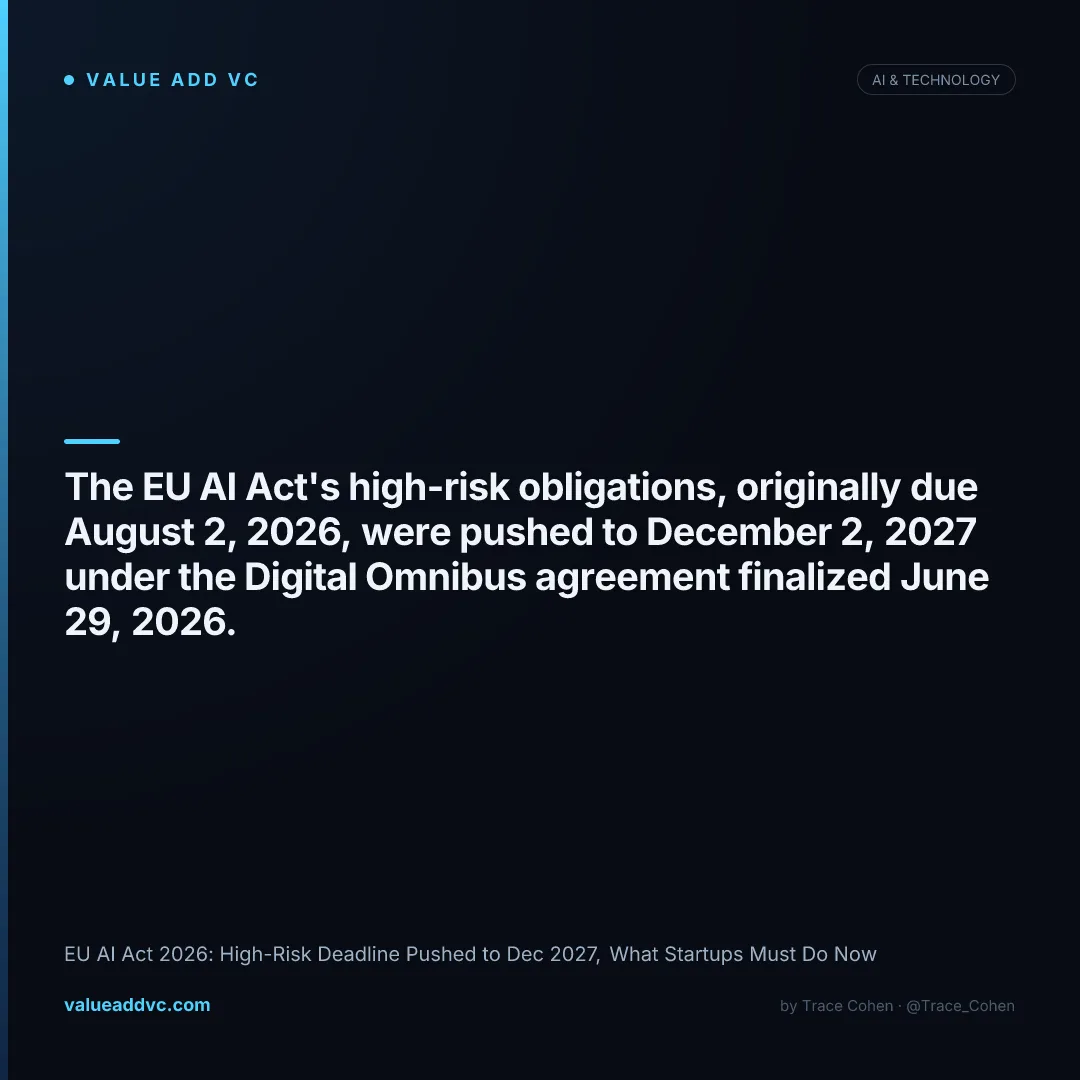
The EU AI Act's high-risk compliance deadline, originally August 2, 2026, was pushed to December 2, 2027 — a 16-month delay finalized on June 29, 2026 under the EU's Digital Omnibus. What the delay does and doesn't buy a startup is the part that matters.
I talk to founders building in Europe regularly, and for the past year the EU AI Act has been the single biggest compliance line item on their minds — bigger than GDPR ever was for most SaaS companies. The law didn't get repealed and it didn't get gutted. But it did just get restructured in a way that changes what a startup building in Europe actually needs to do between now and 2028. Here's the real timeline, the real fines, and the real cost data.
What the EU AI Act Means for Startups Building in Europe in 2026
For startups building in Europe in 2026, the EU AI Act means three things happening at once: prohibited-practice bans and general-purpose AI (GPAI) model obligations are already enforceable, high-risk system obligations were just delayed to December 2, 2027, and fines for the rules that are live can reach €35 million or 7% of global turnover. The practical effect is that most early-stage startups building chatbots, copilots, or narrow vertical AI tools got real breathing room, while any startup building in employment, credit, healthcare, or law enforcement AI still needs to plan for a hard deadline just 17 months away.
The Act entered into force on August 1, 2024. Prohibited practices — manipulative AI, social scoring, unauthorized biometric categorization — became enforceable February 2, 2025. GPAI provider obligations, covering technical documentation, transparency, and systemic-risk mitigation for models like GPT, Gemini, and Claude, became enforceable August 2, 2025. It was the third wave, high-risk system obligations under Annex III (employment, credit scoring, education, law enforcement, migration), that just moved from August 2026 to December 2027.
The AI Act isn't the only EU tech law with teeth in 2026 — the Digital Markets Act is running its own enforcement track, most visibly with the €890 million fine Brussels issued against Google in July 2026, a reminder that gatekeeper platforms startups build on top of face their own regulatory clock.
The EU AI Act Timeline: What's Already Live vs. What Just Got Delayed
The Digital Omnibus agreement — negotiated provisionally on May 7, 2026, endorsed by the European Parliament on June 16, 2026, and given final Council sign-off on June 29, 2026 — is the first substantive amendment to the AI Act since it was adopted in 2024. It doesn't touch the parts of the law already in force. It specifically defers the parts that regulators concluded companies couldn't realistically comply with yet, because the harmonized technical standards from CEN-CENELEC that the conformity assessments depend on aren't finished.
| Obligation | Original Date | Current Status (July 2026) | New Date |
|---|---|---|---|
| Prohibited AI practices (social scoring, manipulation) | Feb 2, 2025 | Live, enforced | No change |
| GPAI model provider obligations | Aug 2, 2025 | Live, enforced | No change |
| GPAI models placed pre-Aug 2025 must comply | Aug 2, 2026 | Delayed | Aug 2, 2027 |
| Annex III high-risk systems (employment, credit, education) | Aug 2, 2026 | Delayed via Omnibus | Dec 2, 2027 |
| Member State regulatory sandbox requirement | Aug 2, 2026 | Delayed | Aug 2, 2027 |
| Annex I high-risk systems (medical devices, lifts, radio equip.) | Aug 2, 2027 | Delayed via Omnibus | Aug 2, 2028 |
| Full Act, all remaining provisions | Aug 2, 2027 | On track | No change |
Figures are 2026 estimates blended from the European Council's June 29, 2026 press release, DLA Piper's Digital AI Omnibus analysis, Gibson Dunn, and White & Case coverage of the Digital Omnibus agreement. Dates reflect the provisional agreement as formally adopted; the legislative text enters into force on the third day after Official Journal publication.
EU AI Act Fines in 2026: The Numbers That Actually Matter to a Startup
The fine structure hasn't changed under the Omnibus, and it's the part founders most consistently underestimate. Prohibited practices carry fines up to €35 million or 7% of total worldwide annual turnover, whichever is higher — a percentage-of-revenue structure modeled directly on GDPR's Article 83. High-risk system violations top out at €15 million or 3% of turnover, and providing incorrect or misleading information to regulators can cost up to €7.5 million or 1% of turnover. SMEs and startups get the lower of the fixed euro amount or the percentage figure, which sounds like relief until you realize €7.5 million is still enough to end most seed and Series A companies outright.
What the EU AI Act Compliance Delay Actually Costs Startups
The delay buys time, but it doesn't make compliance cheap once the December 2027 deadline arrives — and startups already building toward the old date are spending real money now. A medium-sized company with 100 to 250 employees faces initial Quality Management System setup costs of €193,000 to €330,000, plus €71,400 to €150,000 annually in ongoing monitoring and conformity assessment costs, according to 2026 compliance cost surveys. The average initial compliance cost per individual high-risk system exceeds €50,000 before any ongoing monitoring is added. For a startup running two or three high-risk-adjacent products, that's €150,000+ in upfront cost alone, layered on top of legal and QMS overhead.
The downstream effect shows up in product velocity, not just budget. A 2026 industry survey found six in ten EU and UK AI startups and SMEs report delayed access to frontier AI models, and more than a third say they've had to strip or downgrade features specifically to stay compliant. That's a meaningfully different competitive position than a US startup shipping the same feature with none of that friction — which is exactly the gap the Digital Omnibus was designed to narrow.
Are Startups Actually Leaving Europe Over the AI Act?
Some, yes — though the headline numbers are more nuanced than the "EU AI Act is killing innovation" framing suggests. A 2026 CCIA Europe founder survey found 79% of tech founders reported regulatory friction over the prior year, and 24% said they were considering or had already relocated their headquarters due to AI regulation broadly, not the AI Act alone. Separately, joint research from the European Investment Bank and European Commission found roughly 10% of EU scale-ups have relocated abroad in total, with about 85% of those choosing the United States. Nearly a quarter of surveyed startups reported spending more than 30% of their total budget on compliance costs.
Read against our AI Valuations dashboard, the pattern is consistent with what we see in pricing: European AI startups building outside high-risk categories (developer tools, sales copilots, vertical SaaS) are largely unaffected by the delay and keep raising at similar multiples to US peers, while startups in regulated verticals — healthtech, fintech underwriting, HR tech — are the ones actually weighing a Delaware flip or a US-only go-to-market.
Practical Steps for Founders Building AI in Europe After the 2026 Delay
First, classify your product honestly against Annex III before assuming the delay applies to you. High-risk categories — biometric identification, critical infrastructure, education and vocational training, employment and worker management, access to essential private and public services (including credit scoring and insurance), law enforcement, migration, and administration of justice — still face a hard December 2027 deadline, and 17 months is not a long runway to build a documented risk management system, data governance framework, and CE-marking conformity assessment from scratch.
Second, if you provide or fine-tune a general-purpose model, your obligations are already live, not delayed — technical documentation, transparency disclosures, and systemic-risk mitigation for GPAI providers have applied since August 2025, and providers who placed models on the market before that date have until August 2027 to fully comply. Third, budget for compliance now rather than at the deadline: at €50,000+ per high-risk system and €193,000-€330,000 for a QMS build-out, waiting until late 2027 to start means competing with every other regulated European AI company for the same limited pool of conformity assessment bodies and compliance consultants.
Fourth, treat the regulatory sandbox delay as an opportunity, not just a postponement — Member States now have until August 2027 to stand up national sandboxes, and getting into one early gives a startup direct regulator feedback on classification questions before the deadline, rather than guessing and risking a €15 million exposure later. For portfolio companies weighing whether AI regulatory risk changes their valuation, our SaaS Valuations dashboard tracks how compliance-heavy verticals are pricing relative to unregulated categories.
€35M or 7% of global turnover in top-tier fines. A 16-month delay on high-risk rules. €50,000+ per high-risk system to comply once the new deadline lands.
The EU AI Act didn't go away in 2026 — it got a longer runway and the same teeth.
For most startups building chatbots, copilots, and vertical SaaS, the December 2027 deadline is genuinely good news. For anyone building in employment, credit, healthcare, or law enforcement AI, the clock is still running, and €50,000+ per system in compliance cost is real money to start budgeting for well before the deadline, not after it.
Track AI company pricing and regulatory-adjacent risk on the AI Valuations Dashboard and SaaS Valuations tool at Value Add VC. Originally published in the Trace Cohen newsletter.
Latest from the Pulse
Get VC data most people never see
— free to subscribe
Trace's notes on venture, AI and startups, a few times a week. Join 5,000+ subscribers. No spam.