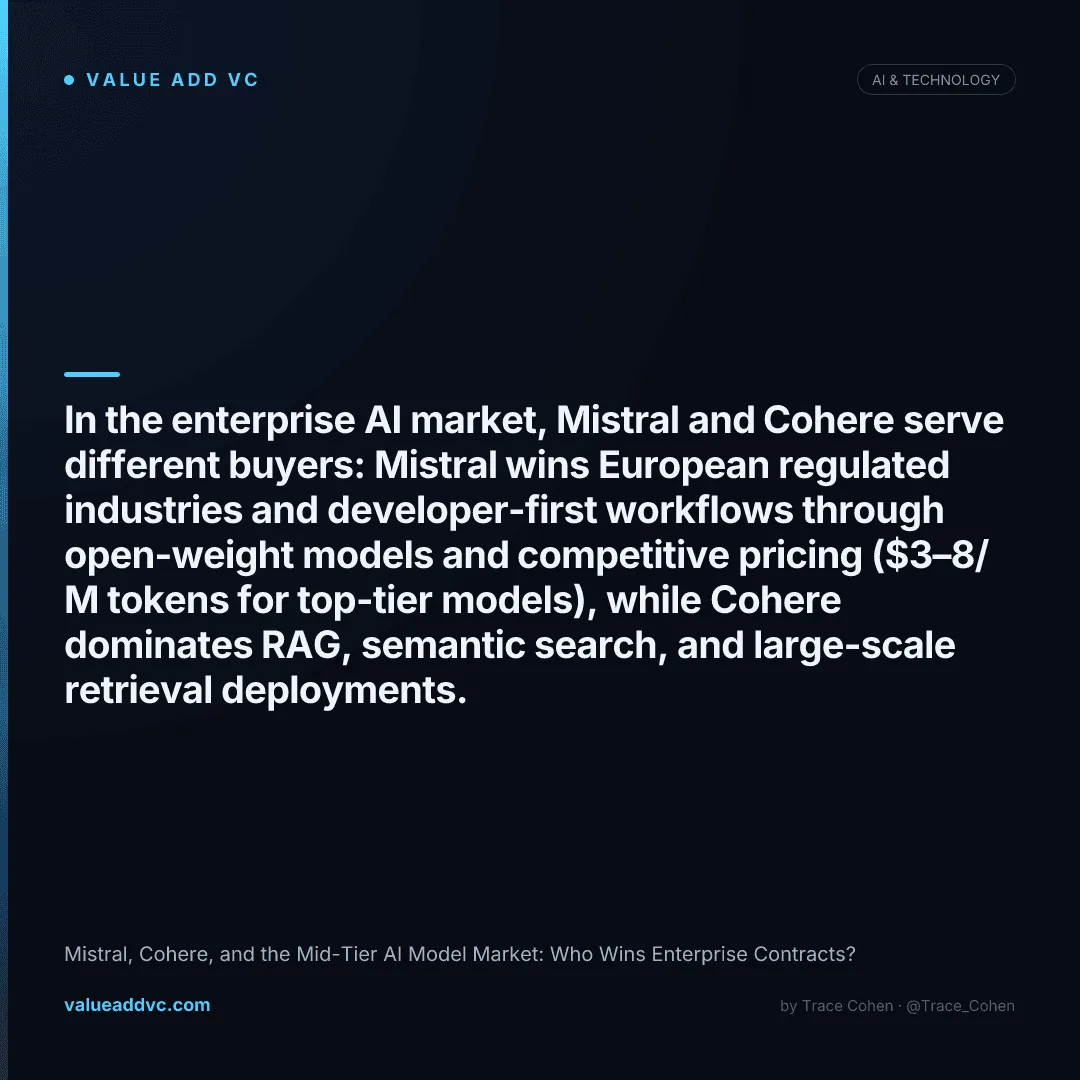
The enterprise AI market is not a single bracket. OpenAI and Anthropic dominate the tier-one conversation, but the contracts being signed at large European banks, healthcare systems, and defense contractors are not going to them.
They're going to Mistral and Cohere — and the reasons why reveal a market segmentation that most AI commentary completely misses. These are not runner-up models. They are winning where the frontier labs can't or won't compete.
What the Mid-Tier AI Model Market Actually Is
"Mid-tier" is a misleading label. Mistral Large and Cohere Command R+ are genuinely capable models that match or exceed GPT-4-era performance on specific enterprise tasks. What separates them from the frontier labs is not raw benchmark performance — it's go-to-market focus and deployment flexibility.
| Company | Founded | Last Valuation | Core Enterprise Bet | Pricing (Top Model) |
|---|---|---|---|---|
| Mistral AI | 2023 | ~$6B (2024) | Open-weight + European sovereignty | $8/M tokens (Mistral Large) |
| Cohere | 2019 | ~$5.5B (2024) | RAG, embeddings, enterprise search | $2.50/M tokens (Command R+) |
| OpenAI | 2015 | $300B (2025) | General-purpose frontier model | $15/M tokens (GPT-4) |
| Anthropic | 2021 | $61B (2025) | Safe, reasoning-heavy enterprise use | $15/M tokens (Claude Sonnet) |
Pricing is approximate API input token costs as of mid-2026. Actual enterprise contract pricing typically involves volume discounts.
Mistral vs Cohere for Enterprise AI: Different Bets Entirely
The single most important insight about these two companies is that they are almost never competing for the same contract. They have landed in distinct enterprise segments by design. On the consumer-facing side, Mistral's Le Chat assistant is its answer to ChatGPT and Claude, even as the enterprise business runs on a different playbook entirely.
Mistral AI
- →French company, built for European data residency requirements
- →Open-weight models deployable on private infrastructure
- →Microsoft Azure partnership gives enterprise distribution
- →Wins: European banks, government agencies, regulated industries
- →Best use case: instruction-following, coding, multilingual generation
Cohere
- →Canadian company, specialized in enterprise NLP infrastructure
- →On-prem, air-gapped, and private cloud deployment options
- →Oracle, Google Cloud, and AWS marketplace presence
- →Wins: large document corpora, internal knowledge search, financial data RAG
- →Best use case: retrieval-augmented generation, semantic search, embeddings
Where Mistral Cohere Enterprise AI Contracts Are Actually Landing
The enterprise AI buying cycle is not monolithic. Two distinct patterns are driving Mistral and Cohere wins, and both are structural — not cyclical.
Data sovereignty mandates
GDPR Article 46, the EU AI Act, and sector-specific regulations in banking and healthcare are forcing European enterprises to avoid US-only providers. Mistral's French domicile and open-weight models that can run on European infrastructure are a genuine competitive advantage that OpenAI and Anthropic cannot match without fundamental structural changes.
EU AI Act compliance deadline: August 2026 for high-risk systems
RAG and document intelligence at scale
Large enterprises — law firms, financial institutions, pharma companies — have millions of internal documents that represent untapped knowledge. Cohere's Embed v3 and Command R+ were built specifically for this use case: high-quality dense retrieval, low hallucination on factual grounding, and cost efficiency at tens of billions of tokens per month.
Cohere Embed v3 outperforms OpenAI text-embedding-3-large on MTEB by ~4% at lower cost
Price sensitivity in production AI
A production AI application serving 10M monthly users at GPT-4 pricing costs roughly $150K/month in inference alone. At Mistral Large pricing, that drops to ~$80K. For enterprises running AI features in their core product, this is a real P&L decision — and it favors mid-tier models that are 'good enough' at 40-50% lower cost.
~40-50% lower inference costs vs comparable frontier models
The Real Risk: Price Compression From the Top
The threat to both Mistral and Cohere is not each other — it's OpenAI and Anthropic cutting prices until the cost differential disappears. OpenAI has already dropped API pricing by over 80% since GPT-3 launched. If frontier models get cheap enough, the mid-tier value proposition evaporates for the price-sensitive segment.
But here's why that logic is incomplete. Price is only one dimension of enterprise decision-making. Data residency requirements do not go away when OpenAI gets cheaper. An EU bank cannot send customer financial data to US servers regardless of the inference cost. On-prem deployment is not just a preference — for defense contractors and national health services, it is a non-negotiable. These are structural moats that Mistral and Cohere are building.
The companies that should be nervous are the ones competing on price alone without a structural data or deployment advantage. Track the AI valuations dashboard to see how the market is pricing mid-tier AI companies relative to frontier labs.
How to Choose: Mistral vs Cohere vs Frontier Models
| Your Situation | Best Fit | Why |
|---|---|---|
| European enterprise, GDPR/AI Act compliance required | Mistral | Data residency, open-weight on-prem deployment, French jurisdiction |
| Large internal document corpus, knowledge search, RAG | Cohere | Command R+ + Embed v3 built specifically for retrieval at enterprise scale |
| General-purpose AI assistant, coding, complex reasoning | OpenAI / Anthropic | Still the quality leaders for instruction-following and reasoning tasks |
| High-volume production AI feature, cost-sensitive | Mistral (or Cohere) | 40–50% lower inference cost vs frontier; 'good enough' quality for most production tasks |
| US defense / government, air-gapped deployment | Cohere or Mistral on-prem | Both offer private deployment; Cohere has more US gov track record |
| Open-source, self-hosted, full model customization | Mistral open models | Mistral 7B and Mixtral are the best openly licensed enterprise-grade models available |
The mid-tier AI model market is not a consolation prize.
Mistral wins on geography and sovereignty. Cohere wins on retrieval infrastructure. These are durable enterprise wedges — not price discounts waiting to be competed away.
Every enterprise AI buyer in Europe and every CTO running a knowledge-intensive RAG application should be evaluating both before defaulting to OpenAI. The benchmark gap has closed. The structural advantages haven't.
Track how AI company valuations — including Mistral and Cohere — are being priced in private markets on the AI Valuations Dashboard. Originally published in the Trace Cohen newsletter.
Latest from the Pulse
Get VC data most people never see
— free to subscribe
Trace's notes on venture, AI and startups, a few times a week. Join 5,000+ subscribers. No spam.