
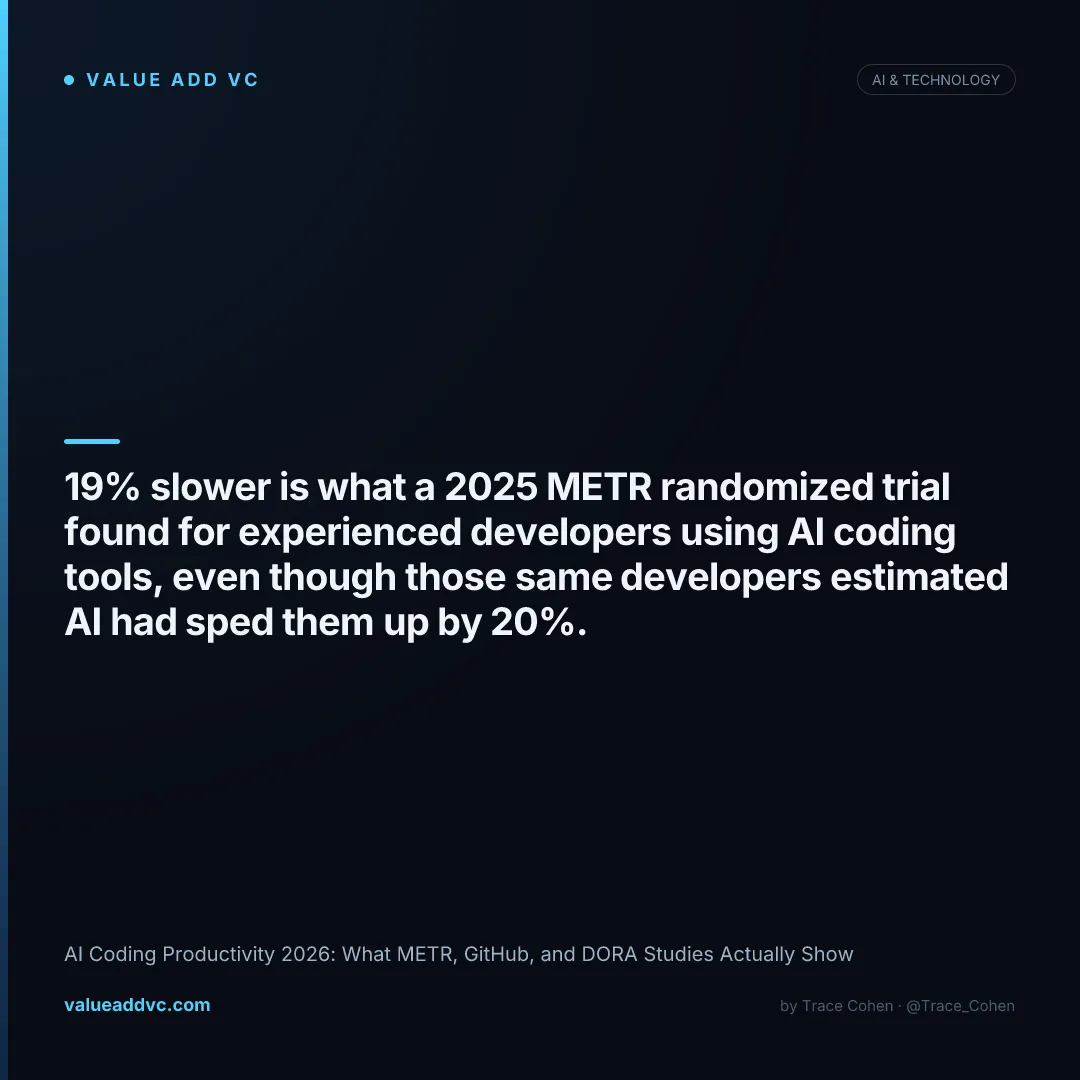
19% slower — that's what a rigorous randomized controlled trial found for experienced developers using AI coding tools on real tasks in 2025. Yet the same developers estimated AI had made them 20% faster. Both numbers are real, and understanding why they coexist is the actual AI coding productivity story in 2026.
Every few weeks a new stat gets thrown around a VC partner meeting or an engineering all-hands: "AI makes developers 55% faster," or "AI makes developers 19% slower," depending on who's presenting and what they're trying to sell. I've sat through both pitches in the same month. Neither side is lying — they're measuring different things, on different developers, doing different tasks. This post pulls together the actual study data — METR's randomized trial, GitHub's controlled experiments, Google's DORA report, and Accenture's enterprise deployment numbers — so you can see the full range instead of one cherry-picked statistic.
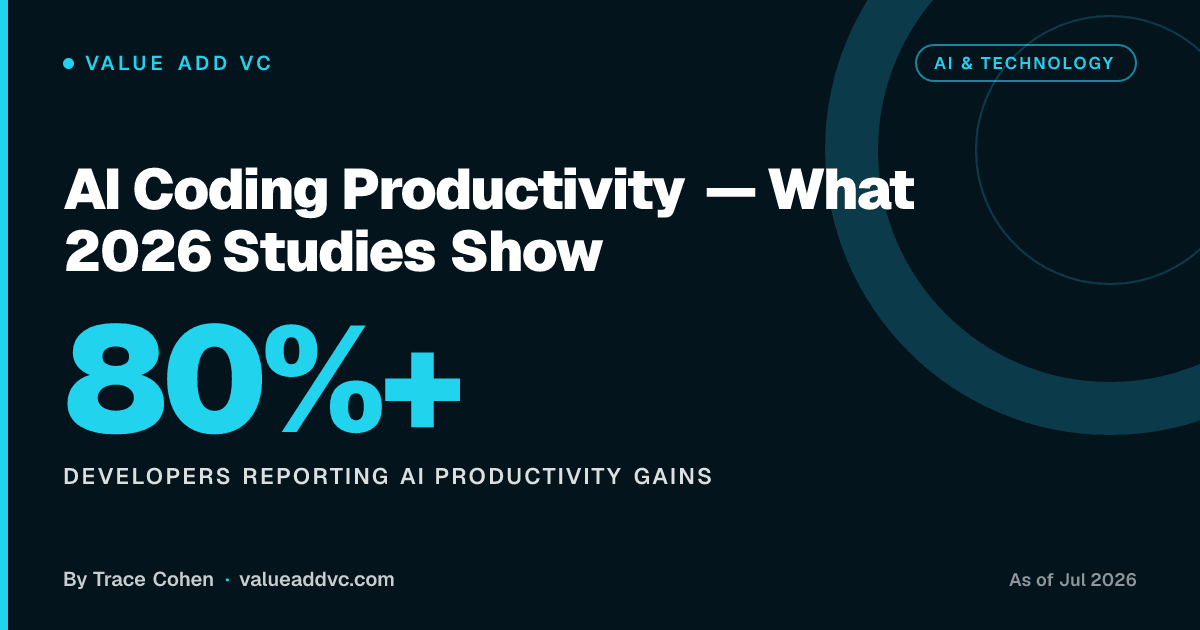
What do AI coding productivity studies actually show in 2026?
AI coding productivity studies in 2025-2026 show a wide and sometimes contradictory range of results: a 19% slowdown for experienced developers on familiar codebases (METR), a 55% speedup on a defined task with an unfamiliar codebase (GitHub), and 80%+ of developers self-reporting productivity gains in large survey data (Google's DORA report). The differences trace back to methodology — randomized controlled trials measuring actual completion time versus large-scale surveys measuring perceived improvement.
None of these numbers are wrong. They're answering different questions. "Does AI make an expert faster at a task they already know well?" and "Does AI make the average developer, on the average task, feel more productive?" are not the same question, and conflating them is how a $100M ARR AI coding startup ends up citing the DORA number in its pitch deck while ignoring the METR number entirely.
There's a third variable that almost never makes it into the headline stat: which model and which tool. METR's slowdown was measured specifically with Cursor running Claude 3.5 and 3.7 Sonnet in early-to-mid 2025 — a full model generation behind what's shipping in mid-2026. GitHub's 55% figure came from Copilot on a greenfield task with no existing conventions to violate. Neither study tells you what happens with a 2026-era frontier coding model on a 10-year-old enterprise monorepo with inconsistent style guides, which is the actual environment most professional developers work in every day. That gap between lab conditions and production reality is exactly why a single percentage from any one study shouldn't be the basis for a company-wide AI tooling mandate.
METR's 19% slowdown vs GitHub's 55% speedup: study comparison
METR (Model Evaluation and Threat Research) ran the most methodologically rigorous study to date: a randomized controlled trial — the same design used in clinical drug trials — with 16 experienced open-source developers completing 246 real tasks on repositories they were already regular contributors to, between February and June 2025. Developers primarily used Cursor Pro with Claude 3.5 and 3.7 Sonnet in chat, agent, and autocomplete modes. The result: developers allowed to use AI took 19% longer to finish tasks than the control group. Afterward, those same developers estimated AI had sped them up by 20% — a roughly 39-percentage-point gap between perception and measured reality.
GitHub's internal study measured something structurally different: developers writing an HTTP server from scratch, a task where the codebase wasn't already memorized. The Copilot group finished in an average of 1 hour 11 minutes versus 2 hours 41 minutes for the control group — a 55% reduction in completion time. GitHub also reports pull request cycle time dropping from 9.6 days to 2.4 days (a 75% reduction) in longitudinal deployment data, and Accenture reported an 84% increase in successful builds after rolling out AI-assisted pull requests internally.
AI Coding Study Results: Reported Change in Developer Speed
METR (2025 RCT), GitHub (controlled task study + longitudinal PR data), Accenture internal deployment, compiled July 2026
Data
| Item | Value |
|---|---|
| METR: experienced devs, familiar repos | -19% (slower) |
| GitHub: task completion, new codebase | +55% (faster) |
| GitHub: PR cycle time reduction | +75% (faster) |
| Accenture: successful build rate | +84% (more builds) |
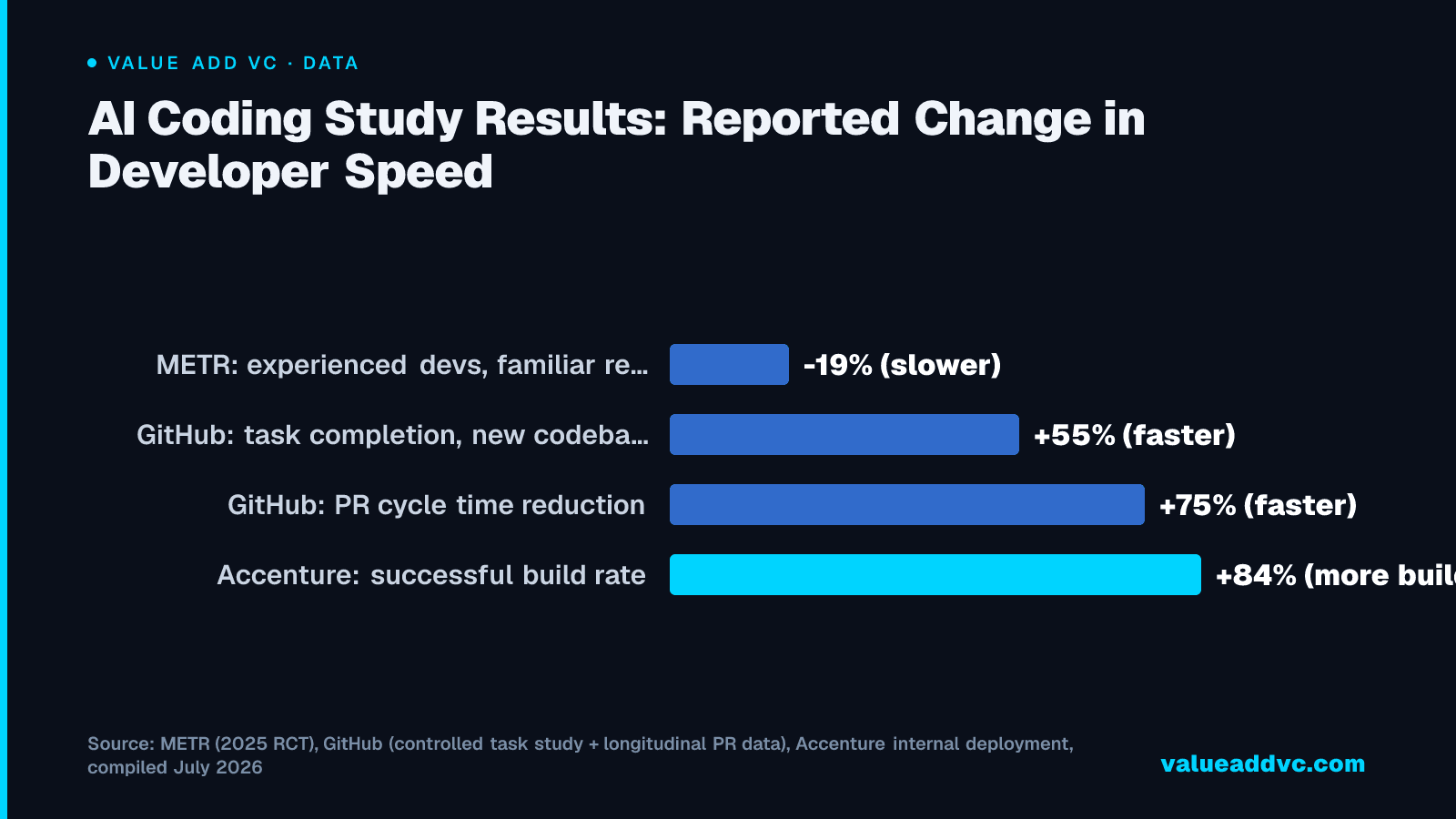
Figures are 2025-2026 study results blended from METR's published RCT, GitHub's research blog and longitudinal case study data, and Accenture's internal AI deployment reporting. Positive values indicate AI-assisted developers outperformed the control or baseline; METR's -19% reflects AI-assisted developers taking longer.
Why the perception gap: developers feel faster even when they aren't
The most important number in the METR study isn't the 19% slowdown — it's the 39-point gap between that slowdown and developers' own 20% "faster" estimate. METR's researchers attribute this to the coding process feeling faster even when total task time increases: typing and syntax lookups happen less often with AI assistance, so the moments a developer notices friction shrink, even as time spent reviewing, correcting, and re-prompting AI output grows in the background. That gap showed up consistently across nearly all 16 developers in the study, which is why METR treats it as a structural feature of AI-assisted workflows rather than a one-off measurement quirk. It's also why enterprise AI ROI tracking increasingly relies on hard delivery metrics — PR cycle time, deploy frequency, defect rate — rather than developer self-reports alone.
Code acceptance data adds another layer: across GitHub Copilot deployments, developers accept between 27% and 30% of AI-generated suggestions, and retain 88% of accepted code in final submissions. That's a meaningful chunk of code shipping with AI involvement, but it also means 70%+ of AI suggestions get rejected outright — time spent generating, reading, and discarding output that a productivity study measuring only "lines accepted" would never capture.
DORA's 2025 findings: AI adoption up 90%, but delivery instability still rising
Google Cloud's 2025 DORA (DevOps Research and Assessment) report surveyed a much larger population than METR or GitHub's controlled studies and found AI adoption among software professionals reached 90%, a 14-percentage-point jump from the prior year, with developers spending a median of two hours a day working with AI tools. Over 80% reported AI improved their productivity and 59% reported a positive effect on code quality. Writing new code was the top use case at 71% of developers, followed by technical literature review (68%) and modifying existing code (66%).
The catch: 2025 was the first year DORA found AI improving delivery throughput — a reversal from 2024, when the measured effect on throughput was negative. But delivery instability kept climbing even as throughput improved, meaning teams are shipping more, faster, with more volatility, unless the seven foundational engineering practices in DORA's AI Capabilities Model are already in place. DORA's framing is that AI is an amplifier: it magnifies the output of high-performing engineering organizations and magnifies the dysfunction of struggling ones, rather than fixing weak practices on its own.
Developer AI Tool Adoption, 2024–2026
Google Cloud DORA State of AI-Assisted Software Development report (2024, 2025), Stack Overflow / industry survey aggregation, July 2026
Data
| Item | % of developers using AI tools |
|---|---|
| 2024 | 76 |
| 2025 | 90 |
| 2026 (daily users) | 84 |
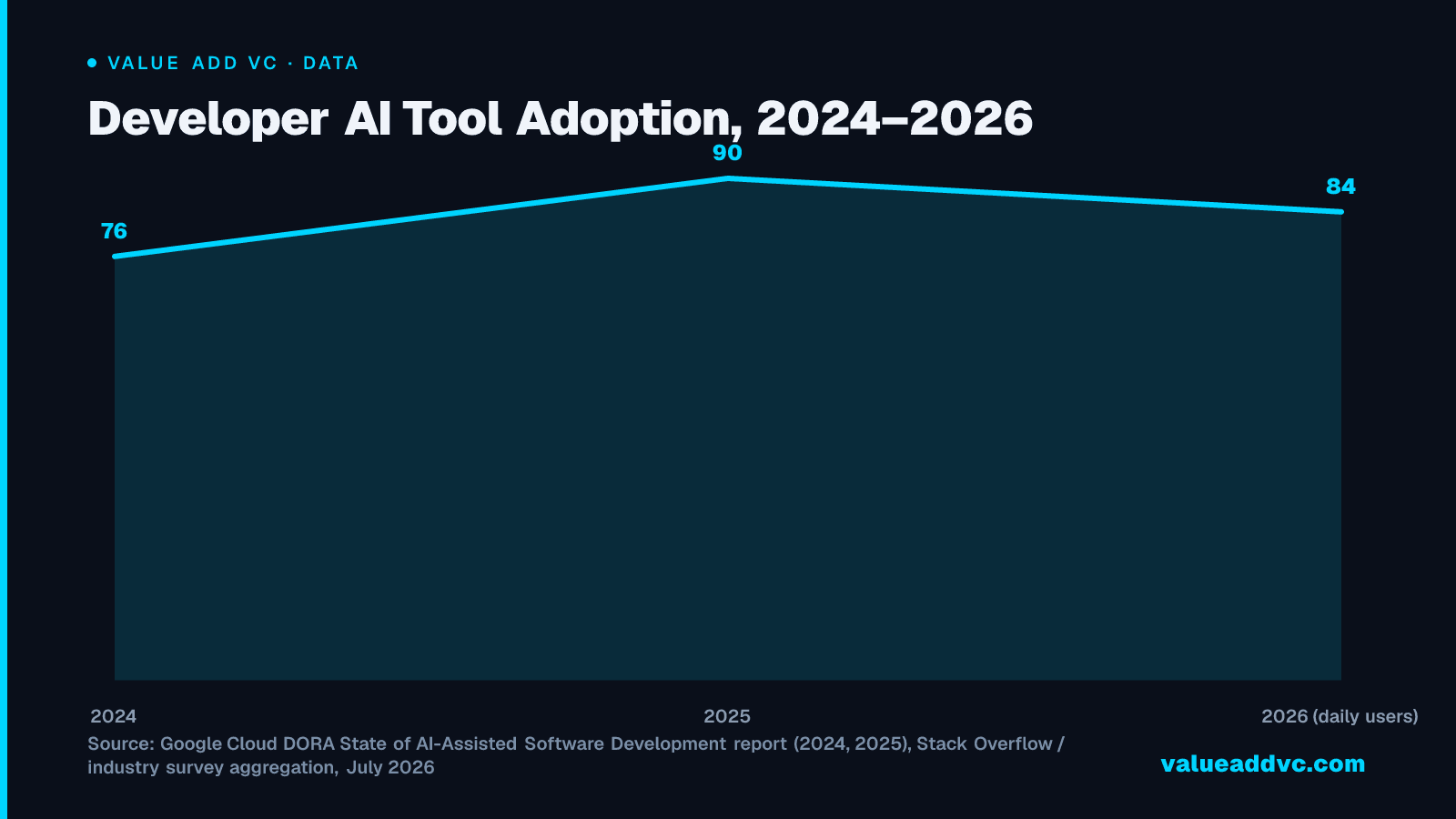
Figures blend Google Cloud's DORA 2025 report (90% adoption, +14pp YoY) with 2026 industry survey data showing 84% of developers using or planning to use AI tools and 51% using them daily.
How AI coding tools break down by use case in 2026
The productivity numbers vary partly because "AI coding" covers wildly different workflows. GitHub Copilot alone reached 20 million cumulative users by July 2025 and 4.7 million paid subscribers by January 2026, with adoption at 90% of Fortune 100 companies, and AI-assisted code now accounts for an estimated 46% of code written by developers using these tools. But that 46% splits across very different use cases — greenfield feature work, boilerplate generation, debugging, code review, and refactoring — each with a different productivity profile.
How Developers Report Using AI Coding Tools (2025 DORA Survey)
Google Cloud DORA State of AI-Assisted Software Development 2025
Data
| Item | Value |
|---|---|
| Writing new code | 71% |
| Technical literature review | 68% |
| Modifying existing code | 66% |
| Proofreading / review | 66% |
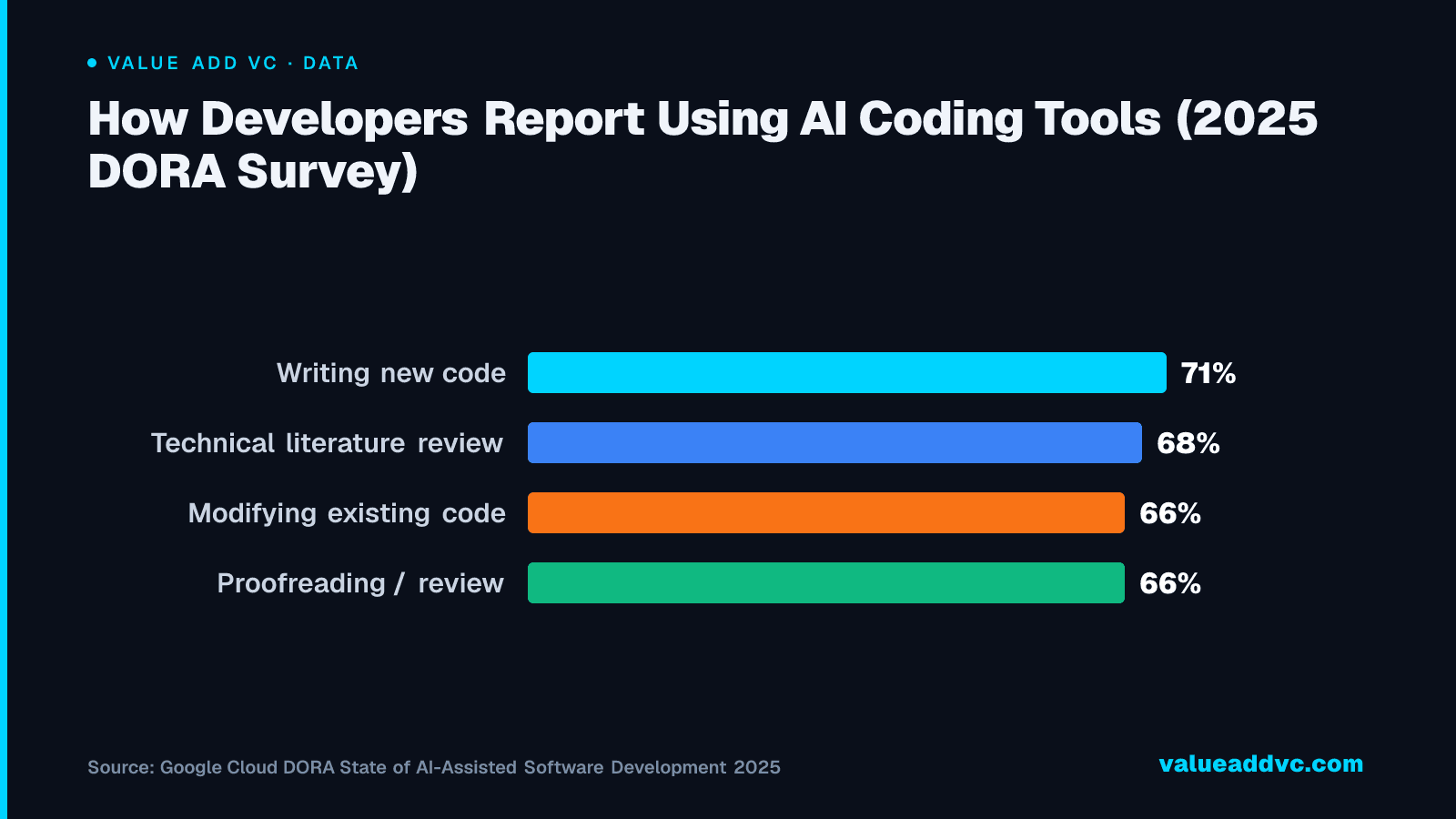
Figures are 2025 DORA survey percentages of developers reporting each use case; categories are not mutually exclusive, so totals exceed 100%.
METR vs GitHub vs DORA: comparing the three major AI coding studies
Here's the side-by-side on methodology, sample, and headline finding — the piece most AI coding productivity claims leave out.
| Study | Method | Sample | Headline finding | Best read as |
|---|---|---|---|---|
| METR (2025) | Randomized controlled trial | 16 experienced devs, 246 tasks | 19% slower task completion | Ceiling case: experts on known code |
| GitHub Copilot task study | Controlled task (HTTP server) | Two developer groups | 55% faster completion | Floor case: unfamiliar codebase task |
| GitHub longitudinal (PR cycle time) | Case study, real deployment | Enterprise engineering org | 9.6 days → 2.4 days per PR | Real-world delivery signal |
| Accenture internal | Deployment case study | Internal engineering org | 84% more successful builds | Build/CI quality signal |
| DORA 2025 | Large-scale survey | Thousands of professionals | 80%+ self-report productivity gains | Perception + adoption trend |
| Copilot acceptance data | Product telemetry | Aggregate Copilot users | 27-30% suggestion acceptance | How much AI output actually ships |
| Copilot satisfaction survey | Cohort survey | Large developer cohort | 90% felt more fulfilled | Job satisfaction, not output speed |
Figures are 2025-2026 estimates blended from METR's published RCT (arXiv 2507.09089), GitHub's official research blog, Accenture's internal AI deployment reporting, and Google Cloud's DORA State of AI-Assisted Software Development 2025 report. Acceptance and satisfaction figures reflect aggregate GitHub Copilot telemetry and cohort surveys.
What this means for engineering teams and investors in 2026
For founders building on the AI Valuations Dashboard's radar and for engineering leaders sizing AI coding tool spend, the practical takeaway is that the METR-vs-GitHub gap isn't a contradiction to resolve — it's a segmentation to plan around. AI coding tools appear to deliver the least (or negative) value when a senior engineer is deep in a codebase they already know cold, and the most value when a developer is working outside their expertise, ramping onto new code, or doing high-volume boilerplate and review work. A team optimizing purely for "AI adoption %" without tracking PR cycle time, defect rate, and rollback frequency is optimizing for DORA's self-report number while flying blind on the METR risk.
There's also a talent-market implication worth flagging: if AI tools genuinely help less-experienced developers close the gap with senior engineers on unfamiliar work — which the GitHub and Accenture data suggests — the wage premium for pure code-writing speed compresses faster than the premium for architectural judgment and codebase-specific expertise, the exact skill set METR found AI tools currently undermine rather than augment.
I'd also flag a measurement problem that's going to keep muddying this data for another year or two: nearly every large-scale AI coding study now has a selection-bias problem, because developers who've opted out of AI tools are increasingly the exception rather than a clean control group. METR itself ran into this — a planned 2026 follow-up study was shelved because too many developers refused to work without AI assistance long enough to generate a usable control arm, which the researchers noted as a data point in its own right. When the population you'd use to measure "life without AI" no longer exists in meaningful numbers, self-reported productivity surveys like DORA's become the primary tool available, even with all the perception-gap risk METR's RCT surfaced. That's worth remembering the next time a vendor's productivity claim comes from a survey rather than a controlled trial.
The Bottom Line:
AI coding tools made experienced developers 19% slower on familiar code in METR's rigorous 2025 trial, while GitHub's controlled study found 55% faster completion on unfamiliar tasks and DORA found 80%+ of developers self-reporting gains. None of these numbers is fake — they're measuring different developers doing different work. The real 2026 question isn't "does AI make coding faster," it's "faster at what, for whom."
Track how AI-native startups and coding tools are being valued on the AI Valuations Dashboard and see which AI companies just crossed $1B on the Unicorn Tracker at Value Add VC. Originally published in the Trace Cohen newsletter.
Latest from the Pulse
Get VC data most people never see
— free to subscribe
Trace's notes on venture, AI and startups, a few times a week. Join 5,000+ subscribers. No spam.
No spam, unsubscribe anytime. Sent via Substack · Privacy · or subscribe on Substack ↗