
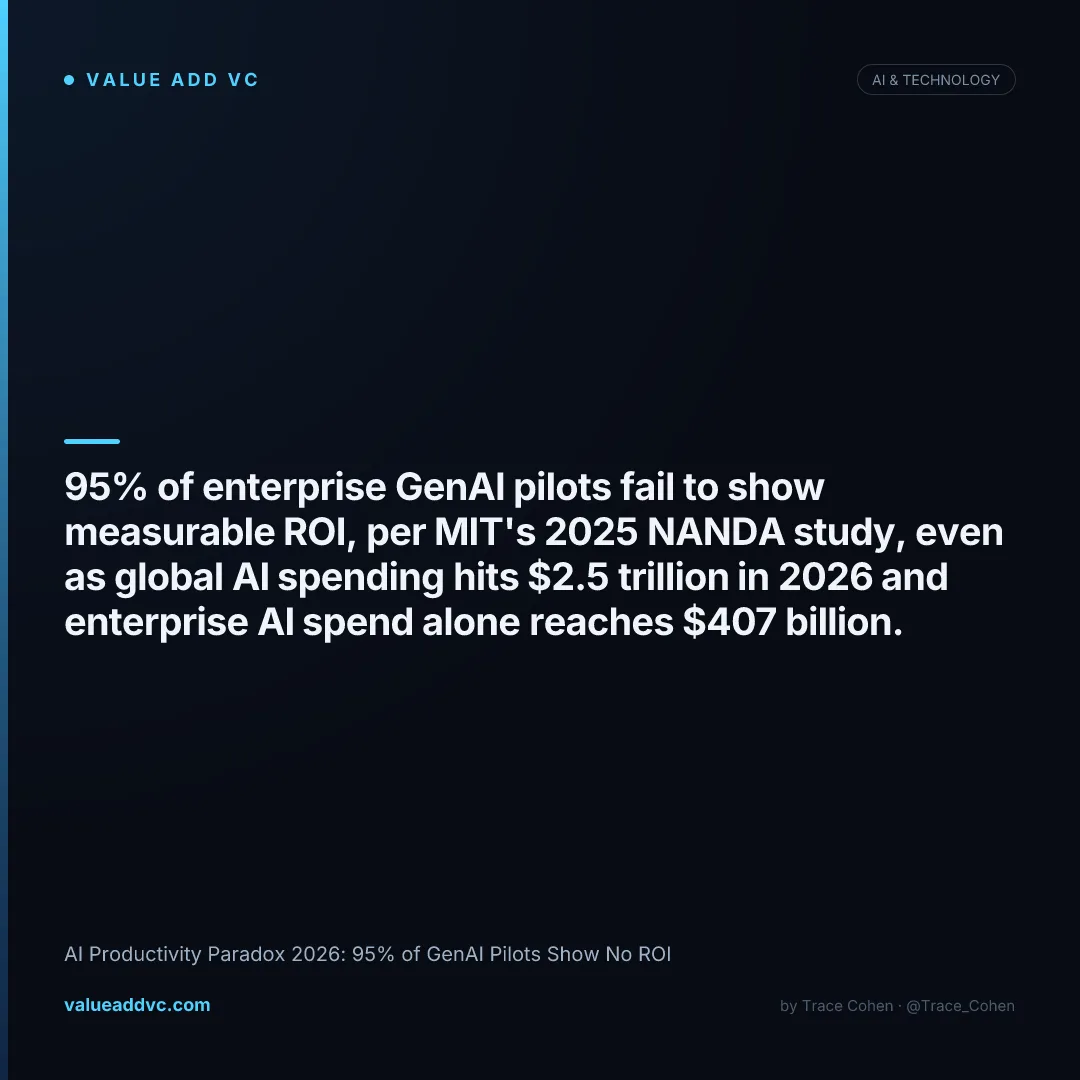
95% of enterprise generative AI pilots fail to deliver measurable ROI, according to MIT's 2025 NANDA research, even as global AI spending is projected to hit $2.5 trillion in 2026 — up from $1.5 trillion in 2025. That's the short answer. The longer answer is that individual employees really are getting faster with AI, while the organizations paying for it mostly aren't.
This is the AI productivity paradox: record capital spending, real individual-level gains, and almost no company-level financial return to show for it. This shift has played out across dozens of enterprise vendors tracked here, and the data now backs up what founders have been saying anecdotally for the past year — most AI deployments never leave the pilot phase.
Figures are 2025-2026 estimates blended from MIT NANDA/MIT Sloan research, Gartner, and WRITER's enterprise AI ROI survey. EBIT-impact figures reflect self-reported company survey data.
What is the AI productivity paradox in 2026?
The AI productivity paradox in 2026 is the widening gap between how much companies are spending on AI and how little of that spending converts into measurable business outcomes. Enterprises are on pace to spend $407 billion on AI this year, yet MIT found that 95% of generative AI pilots produce no measurable ROI, and only 6% of companies say AI has moved EBIT by more than 5%.
The paradox isn't that AI doesn't work — individual-level productivity gains from tools like ChatGPT and Copilot are well documented and show up in usage data almost immediately. The paradox is that those individual gains almost never survive contact with an organization's budget process, procurement, data infrastructure, and change management, which is where the ROI actually has to get proven.
The funnel problem: from pilot to production
MIT's research describes what it calls the "GenAI Divide": over 80% of organizations have piloted tools like ChatGPT or Copilot and roughly 40% report some level of deployment, but that activity mostly boosts individual output rather than organizational metrics. Enterprise-grade AI systems built to change core workflows fare far worse — 60% of firms evaluate them, only 20% reach pilot stage, and just 5% ever go live in production.
| Stage | Share of companies | Source |
|---|---|---|
| Piloted a GenAI tool (ChatGPT, Copilot, etc.) | 80%+ | MIT NANDA, 2025 |
| Reported some level of deployment | ~40% | MIT NANDA, 2025 |
| Evaluated an enterprise-grade AI system | 60% | MIT NANDA, 2025 |
| Reached pilot stage (enterprise-grade) | 20% | MIT NANDA, 2025 |
| Went live in production (enterprise-grade) | 5% | MIT NANDA, 2025 |
| Report "significant ROI" from GenAI overall | 29% | WRITER survey, 2026 |
| Report significant ROI from AI agents specifically | 23% | WRITER survey, 2026 |
| Attribute any EBIT impact to AI | 39% | Gartner survey, 2026 |
| Report AI contributing more than 5% to EBIT | 6% | WRITER/MIT data, 2026 |
Figures blended from MIT NANDA's 2025 "State of AI in Business" report and WRITER's 2026 enterprise AI ROI survey, plus Gartner's 2026 CFO survey on EBIT attribution. Percentages are self-reported by surveyed companies.
Enterprise AI spending keeps rising even as ROI stalls
None of this weak ROI data has slowed spending down. Worldwide AI spending is forecast to hit roughly $2.5 trillion in 2026, up from $1.5 trillion in 2025 per Gartner, and US enterprise AI spend alone is projected at $407 billion, up 34.8% from $302 billion in 2025. Per Bain, 42% of CFOs plan to lift AI spending by at least 30% over the next two years, and 86% of enterprises said their AI budget would rise in 2026 — only about 2% expect a cut.
That combination — rising budgets and a 95% pilot failure rate — is exactly why Forrester found enterprises are now postponing 25% of planned AI spend into 2027 and why only 36% of CFOs say they feel confident they can actually achieve meaningful AI outcomes from the money already committed. Investors tracking this space through our AI valuations dashboard should read that spending-versus-confidence gap as the single biggest swing factor in 2027 AI budgets.
Who's actually using AI? The adoption gap by firm size and sector
Only 17% to 20% of US businesses reported actively using AI in operations between December 2025 and May 2026, according to the Census Bureau's Business Trends and Outlook Survey, with another 20% to 23% expecting to adopt it within six months. Adoption skews heavily by size: 37% of firms with 250 or more employees use AI, versus under 20% of firms with fewer than 20 employees.
Sector matters too — Information companies lead at 39.7% adoption and Finance and Insurance follows at 33.9%, both well above the 19.8% national rate, while Retail Trade trails at around 14%. That distribution lines up almost exactly with which industries have the compute budgets and data infrastructure to move past piloting, which is the same bottleneck showing up in MIT's enterprise-grade pilot data above.
Why the AI productivity paradox exists: individual gains, no organizational return
MIT researchers point to organizational failure modes, not model quality, as the root cause. Projects get scoped too broadly, data architectures were never built to be production-ready, change management gets treated as an afterthought, and companies lack the baseline metrics needed to prove ROI to a board before the project gets killed. MIT Sloan calls the result "POC purgatory" — a permanent pilot phase that burns budget and organizational credibility without ever shipping a production system.
There's also a macro version of the paradox worth separating out. AI-driven capital investment is projected to contribute nearly 40% of total US real GDP growth in 2026, with growth estimates ranging from 2.25% (Vanguard) to 2.6% (Morgan Stanley, citing the buildout in compute). Cognizant has estimated AI could eventually unlock over $4.5 trillion in labor productivity. But that GDP contribution is largely capital spending on data centers and chips showing up in national accounts — it is not the same thing as worker-level productivity gains, which remain far smaller and harder to measure than the headline spending numbers suggest.
This is the same dynamic our AI coding productivity research post found in a narrower slice of the market: individual developers report feeling faster with AI tools, while controlled studies on actual delivered output show much smaller, sometimes negative, gains once review overhead and rework are counted.
What the AI productivity paradox in 2026 means for founders and investors
For founders selling into the enterprise, the 95%-pilot-failure and 5%-production-rate numbers are a sales objection you should get ahead of, not a surprise to react to later. The startups winning enterprise AI deals right now aren't the ones with the best model access — they're the ones that show up with the metrics framework and integration plan a CFO needs to justify the spend past the pilot stage, since 64% of CFOs surveyed can't currently point to a specific financial outcome from their AI investment.
For investors, the paradox argues for underwriting AI-native companies on workflow ownership and measurable output, not on model access or usage volume, which is the same lesson from our why most AI startups are building features, not companies post. We track this spending-versus-return gap closely on the SaaS valuations dashboard, because it's the single clearest early signal of which AI vendors are about to get squeezed when 2027 budget season hits and CFOs start asking for the receipts on the 25% of spend Forrester says is already being pushed out a year.
The practical takeaway is simple: $2.5 trillion in global AI spending in 2026 is not the same signal as $2.5 trillion in AI value creation, and the 90-point gap between companies that pilot AI (80%+) and companies that get it into production (5%) is where the next round of enterprise software winners and losers gets decided.
Bottom line: 95% of enterprise GenAI pilots still fail to deliver measurable ROI even as global AI spending climbs to $2.5 trillion in 2026, because the bottleneck was never model capability — it's organizational: broad project scope, non-production data infrastructure, and no baseline metrics to prove value to a board. Only 5% of enterprise-grade AI pilots reach production and only 6% of companies report AI moving EBIT by more than 5%, which is why 86% of enterprises are still raising AI budgets for 2026 while 25% of that same spend is quietly getting pushed into 2027.
Get VC data most people never see
— free to subscribe
Trace's notes on venture, AI and startups, a few times a week. Join 5,000+ subscribers. No spam.
No spam, unsubscribe anytime. Sent via Substack · Privacy · or subscribe on Substack ↗