
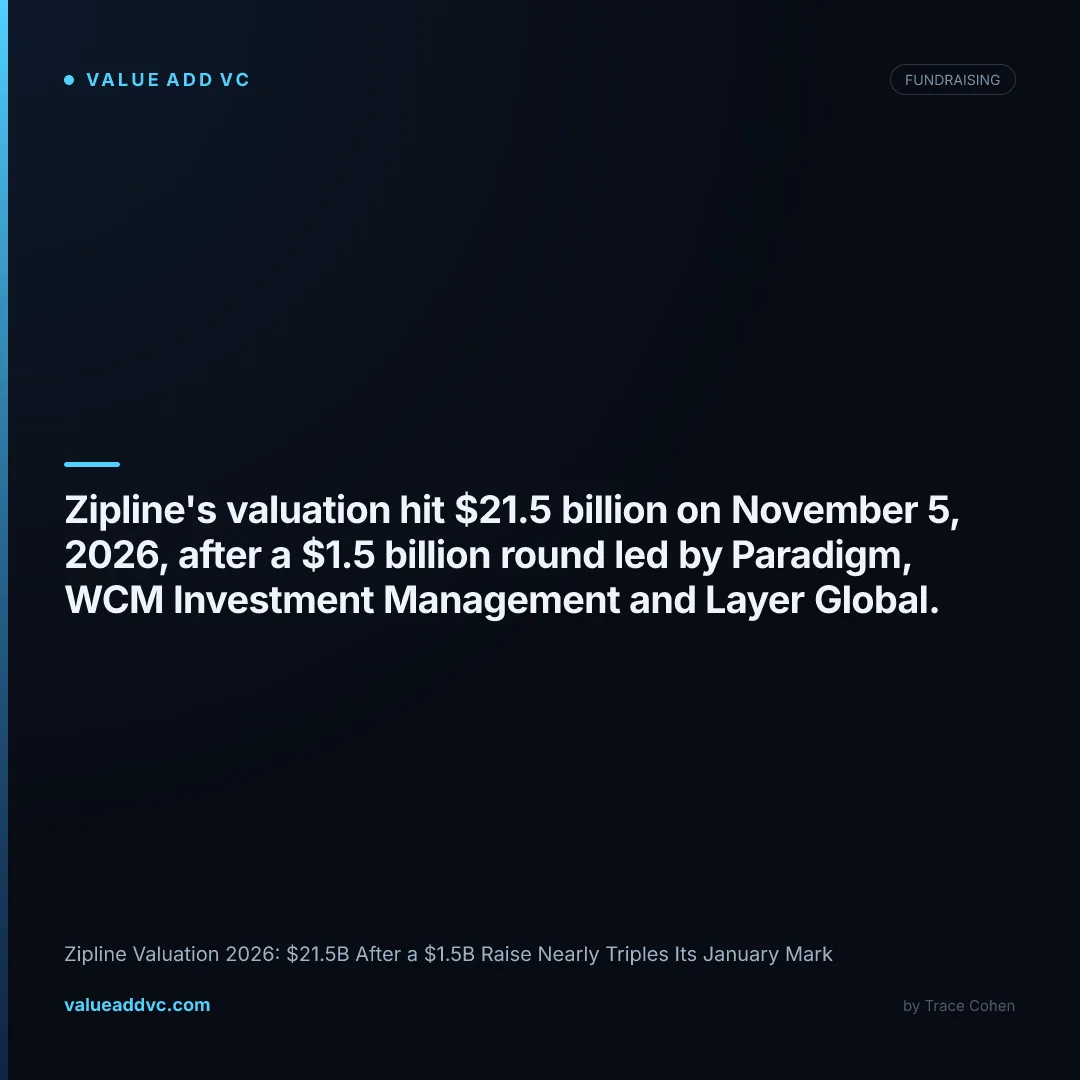
As of November 5, 2026, Zipline is valued at $21.5 billion after closing a $1.5 billion funding round led by Paradigm, WCM Investment Management and Layer Global. That's nearly triple the $7.6 billion mark the drone-delivery company carried in January 2026 — a more than 2.5x jump in valuation in under a year.
Zipline, the drone-delivery company the new round values at $21.5 billion, announced the raise Thursday, the same day Walmart said it would add 300 more Zipline delivery sites under a new multiyear agreement.
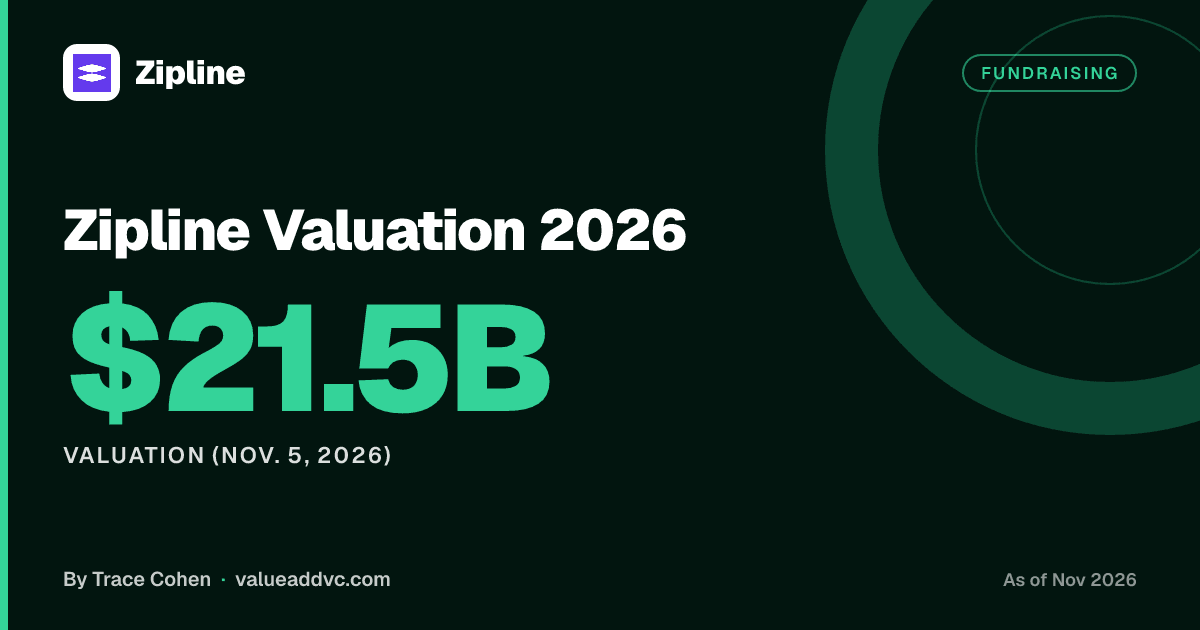
Figures from TechStartups and Zipline, November 5, 2026.
Zipline Valuation 2026: From $7.6B to $21.5B in 10 Months
Zipline's $21.5 billion valuation was set by a $1.5 billion round that closed November 5, 2026, co-led by Paradigm, WCM Investment Management and Layer Global, with Valor Equity Partners, ARK Invest and Salesforce Ventures also participating, according to TechStartups. Uber, Tiger Global, J.P. Morgan and Fidelity Management & Research Company were named as additional backers, though Zipline hasn't disclosed their specific role in the round or whether the capital is primary funding, a secondary sale, or a mix of both.
The jump caps a rapid climb through 2026. Zipline raised more than $600 million at a $7.6 billion valuation in January 2026, led by Valor Equity Partners with Tiger Global, Fidelity and Baillie Gifford participating, up from a $4.2 billion valuation on a $330 million Series F in April 2023 that included Sequoia Capital and Andreessen Horowitz. By September 2026, Zipline was reportedly in early talks to raise roughly $1 billion at close to $20 billion, with Paradigm discussing leading that round, Bloomberg News reported at the time — figures that moved higher by the time the round actually closed two months later.
Zipline has not disclosed a single lifetime funding total, and third-party trackers don't agree on one: estimates range from roughly $1.8 billion to $2 billion raised across more than a dozen rounds since the company's 2014 founding, figures this post can't independently verify.
Zipline's Valuation, 2023-2026
Zipline's valuation nearly tripled in the 10 months between its January 2026 and November 2026 rounds, after a slower climb from $4.2B in 2023.
TechStartups, DroneXL/Bloomberg, Transport Topics, 2023-2026
Data
| Item | Value |
|---|---|
| Apr. 2023 ($330M Series F) | $4.2B |
| 2024 (reported mark) | $5B |
| Jan. 2026 ($600M+ round) | $7.6B |
| Nov. 2026 ($1.5B round) | $21.5B |
Who Led Zipline's $1.5 Billion Round?
Three firms co-led the new round, with six more investors named as participants or backers without a specified role, per TechStartups:
| Investor | Role in Nov. 2026 round | Prior Zipline involvement |
|---|---|---|
| Paradigm | Co-lead | Previously invested; discussed leading the round as early as Sept. 2026 |
| WCM Investment Management | Co-lead | New to this round |
| Layer Global | Co-lead | New to this round |
| Valor Equity Partners | Participant | Led the Jan. 2026 round; longer-standing investor |
| ARK Invest | Participant | New to this round |
| Salesforce Ventures | Participant | New to this round |
| Uber | Named backer, role undisclosed | Announced a drone-delivery partnership and investment in Aug. 2026 |
| Tiger Global | Named backer, role undisclosed | Participated in the Jan. 2026 round |
| J.P. Morgan | Named backer, role undisclosed | New to this round |
| Fidelity Management & Research Co. | Named backer, role undisclosed | Participated in the Jan. 2026 round |
How we counted: every investor TechStartups named for the Nov. 5, 2026 round; 10 investors; as of November 5, 2026. Sources: TechStartups, Transport Topics/Bloomberg, DroneXL.
How Does Zipline's Drone Delivery Business Actually Work?
Zipline, founded in 2014 by Keller Rinaudo, Keenan Wyrobek and Will Hetzler, says it operates the world's largest autonomous delivery network, according to the company: fixed-wing drones that drop packages by parachute or lower them on a tether instead of landing. The company began by delivering blood and vaccines in Rwanda and Ghana and now serves more than 5,000 hospitals and health facilities worldwide, alongside a fast-growing US retail business.
Walmart is Zipline's anchor retail customer. The two companies extended a partnership that began in 2021, and Walmart said on November 5, 2026 it will add 300 more Zipline delivery sites under a new multiyear agreement. In October 2026, Zipline said the median delivery in its network took 19 minutes door-to-door, versus more than 30 minutes for conventional last-mile delivery — a gap the company is betting retailers will pay to close. Zipline has also disclosed completing more than 1 million deliveries in the Dallas-Fort Worth area alone in 2026, and says its aircraft have logged 150 million autonomous commercial miles, figures that are self-reported rather than independently audited.
Separately, Uber announced a strategic partnership and investment in Zipline in August 2026 to bring drone delivery to Uber Eats, with the companies targeting 1 million drone deliveries per day by the end of 2029 — a roughly 1,000x jump from current volumes that will require the new capital to go largely toward aircraft, airspace approvals and ground infrastructure rather than headcount.
How Does Zipline Compare to Amazon's Prime Air and Alphabet's Wing?
Zipline's biggest competitive threat sits inside Big Tech's own logistics arms: Amazon's Prime Air and Alphabet-owned Wing both run competing drone-delivery networks, and Amazon has been expanding Prime Air's city footprint sixfold in 2026, according to Pulse's earlier coverage. Unlike Amazon and Alphabet, which fund their drone units out of in-house logistics and advertising budgets, Zipline depends entirely on outside venture capital to keep scaling — which is precisely why the $21.5 billion valuation matters: it gives Zipline a war chest to try to match Amazon's capex without diluting founders as heavily as a down-valuation round would have.
What the headline misses
A near-tripled valuation in 10 months is a mark set on a private round, not a verified exit or an audited revenue multiple. Zipline has not disclosed revenue, gross margin, or what share of its 5,000-plus health-facility contracts are paid versus pilot programs, so there's no public way to check the $21.5 billion figure against actual sales. The company's own safety and volume statistics — including the 150 million autonomous miles and the Dallas-Fort Worth delivery count — are self-reported rather than independently audited.
A valuation running this far ahead of disclosed revenue also leaves little room for a down round if hospital or retail contracts slow, or if Walmart's 300 new sites don't go live on schedule. Zipline hasn't said whether the new round is primary capital or includes a secondary sale letting early backers or employees cash out near the tripled mark, a distinction that matters for how much of the $1.5 billion actually goes toward scaling the business.
Bottom Line
Bottom line: Zipline's $21.5 billion valuation is real venture pricing from a round backed by crossover funds and hedge-fund money, not just traditional late-stage drone investors, and it comes with concrete commercial traction in Walmart's expanding footprint and Uber's new partnership. But it's a valuation set almost entirely on private-market momentum rather than disclosed revenue, racing against Amazon's and Alphabet's much better-funded in-house drone programs, and whether this mark holds depends on contracts and delivery volumes the company hasn't yet made public.
Latest from the Pulse
Get VC data most people never see
— free to subscribe
Trace's notes on venture, AI and startups, a few times a week. Join 5,000+ subscribers. No spam.
No spam, unsubscribe anytime. Sent via Substack · Privacy · or subscribe on Substack ↗