
Corxel Pharmaceuticals is going public through a $377 million SPAC merger with Amanat Acquisition Corp, announced October 26, 2026 — a bet that an oral obesity pill still in Phase 2 can fund its own path to Phase 3 without a traditional IPO roadshow.
The deal, disclosed in a business combination agreement filed with the SEC and confirmed by Reuters, combines Amanat's $75 million trust account with an oversubscribed $300 million PIPE from specialist healthcare investors. The combined company will list on the Nasdaq Capital Market under a new name and ticker, with closing expected in the first half of 2027.
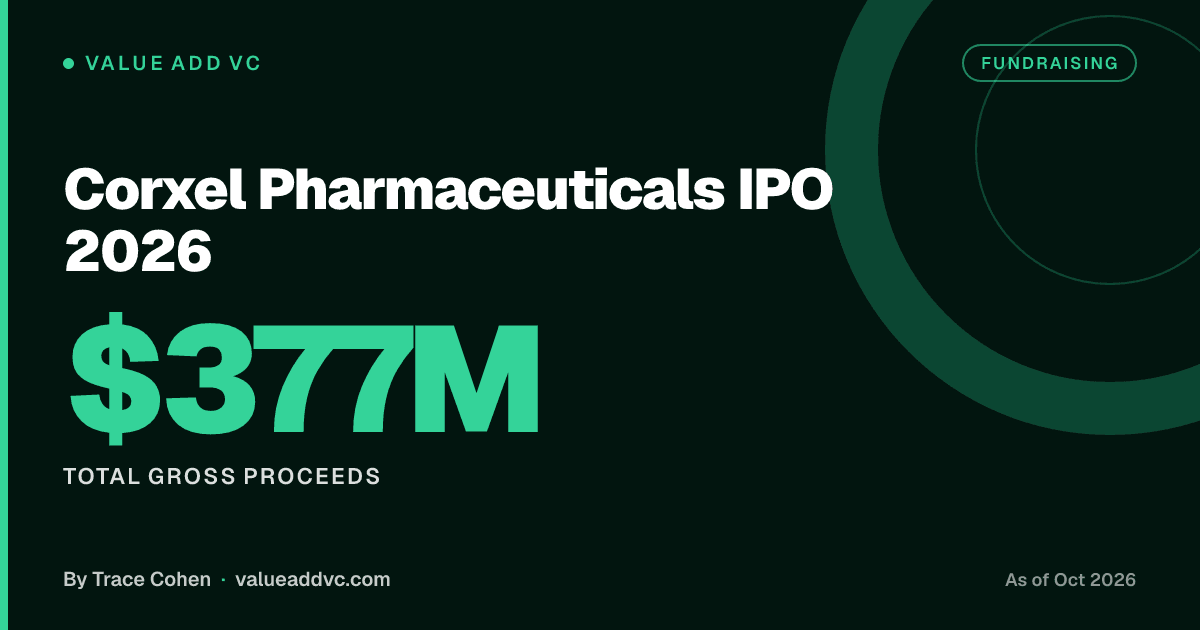
SEC EDGAR, Amanat Acquisition Corp Form 8-K exhibit, filed October 26, 2026; confirmed by Reuters (via Capital.com).
Corxel Pharmaceuticals IPO: How the $377M Amanat SPAC Deal Is Structured
Corxel Pharmaceuticals will go public through a merger with Amanat Acquisition Corp (Nasdaq: AMAN), a healthcare-focused blank-check company, under a business combination agreement both companies' boards approved and disclosed on October 26, 2026. The deal is structured to maximize cash on the balance sheet rather than cash out existing shareholders.
| Deal term | Figure |
|---|---|
| Total expected gross proceeds | ~$377M (before transaction costs) |
| Amanat trust account | ~$75M |
| PIPE financing | ~$300M, oversubscribed |
| Lead placement agent | Leerink Partners |
| Other placement agents | Evercore ISI, Guggenheim Securities, Cantor, LifeSci Capital |
| Expected closing | First half of 2027 |
| Listing venue | Nasdaq Capital Market, new name/ticker TBD |
| Use of proceeds | Funds operations through 2029, incl. CX11 global Phase 3 |
How we counted: deal terms from Corxel/Amanat's October 26, 2026 business combination agreement exhibit filed with the SEC, cross-checked against Reuters' report on the same filing.
Investors may reduce their PIPE subscriptions one-for-one by buying and not redeeming Amanat shares before the shareholder vote, a mechanism that lets the $300 million figure flex down if redemptions run high — a protection PIPE investors typically demand after the redemption waves that hit 2021-2022 SPACs. Cooley LLP is advising Corxel US and Corxel Group, Goodwin Procter LLP is advising Amanat, and Latham & Watkins LLP is advising the placement agents, according to the SEC filing.
Current Corxel US management will keep running the business after closing while Amanat searches for a US-based CEO to lead the combined company — a leadership gap that adds a layer of execution risk most completed SPAC mergers don't carry. On the Amanat side, Pavan Cheruvu, M.D. is CEO and a director, Sandeep C. Kulkarni, M.D. is chairman, and Nicholas Fernandez is CFO, with Brad Middlekauff, Patrick Crutcher, and Rakhi Kumar among the other directors named in the filing. Corxel US's CFO is Kevin Xie, Ph.D., and Corxel Group — the entity's broader, Asia-facing operation that sits outside this SPAC transaction — is led by Executive Director and CEO Sandy Mou.
What Does Corxel's CX11 Obesity Drug Actually Do?
Corxel's lead candidate, CX11, is a once-daily oral small-molecule GLP-1 receptor agonist in development for obesity, type 2 diabetes, and related cardiometabolic conditions. In a US Phase 2 obesity trial, CX11 produced mean body-weight reduction of up to 11.5% at week 36 under the efficacy estimand, per the SEC filing. Tolerability data from the same trial showed nausea in 33% to 34% of participants across dose cohorts, vomiting in 12% to 16%, diarrhea in 4% to 12%, and constipation in 2% to 12%, with no severe gastrointestinal events reported and a 5.0% discontinuation rate tied to GI side effects.
Those side-effect rates come from the 36-week double-blind portion of the US Phase 2 trial, across multiple dose cohorts tested against placebo; the SEC filing reports no severe cases of nausea, vomiting, diarrhea, or constipation, and says most gastrointestinal events occurred during dose escalation and eased once patients reached a maintenance dose. Corxel says it aligned with the FDA on Phase 3 design following an end-of-Phase-2 meeting and plans a global Phase 3 program, which this raise is meant to fund. A Phase 1b study testing higher doses of CX11 is expected to report results in the first half of 2027 — before Phase 3 itself gets underway.
A second, preclinical candidate, CX12, is an oral amylin receptor agonist with multiple lead candidates still under evaluation; Corxel is targeting an IND filing for CX12 in the first half of 2027, the same window as CX11's Phase 1b readout. Neither candidate has started the global Phase 3 program this $377 million raise is meant to fund.
How Does CX11 Compare to Lilly's and Viking's Oral Obesity Drugs?
CX11 is entering a crowded field of oral GLP-1 candidates racing to challenge injectable incumbents Eli Lilly's Zepbound and Novo Nordisk's Wegovy. Eli Lilly's own oral candidate, orforglipron, produced 12.4% average weight loss (27.3 lbs) at 72 weeks in its 3,127-patient ATTAIN-1 Phase 3 trial, versus 0.9% for placebo, according to Lilly's August 7, 2025 results announcement. Viking Therapeutics' oral VK2735 showed an even faster response, reaching 12.2% weight loss (26.6 lbs) at just 13 weeks in its 280-patient Phase 2 VENTURE-Oral trial, per Viking's August 19, 2025 press release, with up to 97% of patients hitting at least 5% weight loss and up to 80% hitting at least 10%, both figures statistically significant against placebo (p<0.0001).
Tolerability is the other half of the comparison. Lilly reported discontinuation rates due to adverse events of 5.1% at the 6 mg dose, 7.7% at 12 mg, and 10.3% at the 36 mg dose of orforglipron, versus 2.6% for placebo — all higher than CX11's reported 5.0% GI-driven discontinuation rate in its own Phase 2 trial, though the trials differ in size, duration, and dosing design enough that a direct read-across is more a directional signal than an apples-to-apples result. Lilly's trial also ran far longer (72 weeks versus CX11's 36) and enrolled roughly 11 times as many patients, which is a reminder of how much further along both rivals are in generating the kind of large-sample safety data regulators and payers will eventually weigh.
Oral GLP-1 Obesity Candidates: Peak Weight Loss Reported in Trials
CX11's 11.5% Phase 2 result sits close to Lilly's and Viking's, but both rivals are further along in development
SEC EDGAR (Corxel/Amanat filing); Lilly results via HFSA, Aug. 7, 2025; Viking Therapeutics IR, Aug. 19, 2025.
Data
| Item | Value |
|---|---|
| Lilly orforglipron (Ph3, 72wk) | 12.4% |
| Viking VK2735 (Ph2, 13wk) | 12.2% |
| Corxel CX11 (Ph2, 36wk) | 11.5% |
Why a SPAC Merger Instead of a Traditional IPO?
A growing number of 2026 biotechs have chosen traditional IPOs even as AI mega-valuations wobble elsewhere — Lycia Therapeutics priced an upsized traditional offering earlier in the year. Corxel is taking a different route: a SPAC merger that is typically faster to close and less exposed to a roadshow's week-to-week pricing swings, but one that carries a higher execution-risk discount after the weak post-merger track record of the broader 2021-2022 SPAC boom-and-bust cycle. Agility Robotics took the same SPAC route into a $2.5 billion Nasdaq listing earlier this year, a useful comp for how the structure performs once shares actually trade.
The PIPE's investor list signals how specialists are pricing the bet: RTW Investments, New Enterprise Associates (NEA), SR One, RA Capital Management, Mirae Asset Capital Life Science, HBM Healthcare Investments, Nantahala Capital, Invus, TCGX, and Propel Bio are all named participants, according to the SEC filing — a lineup of dedicated life-sciences and healthcare funds rather than generalist SPAC capital. That mix is typical of biotech SPACs built around real trial data rather than a story stock.
Why Is a $377M Obesity-Drug SPAC Happening Now?
Reuters, reporting on the same October 26, 2026 filing, frames obesity drugs as "a fast-growing market dominated by Novo Nordisk and Eli Lilly" — the two companies whose injectable GLP-1 franchises, Wegovy and Zepbound/Mounjaro, created the commercial proof that convinced specialist investors like RTW and RA Capital to fund a long list of challengers chasing the oral, cheaper-to-manufacture version of the same mechanism. Corxel's SPAC lands in the same window as Lilly's and Viking's late-stage oral readouts, meaning CX11 will be priced by public investors against rivals that already have more data, not against a blank competitive slate.
That timing cuts both ways. A crowded, well-funded field validates that oral GLP-1s are a real commercial category worth the capital this deal raises, but it also means Corxel's $377 million has to stretch across a Phase 3 program against competitors who will likely have pricing, manufacturing scale, and physician familiarity sewn up well before CX11 could realistically reach the market.
What the headline misses
Corxel's own filing is not entirely internally consistent: its narrative description says CX11 was evaluated in a US Phase 2 obesity trial, while a separate "About Corxel" section in the same exhibit states the company "has completed... Phase 3 clinical development in Asia" — a claim the body text doesn't support anywhere else in the filing. Until that's clarified, the safest read is that CX11's most advanced US obesity data is still Phase 2, meaning the global Phase 3 program this raise is meant to fund hasn't started yet. Add the broader SPAC track record and the management gap at the top — Amanat is still searching for a US-based CEO to run the combined company — and the $377 million headline is better read as funding for the next two years of trials, not confirmation that CX11 works.
Bottom line: Corxel Pharmaceuticals' $377 million SPAC merger with Amanat Acquisition Corp, expected to close by mid-2027, funds a Phase 3 program for an oral obesity drug that showed competitive but earlier-stage results against Eli Lilly's and Viking Therapeutics' rival candidates. The deal's specialist PIPE investors are betting on CX11's data holding up at scale — the SPAC structure itself is the bigger near-term risk.
Latest from the Pulse
Get VC data most people never see
— free to subscribe
Trace's notes on venture, AI and startups, a few times a week. Join 5,000+ subscribers. No spam.
No spam, unsubscribe anytime. Sent via Substack · Privacy · or subscribe on Substack ↗