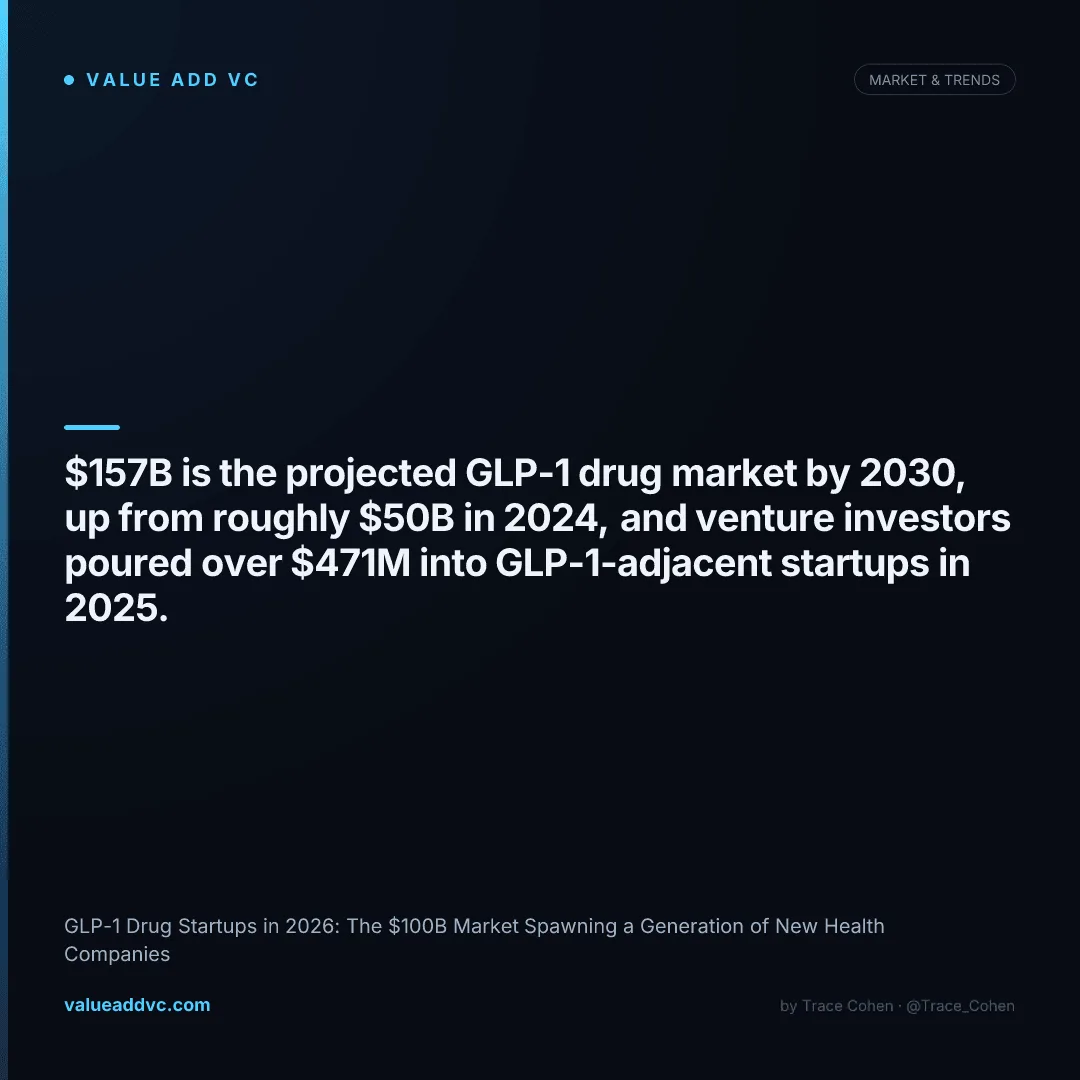
The GLP-1 market is on track to hit $157B by 2030, up from about $50B in 2024, and venture investors put over $471M into GLP-1 startups in 2025 alone.
That's the short answer. The longer answer is more interesting — because almost none of that startup money is going toward making the drugs. It's going toward solving who gets them, how they stay on them, and what comes after them.
GLP-1 Startup Companies in 2026: What's Actually Getting Funded
GLP-1 startup companies in 2026 fall into four categories: telehealth prescribers, access and compounding plays, next-generation molecule developers, and side-effect or adherence startups. The drugs themselves — semaglutide and tirzepatide — are owned by Novo Nordisk and Eli Lilly, who together control over 95% of branded GLP-1 supply. Startups don't compete on the molecule; they compete on distribution, retention, and the long tail of patients the incumbents ignore.
This is the same pattern I've watched play out in fintech and AI: when a platform shift creates massive demand, the first wave of value accrues to whoever owns the customer relationship, not whoever owns the underlying technology. Stripe didn't invent payments. Hims didn't invent semaglutide. Both built the layer the incumbent couldn't.
The Money: GLP-1 Funding Rounds in 2024–2025
Here are the largest GLP-1 startup funding events of the last 18 months. Note how much of the capital flows to next-generation drug developers and distribution — not to copycats.
| Company | What They Do | Raised | Category |
|---|---|---|---|
| Metsera | Oral & injectable next-gen obesity drugs | ~$290M + acquisition | Next molecule |
| Kailera Therapeutics | Licensed China-origin GLP-1 assets | ~$400M Series A | Next molecule |
| Verdiva Bio | Once-weekly oral amylin/GLP-1 | ~$411M seed | Next molecule |
| Hims & Hers | Telehealth + compounded GLP-1 access | Public (~$1.5B rev) | Distribution |
| Ro | Telehealth Zepbound/Wegovy prescribing | ~$1B total, ~$7B val. | Distribution |
| Function Health | Lab testing + metabolic tracking | ~$200M Series B | Diagnostics |
Figures are approximate and drawn from public announcements and reporting through early 2026. The Metsera deal — a multi-billion-dollar acquisition contest between Pfizer and Novo Nordisk — was the single loudest signal that incumbents will pay almost anything to own the next molecule.
The Four Categories of GLP-1 Startup Companies
Why GLP-1 Startup Companies Are a $100B Opportunity
The reason this market keeps expanding isn't weight loss — it's indication creep. GLP-1s have now shown benefit across an unusually broad set of conditions, and each new approval expands the treatable population by tens of millions.
Cardiovascular disease
Wegovy approved to cut major cardiac events by ~20%
Sleep apnea
Zepbound approved for moderate-to-severe OSA in 2024
Addiction & alcohol use
Multiple trials underway; early signals are strong
Chronic kidney disease
Semaglutide showed ~24% risk reduction in trials
Alzheimer's & cognition
Phase 3 readouts expected through 2026
MASH / fatty liver
A large untreated population with no standard drug
Each of those turns a weight-loss prescription into a chronic-care relationship that can last decades. That's why analysts model the category at $100B+ by 2030 — and why a startup that owns adherence or a novel molecule can be worth billions. For founders thinking about valuation in fast-growing categories, the same multiple dynamics show up across SaaS and AI valuations: demand certainty compresses risk and expands multiples.
The Risks Every GLP-1 Startup Faces
What Survives
- ✓ Novel molecules with defensible IP and clinical data
- ✓ Distribution that owns the patient and the data
- ✓ Adherence tools that fix the 50%+ dropout rate
- ✓ Diagnostics that prove the drug is working
What Gets Squeezed
- ✕ Pure compounding plays once shortages end
- ✕ Thin telehealth wrappers with no retention
- ✕ Anyone whose margin depends on brand-drug pricing gaps
- ✕ Single-indication bets when patents expire ~2031–2032
The compounding window is the clearest example. When semaglutide was in shortage, the FDA permitted compounding pharmacies to make copies — and a wave of telehealth startups built their economics on that gap. The shortage was declared resolved in 2025, and a chunk of those businesses had to pivot or shut a key revenue line overnight. Regulatory tailwinds aren't a moat.
The GLP-1 drugs are a Big Pharma story.
The GLP-1 startups are a distribution, adherence, and next-molecule story — and that's where the next $100B of value gets built.
Track health and tech IPOs on the Tech IPO Tracker and emerging category leaders on the Unicorn Tracker at Value Add VC. Originally published in the Trace Cohen newsletter.
Latest from the Pulse
Get VC data most people never see
— 100% free
Weekly benchmarks, valuations, and fund data. Join 5,000+ investors. No spam.