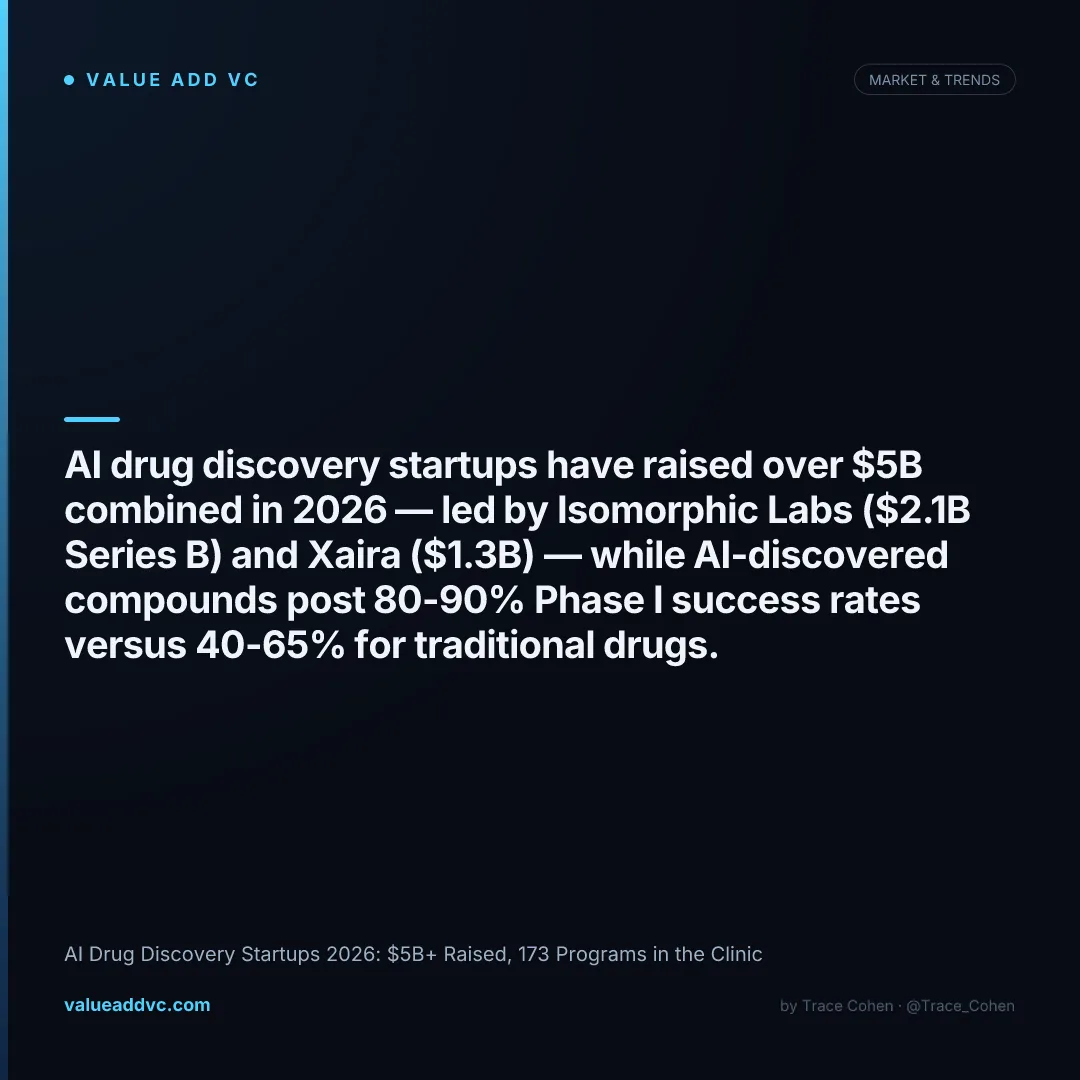
AI drug discovery startups have raised over $5.2B combined in 2026, led by Isomorphic Labs' $2.1B Series B, and 173 AI-originated drug programs are now in clinical trials — up from just 24 in late 2023. From 24 clinical programs to 173 in under three years — that curve is the thing to explain.
The pitch behind every AI drug discovery startup is the same: compress the 10-to-15-year, $2-3B traditional drug development timeline into a fraction of that by using machine learning to predict protein structures, screen for toxicity, and design molecules computationally instead of through years of wet-lab trial and error. The money says investors believe it. The clinic — where zero AI-designed drugs have reached market as of mid-2026 — says the jury is still out.
What Are the Top AI Drug Discovery Startups in 2026?
The best-capitalized AI drug discovery startups in 2026 are Isomorphic Labs (Alphabet-backed, $2.1B Series B), Xaira Therapeutics ($1.3B total, the largest debut round ever recorded in the space), Insilico Medicine (publicly listed with ~$293M raised), and Recursion Pharmaceuticals (which absorbed Exscientia's pipeline and capital in a 2024 merger). A second tier — Eikon, insitro, Iambic Therapeutics, Genesis Therapeutics, and Chai Discovery — is racing to catch up on both capital and clinical progress.
What separates this cohort from the AI wrapper problem plaguing much of enterprise software is that these companies aren't reselling a foundation model API — most run proprietary structure-prediction and generative-design models trained on years of proprietary wet-lab and structural biology data, which is a real moat traditional software startups don't have.
Isomorphic Labs vs Xaira vs Insilico vs Recursion: The Funding Breakdown
Every AI drug discovery startup is pitching some version of the same thesis, but the capital structures differ sharply — some are pure venture bets, one has already tapped public markets, and one is a corporate spin-out with a balance sheet behind it.
| Company | Total Disclosed Funding | Latest Round | Key Backer / Deal | Clinical Stage |
|---|---|---|---|---|
| Isomorphic Labs | $2.7B+ (incl. deal value) | $2.1B Series B (May 2026) | Alphabet + Thrive, GV | Preclinical, Lilly/Novartis partnerships |
| Xaira Therapeutics | $1.3B | $1.0B debut round (2024) | ARCH Venture Partners, Foresite | Preclinical / early IND |
| Insilico Medicine | ~$293M (public listing) | HK IPO, Dec 2025 | Public markets (HKEX) | Phase IIa positive (Nature Medicine) |
| Recursion Pharmaceuticals | $500M+ (post-Exscientia merger) | 2024 all-stock merger | Nvidia (equity stake) | Multiple Phase I/II programs |
| insitro | $700M+ | Series D (2023) | Andreessen Horowitz, GV | Preclinical |
| Eikon Therapeutics | $1.3B+ | Series D-plus | Kenneth Griffin, Roche | Preclinical / IND-stage |
| Formation Bio | $372M raised, 2 exits in 2025 | Sanofi (€545M) and Lilly (~$2B) exits | a16z, Kinnevik | Post-exit; assets absorbed by acquirers |
Figures are 2026 estimates blended from company disclosures, PitchBook, Tracxn, PR Newswire, and reporting from IntuitionLabs and Startup Fortune. Deal-value figures for pharma partnerships include upfront plus milestone payments, which are not guaranteed.
Why AI Drug Discovery Startups Are Raising at These Valuations
The math investors are underwriting: traditional drug development costs $2-3B per approved compound and takes 10-15 years, with an overall clinical success rate historically below 10% from Phase I to approval. If AI can meaningfully move Phase I success rates from the 40-65% traditional range to the 80-90% range now being reported for AI-discovered compounds, the expected value of every dollar spent on R&D goes up substantially — which is the entire basis for real options valuation models being applied to this sector instead of standard revenue multiples.
That's also why pharma is writing the biggest checks in venture right now, not through direct equity but through milestone-heavy partnerships. Isomorphic Labs' nearly $3B in combined Lilly and Novartis deal value dwarfs its own equity raise, and Nvidia and Eli Lilly's separate $1B AI co-innovation lab shows the chip makers want a piece of the pipeline too, not just the compute contract.
How AI Drug Discovery Actually Works, in Plain English
Most of these companies are not using a single technique — they're stacking three distinct AI capabilities on top of each other. First, structure prediction: models descended from DeepMind's AlphaFold lineage (Isomorphic Labs is literally the commercial spin-out of that team) predict how a protein folds in 3D from its amino acid sequence, replacing what used to take months of X-ray crystallography with a computation that runs in minutes. Second, generative molecule design: once a target protein's shape is known, generative models propose candidate small molecules or antibodies likely to bind it, rather than screening existing chemical libraries one at a time. Third, toxicity and ADMET prediction (absorption, distribution, metabolism, excretion, toxicity) — the step most responsible for the 80-90% Phase I success rate figure, since it flags compounds likely to fail safety testing before a single dollar is spent on a clinical trial.
None of this eliminates the wet lab. Every company on this list still runs physical experiments to validate model predictions — the pitch is narrowing the search space from millions of candidate molecules down to dozens worth actually synthesizing, not replacing chemistry with software entirely. That distinction matters for diligence: a startup claiming to have removed the wet lab is overselling the technology, while one claiming to have compressed the discovery-to-IND timeline from 4-6 years to 12-18 months is describing what the best players are actually delivering.
AI Drug Discovery Clinical Pipeline Growth: 2023 to 2026
The number of AI-originated drug programs entering clinical development has grown more than 7x in under three years — from roughly 24 programs in late 2023 to 173 as of early 2026. That's the strongest evidence the sector has produced so far that AI drug discovery is moving from a research thesis to an actual pipeline, even without a single approved drug yet.
The Risk: Zero AI-Designed Drugs Have Reached Market
Here's the honest counterpoint every LP evaluating this sector needs to hold alongside the funding numbers: despite $5.2B+ raised and 173 programs in the clinic, no AI-designed drug had received full market approval as of mid-2026. Insilico Medicine is furthest along, with a positive Phase IIa readout published in Nature Medicine, but Phase IIa is still years and multiple trial phases away from an approved product.
Drug approval has a brutal base rate regardless of how a compound was discovered — most drugs that enter Phase I never reach market, and pharma's own multi-decade actuarial data on attrition doesn't disappear just because a neural network picked the molecule instead of a chemist. The 80-90% Phase I success rate figure being cited for AI-discovered compounds is real but reflects a still-small sample size relative to the tens of thousands of traditionally discovered drugs that have gone through Phase I over the last 40 years.
The bull case
AI compresses discovery and preclinical timelines from years to months, and pharma is already paying up through milestone deals worth billions before a single Phase III readout.
The bear case
No AI-discovered drug has reached market. Phase III and regulatory approval — where most drugs still fail — remain untested for this cohort at scale.
What changes the thesis
The first AI-discovered drug to clear Phase III and get FDA approval, expected as early as 2027-2028 for the most advanced Insilico and Recursion programs.
Who's exiting already
Formation Bio proved you don't need FDA approval to generate returns — its Sanofi (€545M) and Lilly (~$2B) exits came from asset sales, not approved drugs.
How VCs Should Underwrite AI Drug Discovery Startups
For investors underwriting this category, the framework should weight three things: proprietary data (does the company own structural or wet-lab data a competitor can't replicate), pharma deal validation (are large pharma companies putting real milestone dollars behind the platform, not just running a pilot), and clinical proof points (has any program cleared Phase I with data that beats the historical baseline). Isomorphic Labs and Eikon score highest on the first two; Insilico currently leads on the third.
This is also a sector where AI valuation benchmarking matters more than in most software categories, since a $2.1B round with no product revenue only makes sense if you believe the option value of the pipeline — not current cash flow — justifies the price. Compare that against traditional biotech valuation multiples on our valuations dashboard before assuming the AI premium is durable.
$5.2B+ raised. 173 programs in the clinic. Zero drugs approved.
AI drug discovery is real capital chasing a real thesis — but it's still pre-proof, and the winners will be decided in Phase III, not in the next funding round.
Isomorphic Labs and Eikon have the strongest data moats and pharma validation today. Insilico has the clearest clinical lead. The next 24 months, when the first AI-discovered compounds hit late-stage trials, will separate the platforms with a real edge from the ones that were just well-funded.
Track AI company valuations on the AI Valuations Dashboard and compare fund performance on Fund Benchmarking at Value Add VC. Originally published in the Trace Cohen newsletter.
Latest from the Pulse
Get VC data most people never see
— 100% free
Weekly benchmarks, valuations, and fund data. Join 5,000+ investors. No spam.