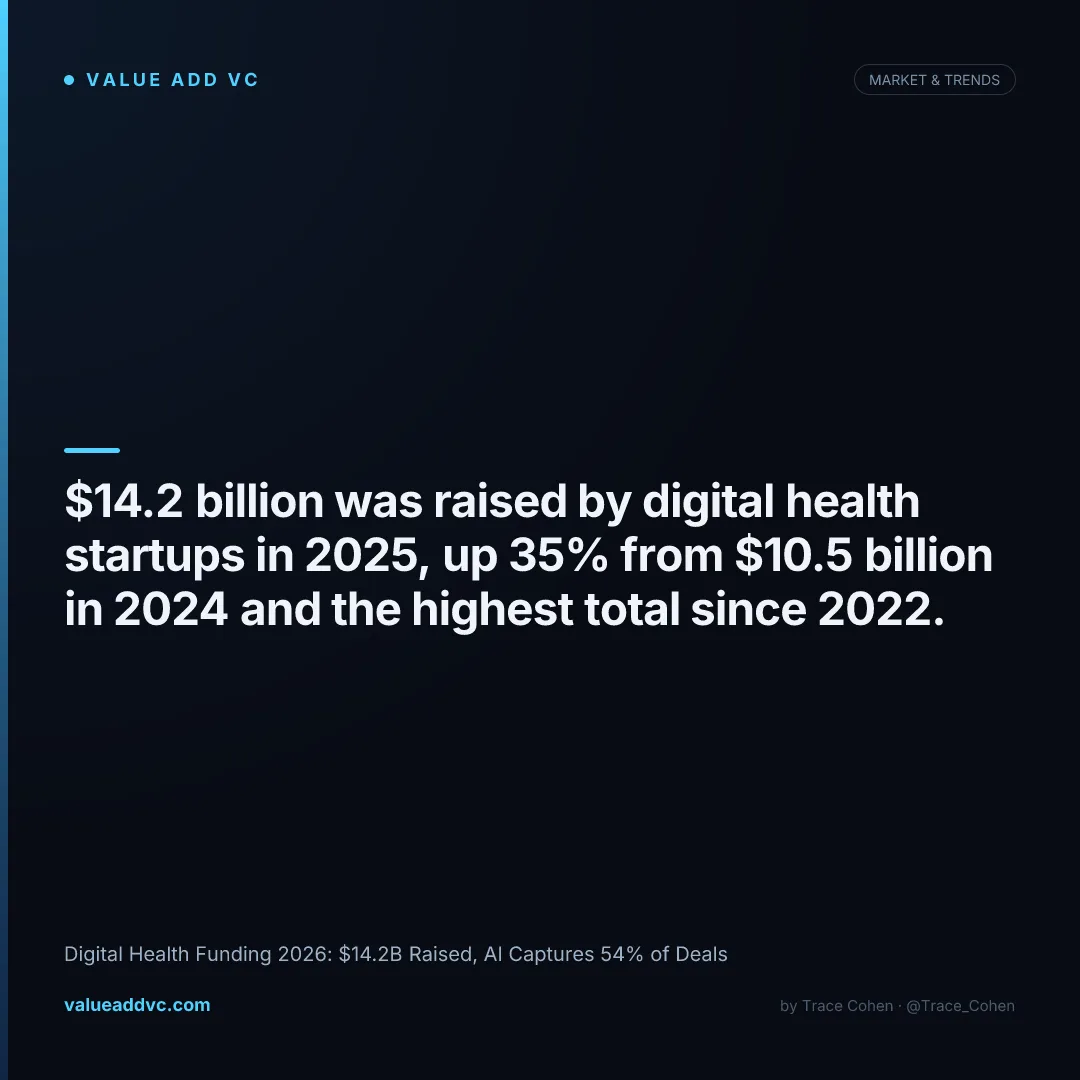
Digital health startups raised $14.2 billion in 2025, up 35% from $10.5 billion in 2024, and AI-branded companies captured 54% of every dollar invested. This isn't a broad recovery — it's a dozen mega-deals a quarter propping up a market where deal count keeps shrinking.
I've watched digital health go from the 2021 free-money peak to the 2022-2023 crash to what Rock Health is now calling a "tale of two markets." The headline total looks like a recovery. The deal-count data underneath it tells a very different story about who's actually getting funded in 2026.
Digital Health Funding in 2026: What's Getting Funded After the Post-COVID Crash
U.S. digital health startups raised $14.2 billion across 482 deals in 2025, a 35% jump from the $10.5 billion raised across 509 deals in 2024, and the highest annual total since 2022. Fewer deals moved more money: average deal size rose to $29.3 million in 2025 from $20.7 million in 2024, and 26 mega-deals of $100M or more accounted for 42% of total dollars — the highest mega-deal concentration since 2021. Fifteen new digital health unicorns were minted in 2025, up from six the year before.
The recovery is real in dollar terms but narrow in distribution. Investors aren't spreading capital back across the market the way they did in 2021 — they're concentrating bigger checks into fewer companies that have already proven traction, which is the same late-cycle pattern showing up across broader venture. You can see similar concentration trends across the AI funding market on our AI valuations dashboard.
Digital Health Funding by Year: 2023-2026
Q1 2026 alone brought in $4.0 billion across 110 deals, a full billion dollars ahead of Q1 2025's $3.0 billion across 122 deals, and H1 2026 totaled $22.6 billion versus $21.4 billion in H1 2025. At the current mega-deal pace, Rock Health projects roughly 50 rounds of $100M-plus closing in 2026, nearly double 2025's count. That trajectory puts full-year 2026 on pace to meaningfully exceed the $14.2 billion raised in 2025, assuming the second half doesn't slow.
Where AI Is Capturing Digital Health Dollars in 2026
AI-branded companies captured 54% of all 2025 digital health funding, up from 37% in 2024, and Rock Health retired its standalone "AI deal" tracking category in 2026 because AI functionality is now considered table stakes rather than a differentiator worth flagging separately. Within H1 2026's $22.6 billion, mental health led therapeutic categories at $1.27 billion across 14 deals — even as venture funding into behavioral health platforms keeps consolidating around a few large winners — neurology drew $718 million across 10 deals, and the disease-agnostic AI layer alone absorbed $2.88 billion. Six of the ten largest disclosed 2026 rounds sit in research solutions or AI-biology categories rather than traditional patient-facing apps.
| Company | 2026 round | Amount | Category |
|---|---|---|---|
| Earendil Labs | Growth round | $787M | AI drug discovery |
| WHOOP | Series G | $575M | Wearables / AI health |
| Isomorphic Labs | Growth round | $600M | AI-biology |
| OpenEvidence | Series D | $250M | Clinical AI search |
| Talkiatry | Series D | $210M | Mental health |
| Capchase (adjacent fintech) | Debt facility | $200M | Healthcare vendor financing |
| Trase | Growth round | $107M | AI clinical agents |
Figures are 2026 estimates blended from Rock Health, Galen Growth, Fierce Healthcare, and citybiz funding trackers. Round sizes and valuations reflect the most recently disclosed figures as of Q2 2026 and are subject to revision as terms are finalized.
Deal Count vs. Dollar Volume: The Concentration Problem
The number of financed digital health ventures fell from 975 in H1 2025 to 608 in H1 2026, even as total dollars stayed roughly flat near $22 billion — meaning the same amount of capital is now being split among nearly 40% fewer companies. Nearly 60% of Q1 2026's investment came from just 12 mega-deals, and average deal size hit $36.7 million in Q1 2026, the highest single-quarter average since Q4 2021. For founders raising a seed or Series A today, that concentration means the funding environment looks stronger in headlines than it feels in an actual fundraise unless you're already at scale.
The Post-COVID Crash, and Why 2026 Isn't a Full Recovery
Digital health funding peaked at roughly $29.1 billion in 2021 on the back of pandemic-driven telehealth adoption, then crashed to $15.3 billion in 2022 and bottomed around $10.7 billion in 2023 as valuations reset and dozens of pandemic-era darlings either shut down or sold at down rounds. The $14.2 billion raised in 2025 is a meaningful recovery off that 2023 floor, but it's still less than half the 2021 peak, and the composition of who's getting funded has changed entirely. In 2021, capital was chasing almost any company with a telehealth or remote-monitoring angle; in 2026, it's chasing companies with a defensible AI model, proprietary clinical data, or a workflow moat that's hard for a hospital system or payer to replicate internally.
Not every large round moves the valuation needle, either — Function Health raised $450M in 2026 without its $2.5B price tag budging at all, a structure built specifically to avoid the dilution math driving these bigger checks. That shift matters for how you read the headline numbers. A 35% year-over-year jump sounds like a broad-based recovery, but it's really a small number of very large checks — Earendil Labs' $787 million round and Isomorphic Labs' $600 million round together account for more capital than the bottom 300+ deals of 2025 combined. Investors who got burned on 2021-vintage digital health bets are now underwriting fewer, bigger positions in companies that look more like AI infrastructure plays than consumer health apps, which is the same dynamic reshaping enterprise software funding more broadly — and it shows up almost identically in what got funded and what failed in proptech this year.
What This Means If You're Raising a Digital Health Round in 2026
If you're a founder building in digital health right now, the data points to three practical takeaways. First, category matters more than it used to: mental health, neurology, and disease-agnostic AI absorbed a disproportionate share of H1 2026 dollars, so a generic point-solution outside those categories will face a harder time even with strong metrics. Second, the bar for what counts as "AI-native" has risen sharply — with AI functionality now considered table stakes rather than a differentiator, investors are underwriting the depth of your data moat and clinical validation, not just the presence of a model in your stack. Third, expect longer diligence cycles and larger minimum check sizes at every stage, since the same investors writing $36.7 million average rounds are also pushing seed and Series A rounds to be larger and less frequent than in 2021-2022.
None of this means digital health is a bad category to build in — quite the opposite, given $14.2 billion in 2025 dollars and a healthy 195-deal M&A market for exits. It means the fundraising playbook that worked in 2021 (raise fast on a growth story, spend on customer acquisition, raise again) doesn't work in 2026. The playbook now looks more like enterprise SaaS: prove a defensible technical moat, show real revenue or clinical outcomes data, and expect investors to reward concentration of proof over breadth of narrative. Founders evaluating whether venture is even the right capital source should also weigh alternatives — revenue-based financing has become a real option for digital health companies with recurring payer or subscription revenue that want to avoid further dilution at today's valuations.
M&A and Exit Activity Picking Up
Digital health M&A activity surged to 195 deals in 2025, up 61% from 2024's five-year low, which matters for LPs and GPs watching for liquidity signs in a sector that has been mostly locked up since 2022. Rising M&A alongside 15 new unicorns in 2025 suggests strategic acquirers and late-stage investors are both willing to pay up for companies with real AI-driven differentiation, even as early-stage deal flow keeps thinning. That's consistent with what we're tracking across broader startup exit data on our tech IPO dashboard.
The practical read for founders: if you're building something AI-native with a defensible data or clinical-workflow moat, 2026 is a genuinely good year to raise — the $36.7 million average deal size and record mega-deal share prove capital is available at scale. If you're building a more generic patient-engagement or telehealth app without a clear AI wedge, you're competing for a shrinking pool of early-stage checks against 975-to-608 deal-count math that isn't moving in your favor.
The Bottom Line
Digital health funding in 2026 is not a return to 2021-style exuberance — it's a bifurcated market where $14.2 billion in 2025 dollars and a projected 50 mega-deals in 2026 mask a 38% drop in the number of companies actually getting funded. AI capturing 54% of all dollars isn't optional positioning anymore; it's the price of entry for getting into the room with investors writing $36.7 million average checks. Watch the deal-count trend more than the dollar total — that's the number that tells you whether this recovery is broadening or just getting more concentrated at the top.
$14.2B raised in 2025. 54% went to AI companies. Deal count is down 38% year-over-year.
Digital health isn't back — it's concentrating around AI and mega-deals.
Track how AI-native startups are being valued on our AI Valuations Dashboard at Value Add VC. Originally published in the Trace Cohen newsletter.
Latest from the Pulse
Get VC data most people never see
— 100% free
Weekly benchmarks, valuations, and fund data. Join 5,000+ investors. No spam.