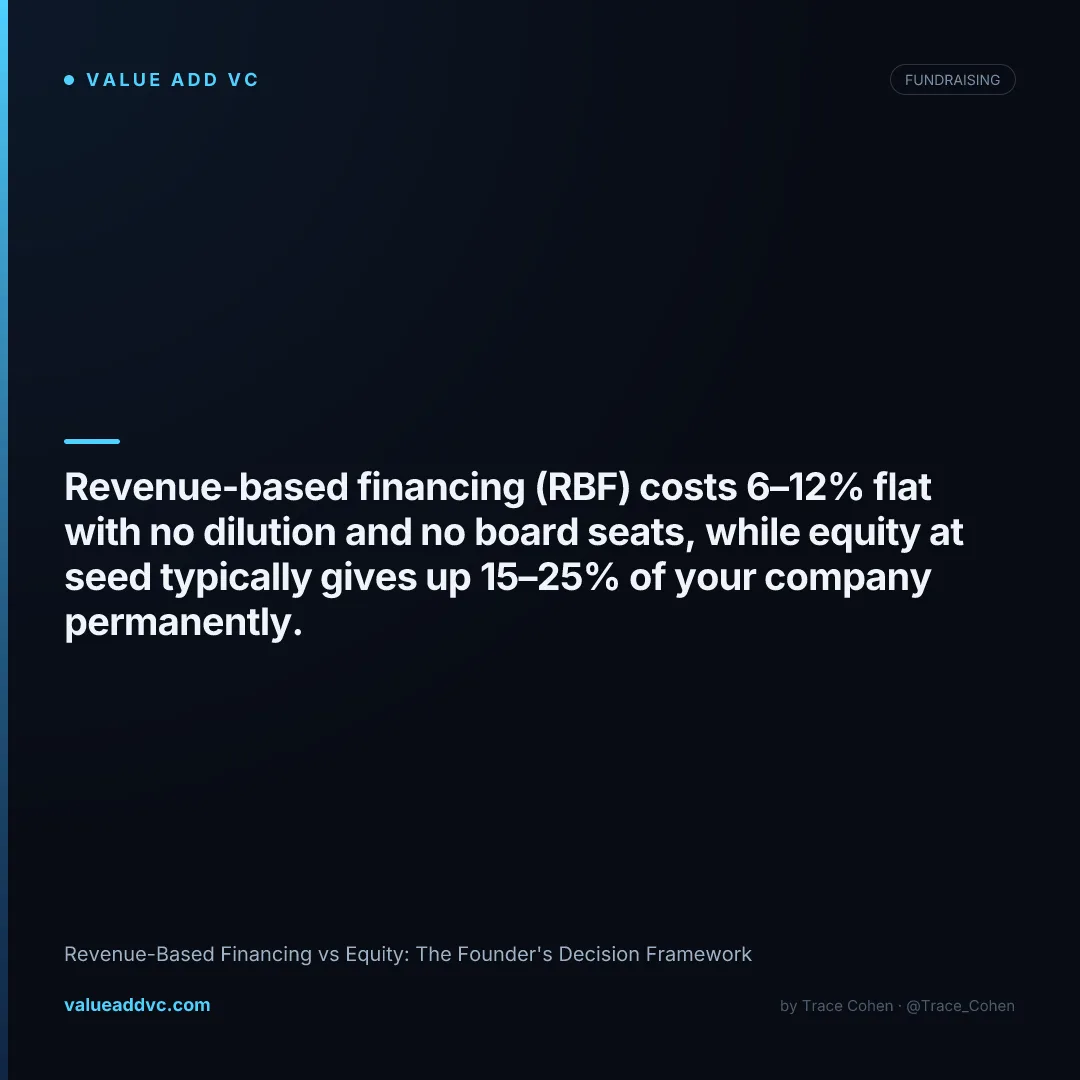
The average seed round in 2026 gives away 18–22% of your company at a $10–14M post-money valuation. Revenue-based financing gives away zero percent, and the total cost is 6–12 cents on the dollar.
Those two sentences make RBF sound like an obvious win. It isn't. Revenue-based financing is a structurally specific tool — one that works exceptionally well for certain businesses and destroys others. The decision framework matters more than the headline cost comparison.
What Revenue-Based Financing Actually Is
RBF providers advance capital — typically 1–3x your monthly recurring revenue — in exchange for a fixed percentage of future revenues until you've repaid a predetermined cap. Rates and structures shifted meaningfully in 2026: Pipe wound down the original marketplace model that made it famous, and Founderpath has become one of the largest remaining SaaS-focused lenders. Current published terms as of August 2026:
| Provider | Advance / Min. Revenue | Flat Fee / APR | Best For |
|---|---|---|---|
| Founderpath | $500K+ trailing revenue | 7% flat/yr or 14% APR | B2B SaaS, no personal guarantee |
| Capchase Grow | $150K+ ARR floor | 10–12% flat | Subscription SaaS, 3–24 mo terms |
| Lighter Capital | $50K–$4M / $15K+ MRR | 8–12% | B2B SaaS with recurring revenue |
| Clearco | Up to 3x MRR | 6–12% | E-commerce, SaaS |
| Wayflyer | $10K+/mo revenue | Varies by risk | E-commerce inventory and ad spend |
Source: Founderpath provider comparison, company pricing pages, August 2026.
The Real Cost Comparison: Revenue-Based Financing vs Equity
The equity cost is not 20% upfront — it compounds across every subsequent round. Here's what that actually looks like on a hypothetical $500K raise at seed:
RBF: $500K Advance
- • Total repayment: $560K–$600K (12% flat fee)
- • Equity given up: 0%
- • Effective APR (12-month repayment): ~22%
- • Board seats: None
- • Information rights: None
- • Future fundraising: Unconstrained
Equity: $500K Seed
- • Post-money valuation: ~$3–5M (typical pre-revenue seed)
- • Equity given up: 10–17%
- • If company exits at $50M: cost is $5–8.5M
- • Board seats: Often 1 observer or full seat
- • Information rights: Typically yes
- • Future fundraising: Requires cap table management
The equity math only looks cheap if the company doesn't work. If you exit at $100M on a 10% seed dilution, that "cheap" $500K cost you $10M. RBF at 12% flat cost you $60K. For a capital-efficient SaaS that exits, RBF is almost always cheaper in absolute dollars — but only if the business can generate the revenue to repay it. (See current SaaS valuation multiples for context on what exit multiples look like today.)
When Revenue-Based Financing Wins
RBF is structurally correct in four specific scenarios:
Capital-efficient SaaS with predictable MRR
If you have $50K+ MRR, growing 10–20% month-over-month, and a clear customer acquisition cost with 6–12 month payback, RBF is cheaper than equity by a large margin. The revenue share is predictable and doesn't spike your effective APR.
Signal: MRR: $50K+, CAC payback: <12 months
Bridge to a higher-valuation equity round
If you're 6–9 months from a Series A with demonstrated metrics, taking RBF to accelerate growth and raise at a 20–30% higher valuation saves far more in dilution than the flat fee costs. Many founders use $250K–$1M in RBF to reach the MRR threshold that unlocks institutional pricing.
Signal: Series A target MRR: $200–400K
Founders who've already given up significant equity
If you're post-seed with 60–65% founder ownership and a strong revenue profile, every incremental equity round is more expensive than before. RBF protects the remaining ownership for the rounds where strategic capital genuinely matters.
Signal: Founder ownership: <70% pre-RBF
Marketing and customer acquisition spend with clear unit economics
Paid acquisition with a tracked LTV:CAC ratio above 3x and 12-month payback is exactly the use case RBF was designed for. You're essentially borrowing against future revenue that you have high confidence in generating. This is why e-commerce and performance-marketing-driven SaaS use RBF most heavily.
Signal: LTV:CAC > 3x, payback < 12 months
When Equity Wins (and RBF Would Break You)
Three situations where equity financing is structurally superior — not just marginally better, but where RBF actively creates risk:
Long payback cycles
If your product requires 18–36 months to generate revenue (biotech, hardware, enterprise SaaS with 9-month sales cycles), the monthly revenue share kills cash flow before the business matures. Equity has no payment schedule.
Capital-intensive markets
If you need $10M+ to reach meaningful scale — infrastructure, manufacturing, deep tech — RBF advance sizes (capped at 1–3x MRR) won't close the gap. Equity can write the check RBF cannot.
Strategic relationships matter
Sequoia, a16z, and Benchmark don't just write checks — they open enterprise doors, make introductions, and signal credibility to your next hire. RBF providers offer capital and analytics. If GTM is your constraint, not cash, equity from the right partner wins.
The Decision Framework
Run through these four questions in order. The first "no" tells you which path to take.
1. Do you have $30K+ MRR with at least 6 months of data?
2. Will the capital deploy into activities with payback under 18 months?
3. Do you need strategic help beyond capital (GTM, hiring, enterprise intros)?
4. Is the advance size large enough to move the needle?
Many founders also combine both: equity for the strategic relationship and headline check, RBF for the ongoing customer acquisition spend. This is increasingly common at Seed and Series A — institutional capital to establish the company, non-dilutive capital to run the growth engine. Check the Startup Benchmarking Dashboard to understand where your MRR, CAC payback, and growth rate stand relative to funded peers raising at your stage.
What's Changed Since Spring 2026
The RBF market consolidated over the summer. Pipe, once the category's highest-profile brand, wound down the open marketplace model that let founders auction their revenue contracts to institutional buyers — a shift PitchBook covered as part of a broader move toward direct-lender models like Founderpath and Capchase Grow. Founders who previously got Pipe quotes should re-shop with a direct lender rather than assume the old marketplace pricing still applies.
This likely means the RBF market is bifurcating: durable, well-capitalized direct lenders (Founderpath, Capchase, Lighter Capital) are absorbing the volume that used to flow through marketplaces, while thinner-margin players consolidate or exit. For founders, that's a net positive — fewer intermediary fees, but also fewer competing bids on any single deal, so getting 2–3 term sheets before signing matters more than it did in 2025.
Revenue-based financing is not cheap debt — it's expensive at the APR level.
But for the right business, it's cheaper than selling equity you'll regret giving away at the worst possible time in your company's history.
Compare your startup's metrics against funded peers on the Benchmarking Dashboard at Value Add VC. Originally published in the Trace Cohen newsletter.
Latest from the Pulse
Get VC data most people never see
— free to subscribe
Trace's notes on venture, AI and startups, a few times a week. Join 5,000+ subscribers. No spam.
No spam, unsubscribe anytime. Sent via Substack · Privacy · or subscribe on Substack ↗