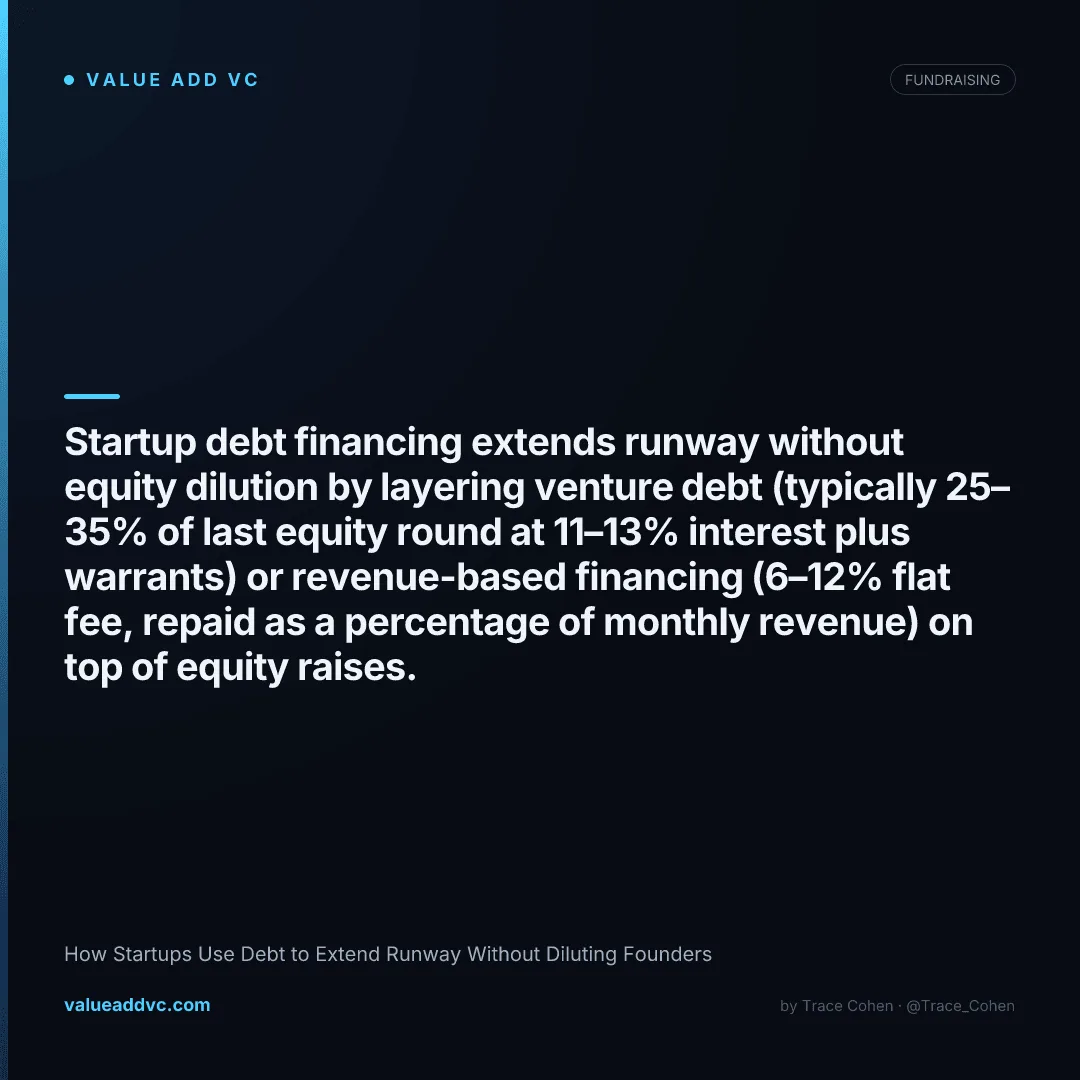
Startup debt financing for runway is not a fallback. It is a deliberate capital stack decision that can save 15–25% of your equity — or accelerate your death if you use it wrong.
I have seen founders raise venture debt at exactly the right moment and walk into their Series B 12 months later at a valuation 3x higher than they would have reached without the bridge. I have also watched companies take on $4M in debt they could not service, trigger covenants at month eight, and lose control of the business entirely. The instrument is neutral. The timing and structure are everything.
Here is the clear-eyed framework for when and how to use startup debt financing to extend runway without diluting founders.
The Three Main Tools for Non-Dilutive Runway Extension
Not all startup debt is created equal. The three instruments founders most commonly use serve very different purposes and carry very different risk profiles.
Typical size
25–35% of last equity round
Best for
Post-Series A or B companies with institutional VC backing; extending runway to a binary milestone
Key risk
Financial covenants — minimum cash, minimum revenue growth — can trigger early repayment
Typical size
$100K–$5M, scaled to MRR
Best for
SaaS companies with $100K+ MRR, 60%+ gross margins, short CAC payback; funding growth campaigns
Key risk
High effective APR if you repay quickly; not suitable for pre-revenue or long sales cycle businesses
Typical size
Up to 80–90% of eligible receivables
Best for
B2B companies with long payment cycles or hardware companies with inventory carrying costs
Key risk
Only works if you have real receivables; draws down on customer relationships if lender contacts them
The Real Math: Debt vs. Equity on a $10M Series A
The reason founders reach for startup debt financing for runway is simple: equity is expensive. If you give up 20% at your Series A and could have waited 12 months with $3M in venture debt to raise at a 3x higher valuation, you cost yourself millions in dilution for your team and yourself. Here is the concrete math:
| Scenario | Post-money Val | Capital Raised | Dilution | True Cost |
|---|---|---|---|---|
| Raise equity now (early milestone) | $15M | $3M | 20% | 20% equity |
| Venture debt now, equity later (stronger milestone) | $45M | $3M debt + $10M eq. | ~8% eq. + 1% warrants | ~$390K interest + 9% |
| RBF for growth sprint only | $15M → $30M | $2M RBF | 0% | ~$200K flat (10% fee) |
Assumptions: 3x valuation improvement over 12 months with debt, 12% venture debt interest rate, 1% warrant coverage, 10% RBF fee. Illustrative — not financial advice.
When Startup Debt Financing for Runway Actually Works
Debt is not magic. It works when specific conditions are true. Miss these, and you are just adding a time bomb to a struggling business.
✓ You have a clear binary milestone
FDA approval, enterprise contract close, specific ARR target — something that dramatically changes your valuation in 6–18 months.
✓ Your revenue is predictable
Debt service requires cash. If revenue is lumpy, early covenant triggers can force a sale. Consistent MRR is the key qualifying factor for most lenders.
✓ Institutional VCs are co-signing
Virtually every major venture debt lender requires a lead VC on your cap table. Solo-funded companies and bootstrapped startups rarely qualify.
✓ You are not solving a product problem with capital
Debt amplifies whatever trajectory you are already on. If the business is broken, more runway just delays the reckoning and adds creditors to the cap table.
The 2026 Lender Landscape After SVB
Silicon Valley Bank's March 2023 collapse wiped out the dominant venture debt lender overnight. The market has consolidated around a smaller set of institutional players, and terms have tightened. Here is where startups are actually getting debt capital today:
Hercules Capital
Late seed through growth stage; $2M–$100M facilities; NYSE-listed BDC with strong balance sheet
Best for: Series A–C SaaS, life sciences, tech
Western Technology Investment (WTI)
Early-stage focused; will do $1M facilities for seed-stage companies with VC backing
Best for: Seed–Series A, deep tech, SaaS
Lighter Capital
Pure RBF; $10K–$4M; no VC required; fastest underwriting in the market (often 2 weeks)
Best for: B2B SaaS, $30K+ MRR, 50%+ gross margins
Arc
RBF and credit lines for SaaS; integrates directly with Stripe, QuickBooks for real-time underwriting
Best for: SaaS with $50K+ MRR; US-based
Runway Growth Capital
Larger facilities for growth-stage; $5M–$100M; requires institutional VC sponsorship
Best for: Series B+ companies with $5M+ ARR
Check current startup benchmarking data and SaaS valuation multiples to understand how lenders are sizing facilities relative to ARR multiples in the current market.
What Investors Actually Think About Debt on the Cap Table
Most VCs are indifferent to modest venture debt — they have seen it a thousand times. What they scrutinize is the ratio and the covenant structure. Specific flags I watch for in diligence:
- ✕Debt exceeding 50% of the last round: signals the company is in distress-mode capital-raising, not opportunistic debt deployment.
- ✕Covenants with <6 months of cushion: if the minimum cash covenant leaves only a 3-month buffer at current burn, the company is perpetually in covenant-breach risk.
- ✕Debt used to fund operating losses, not growth: debt should be deployed into initiatives with measurable ROI — growth campaigns, inventory — not to keep the lights on.
- ✓Venture debt taken immediately after a clean equity raise: the strongest signal — company is proactively extending runway, not scrambling. Lenders also offer the best terms in this window.
- ✓RBF for a specific, bounded campaign: using $500K in RBF to fund a marketing channel test with clear unit economics is exactly what the instrument is designed for.
The right question is not "can we get debt?" — it is "do we know exactly what milestone we are buying time to hit?"
Startup debt financing extends runway. It does not fix business models. Use it when you know what you are building toward — not when you are buying time to figure that out.
Benchmark your burn rate and runway against stage-appropriate peers on the Benchmarking Dashboard at Value Add VC. Originally published in the Trace Cohen newsletter.
Latest from the Pulse
Get VC data most people never see
— free to subscribe
Trace's notes on venture, AI and startups, a few times a week. Join 5,000+ subscribers. No spam.
No spam, unsubscribe anytime. Sent via Substack · Privacy · or subscribe on Substack ↗