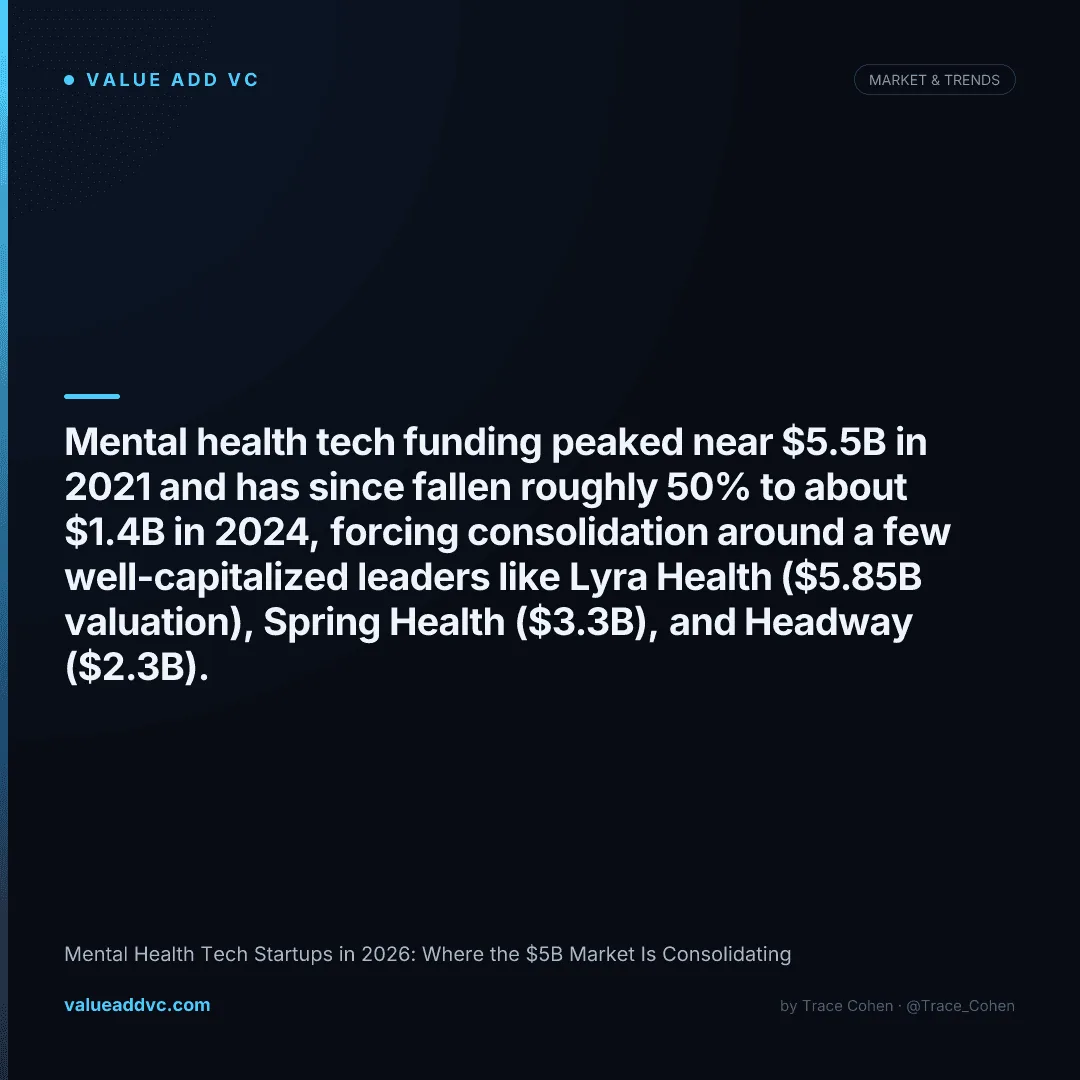
Mental health tech funding peaked at roughly $5.5B in 2021 and has since fallen about 50% to near $1.4B in 2024 — and that contraction is exactly why the surviving startups are bigger, not smaller. The capital is consolidating around a handful of employer- and insurance-distributed platforms valued above $2B each.
"The market is consolidating" usually reads as bad news — here it isn't. The 2021 bubble funded a few hundred apps chasing the same anxious consumer with the same meditation timer. Most of them are gone. What's left is a smaller set of companies that figured out the only distribution that works in healthcare: getting an employer or a health plan to pay. Here's who won, what they're actually worth, and where I'd put money in 2026.
Mental Health Tech Startups in 2026: What the Market Looks Like Now
Mental health tech startups in 2026 operate in a market that has consolidated sharply since the 2021 funding peak of about $5.5 billion. A few well-capitalized leaders — Lyra Health, Spring Health, and Headway, each valued above $2 billion — now dominate venture attention, while dozens of direct-to-consumer apps have shut down, merged, or been absorbed. The category is bigger by revenue but narrower by company count.
The headline distinction is distribution. The winners don't sell to individuals downloading an app at 2 a.m. — they sell to HR departments and insurers who pay per covered employee or per reimbursed visit. That single design choice separates the multi-billion-dollar platforms below from the wreckage of the consumer-app era. Here is the current leaderboard.
| Company | Model | Valuation | Raised | Distribution |
|---|---|---|---|---|
| Lyra Health | Employer EAP + therapy | ~$5.85B | ~$910M | Large employers |
| Spring Health | Employer mental health | ~$3.3B | ~$466M | Employers / payers |
| Headspace | Meditation + clinical care | ~$3.0B | ~$400M+ | B2B2C + consumer |
| Headway | In-network therapy network | ~$2.3B | ~$225M+ | Health insurance |
| Calm | Consumer meditation app | ~$2.0B | ~$218M | Direct-to-consumer |
| Talkspace (TALK) | Teletherapy | ~$0.5B mkt cap | Public | Payers + consumer |
| Cerebral | Telepsychiatry / Rx | ~$0.5B (from $4.8B) | ~$462M | Direct-to-consumer |
| BetterHelp (Teladoc) | Teletherapy marketplace | Part of TDOC | ~$1B revenue | Direct-to-consumer |
Figures are 2025–2026 estimates blended from PitchBook, CB Insights, Crunchbase, and company press releases. Valuations reflect last-known primary rounds and may differ from current secondary marks; Talkspace and BetterHelp figures reflect public filings from Talkspace and Teladoc Health.
Why Mental Health Tech Startups Are Consolidating in 2026
Three forces drove the consolidation, and they reinforced each other. First, the macro reset: the 2022–2024 venture downturn raised the bar on revenue quality across all of digital health — total digital health funding fell from a 2021 record to about $10.1 billion in 2024 per Rock Health, and mental health, as the most overfunded clinical category, fell hardest. Second, trust evaporated after a string of blowups. Third, the underlying unit economics of direct-to-consumer mental health simply never worked at scale.
| Year | Mental Health Funding | Trend |
|---|---|---|
| 2019 | ~$0.9B | Pre-pandemic baseline |
| 2020 | ~$2.4B | COVID acceleration |
| 2021 | ~$5.5B | All-time peak |
| 2022 | ~$3.3B | Correction begins |
| 2023 | ~$2.0B | Flight to quality |
| 2024 | ~$1.4B | Consolidation floor |
Annual mental health startup funding figures are directional estimates blended from CB Insights, Rock Health, and PitchBook digital-health reports. Totals vary by source depending on whether teletherapy, wellness, and behavioral-health-adjacent deals are included.
The cautionary tale is Cerebral, which raced to a $4.8 billion valuation in 2021 on a telepsychiatry-plus-prescription model, then collapsed under a DOJ investigation into its controlled-substance prescribing, multiple rounds of layoffs, and a leadership purge. It became the case study every later-stage investor cited for why "growth at all costs" in regulated healthcare is a trap. You can see the same employer-side fallout in our Tech Layoffs tracker.
The Distribution Winners: Employer and Insurance Channels
The companies that survived all answered the same question correctly: who actually pays? Lyra Health and Spring Health sell into the employee-benefits budget — large employers contract for mental health coverage the way they contract for dental, producing multi-year, recurring revenue with low churn and customer-acquisition costs that an app store can never match. Lyra reached a ~$5.85 billion valuation on that model; Spring raised at ~$3.3 billion.
Headway took a different but equally durable path: it built the rails that let independent therapists accept health insurance and get paid reliably, then took a cut of in-network visits. That positions it inside the reimbursement system rather than fighting it, and it earned a ~$2.3 billion valuation by late 2024. The common thread is that all three are infrastructure for an existing payer, not a consumer brand begging for attention. Several have crossed into unicorn territory and show the kind of recurring-revenue profile we track on the SaaS Valuations dashboard.
The losers were the mirror image. Pure direct-to-consumer apps faced churn rates that made paid acquisition unprofitable — a meditation subscription a user cancels in three months can't justify a $60 customer-acquisition cost. Tracking that dynamic in real time requires a product analytics platform like Amplitude, but even perfect visibility couldn't fix the underlying unit economics. Calm ($2.0B) and Headspace survived by going B2B2C and selling into employers and health plans too; the apps that didn't pivot mostly disappeared.
Where AI Fits Into Mental Health Tech Startups in 2026
AI is the loudest theme and the most overhyped one. The honest 2026 picture: AI is reshaping the workflow of mental health tech, not replacing the clinician. The highest-value uses are triage and intake, automated measurement-based care, and ambient clinical documentation that gives therapists back administrative hours — the same back-office leverage AI is delivering across healthcare operations.
The frontier is conversational support. Slingshot AI raised $93 million in 2025 to build an AI model purpose-built for psychology — part of a broader surge in AI startup funding — and a wave of chatbot-first entrants is testing whether software can deliver evidence-based techniques like CBT at near-zero marginal cost. The counterweight is regulation and liability: the FDA cleared Rejoyn — the first prescription digital therapeutic for major depressive disorder — in 2024, but the clearance bar for anything that diagnoses or treats keeps autonomous AI therapy years away for serious conditions.
For founders, that's the strategic tension. Pure AI companion apps can grow fast and cheap but inherit the same D2C retention problem that sank the last cycle — plus real safety risk. The defensible play is AI inside a reimbursable clinical model, where the technology lowers cost-to-serve on revenue that's already contracted. That's the same infrastructure-versus-application logic playing out across the broader AI agent market.
The Numbers Behind the Demand
None of this consolidation reflects shrinking demand — the opposite. Roughly 59 million U.S. adults (about 23%) experience mental illness in a given year, U.S. mental health spending runs north of $280 billion annually, and the chronic shortage of clinicians means access — not interest — is the binding constraint. The global digital mental health market is still projected to roughly double from about $19–20 billion in 2025 to near $45 billion by 2030.
So the story isn't a category in decline — it's a category that got repriced. The 2021 vintage funded distribution-less apps at growth-stock multiples; the 2026 vintage funds clinically rigorous, reimbursable platforms at saner ones. That's a healthier market to invest in, even if the headlines about app shutdowns sound grim.
The Bottom Line
Mental health tech didn't collapse — it concentrated. Funding fell ~50% from a $5.5B peak, but the survivors (Lyra at $5.85B, Spring at $3.3B, Headway at $2.3B) are bigger because they sell to employers and insurers, not individuals.
If I'm underwriting mental health tech in 2026, the filter is simple: who pays, and how recurring is it? The platforms wired into the employer-benefits or insurance-reimbursement budget have durable, low-churn revenue and a clear path to profitability. The direct-to-consumer apps — and most pure AI-companion plays — still fight the same retention math that sank the last cycle. AI is a margin lever inside a reimbursable model, not a business model on its own. Bet on distribution and clinical rigor, and the $45B-by-2030 demand curve does the rest.
Track unicorn valuations, SaaS multiples, and tech layoffs on the Unicorn Tracker, SaaS Valuations, and Tech Layoffs dashboards at Value Add VC. Originally published in the Trace Cohen newsletter.
Latest from the Pulse
Get VC data most people never see
— 100% free
Weekly benchmarks, valuations, and fund data. Join 5,000+ investors. No spam.