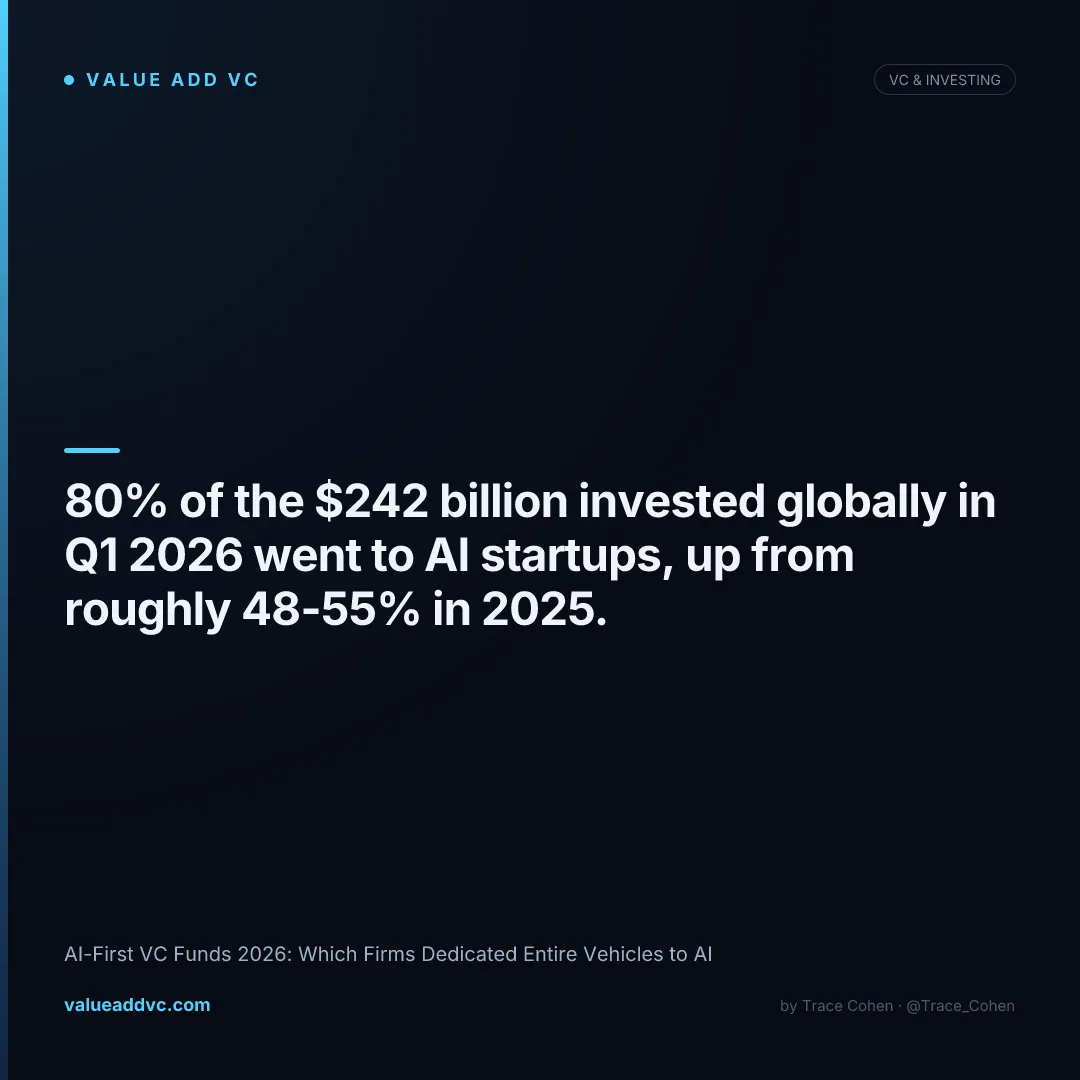
AI startups took $242 billion of the $300 billion invested globally in Q1 2026 — 80% of all venture capital deployed that quarter. Behind that number, a growing list of firms have stopped treating AI as a sector inside a generalist fund and started raising vehicles that exist for nothing else.
ICONIQ Capital is running an estimated $26 billion AI-focused war chest. Kleiner Perkins closed a $3.5 billion fund dedicated exclusively to AI. a16z structured $6.75 billion of its record $15B+ 2026 raise as a growth vehicle concentrated in AI and infrastructure. General Catalyst layered a separate $1.5 billion AI roll-up strategy on top of its core fund. None of this is incidental — it's a structural bet that AI-sector returns will outpace diversified venture returns by enough to justify concentrating capital in a single thesis.
Which Firms Are Dedicating Entire Vehicles to AI in 2026?
Firms dedicating entire vehicles to AI in 2026 include ICONIQ Capital ($26B AI-focused pool), Kleiner Perkins ($3.5B AI-only fund), a16z ($6.75B growth fund concentrated in AI), General Catalyst ($1.5B AI roll-up strategy plus a reported $10B raise in progress), and Thrive Capital ($10B fund weighted heavily toward AI, including its OpenAI position). These aren't side bets — they're purpose-built pools of capital that let each firm write outsized checks into AI rounds without diluting a generalist fund's exposure to other sectors.
How Much of All VC Funding Is Now AI-First?
The share of venture capital going to AI has climbed every year since 2023. Crunchbase put AI at roughly 48-55% of global VC dollars across 2025, itself a record; CB Insights' methodology landed closer to 48%. That share jumped to 80% in Q1 2026 alone, driven by four mega-rounds — OpenAI's $122 billion raise, Anthropic's $30 billion round, xAI's $20 billion raise, and Waymo's $16 billion round — that together accounted for 65% of the entire quarter's global venture investment. Total 2025 AI funding hit roughly $202 billion, a 75% jump from $114 billion in 2024.
| Period | AI Share of Global VC | Total AI Funding | Source |
|---|---|---|---|
| 2024 (full year) | ~35-40% | $114B | Crunchbase |
| 2025 (full year) | 48-55% | $202B | Crunchbase / CB Insights |
| Q1 2025 | 55% | n/a | Crunchbase |
| Q1 2026 | 80% | $242B | Crunchbase |
| Top 4 rounds, Q1 2026 | 65% of quarter | $188B | Crunchbase |
| OpenAI Q1 2026 raise alone | ~41% of quarter | $122B | Crunchbase |
Figures blended from Crunchbase News, CB Insights, tech-insider.org, and insights4vc, 2024-2026. AI share estimates vary by data provider depending on how "AI startup" is classified.
Inside the Structure of the Four Biggest AI-First Funds
ICONIQ Capital is the least publicly discussed of the group but the largest by dollars committed to AI. The firm built its reputation managing capital for tech billionaires and has quietly rolled that LP base into an estimated $26 billion AI-focused pool, spanning both direct startup investment and infrastructure-adjacent bets. Unlike a16z or Thrive, ICONIQ rarely announces individual fund closes publicly, which means the $26 billion figure is a market estimate rather than a disclosed number — but it's consistently cited as the largest dedicated AI war chest in the industry.
Kleiner Perkins took the opposite approach: a single, explicitly labeled $3.5 billion fund with a mandate that excludes non-AI sectors entirely. That's a meaningful bet for a firm with a 50-plus-year history spanning biotech, cleantech, and consumer internet — Kleiner is telling LPs that its next cycle of returns will come overwhelmingly from AI, not from the sector diversification that defined its earlier funds. a16z split the difference, folding its AI concentration into a $6.75 billion growth fund that sits alongside separate $1.7 billion infrastructure and apps vehicles, so the firm retains sector diversification at the platform level even as its largest single fund skews AI-heavy.
General Catalyst's structure is the most unusual: a $1.5 billion AI roll-up strategy that sits on top of, not instead of, its core venture fund. Rather than just writing growth checks into AI startups, General Catalyst is using that capital to acquire and consolidate traditional service businesses — healthcare administration, insurance back offices — and rebuild them with AI-native operations. That's a private equity playbook wrapped in a venture fund's LP base, and it's a structurally different bet than ICONIQ or Kleiner Perkins are making with straight equity checks into AI-native startups.
Why AI-First VC Funds Exist Instead of Generalist Funds Just Investing More
The structural reason for AI-dedicated vehicles is round size. OpenAI's $122 billion raise, Anthropic's $30 billion round, and xAI's $20 billion round are each individually larger than most VC firms' entire AUM. A $500M-$1B generalist fund physically cannot write a check that moves the needle in a round that size without concentrating the fund dangerously in one company. A dedicated AI vehicle solves that by raising capital specifically earmarked for AI, letting a firm like a16z deploy $6.75B from its growth fund into a handful of mega-rounds while its smaller apps and infrastructure funds ($1.7B each) stay diversified across earlier-stage bets.
It also solves an LP-matching problem. Sovereign wealth funds, pensions, and family offices increasingly want direct AI exposure, not blended exposure across a generalist fund's full sector mix. A standalone AI fund gives them a vehicle to commit to without also underwriting a GP's fintech or biotech theses. You can track how that capital concentration is showing up across firm-level performance on our VC Performance dashboard and see valuation trends on the AI Valuations dashboard.
What AI-First Funds Mean for Managers Without One
I've made 65+ investments and sat on both sides of this dynamic — as a fund manager competing for allocation and as an operator raising from funds of very different sizes. The practical read for a $50M-$300M fund manager watching ICONIQ deploy a $26B AI war chest is that you cannot out-capitalize that firm on a hot late-stage AI round, full stop. Trying to compete on check size against a fund built specifically to write nine-figure AI checks is a losing game.
The funds actually winning allocation in this environment are specializing one level deeper than "AI" — defense AI, applied AI for a specific regulated industry, AI infrastructure at the chip or power layer — where the megafunds' broad AI vehicles have less depth and founders still want a specialist in the round, not just capital. That's the same barbell dynamic showing up across venture generally: platform megafunds on one end, hyper-specialized or pre-seed-focused funds on the other, and a shrinking middle tier that's neither big enough to write the mega-round check nor differentiated enough to win on thesis.
What to Watch Next in AI-First Fund Formation
General Catalyst is reportedly raising a new $10 billion fund on top of its existing AI roll-up strategy, and Founders Fund and Spark Capital are both said to be pursuing larger war chests of their own, per Newcomer's reporting. Menlo Ventures closed its own new $3 billion fund on the back of a $14 billion Anthropic stake, another sign that firms already deep in AI are raising fresh, larger vehicles rather than stretching existing ones. If those raises close near the reported figures, 2026 will have produced more single-year AI-dedicated fund capacity than the entire venture industry raised across all sectors as recently as 2019. The open question is deployment discipline — whether that capital gets allocated at a pace and price that holds up if AI valuations correct, or whether dry powder sits idle while GPs wait for better entry points.
The other signal worth tracking is whether the 80% AI share of Q1 2026 funding holds or reverts toward the 48-55% range seen across 2025. A sustained 80% share would confirm AI has become close to the entire venture asset class rather than one sector within it; a reversion toward 50-55% would suggest Q1's number was inflated by four outlier mega-rounds that won't repeat every quarter.
The Risk in Concentrating an Entire Fund in One Sector
The obvious counterargument to AI-first funds is the same one that applied to every prior sector-concentration bet in venture history: crypto funds raised in 2021, cleantech funds raised in 2007, and biotech-only vehicles raised at various points all delivered strong returns right up until the sector-specific correction hit, at which point LPs in a single-sector fund had no diversification to fall back on. A $3.5 billion fund that can only invest in AI has no mechanism to rotate into a different sector if AI valuations compress the way crypto did in 2022 or cleantech did after 2008. That's a real structural risk that generalist funds don't carry, and it's the trade LPs are explicitly accepting when they commit to a Kleiner Perkins AI-only vehicle instead of a blended fund.
The counter-counterargument, and the reason LPs are still writing these checks at record pace, is that AI's share of total enterprise software and infrastructure spend keeps climbing even as public AI stocks have had multiple sharp pullbacks since 2023. Nvidia alone has seen 15-20% drawdowns several times over the past three years without the underlying capex thesis breaking, which is the closest public-market proxy LPs have for reading whether private AI valuations are due for a similar correction. Whether that pattern holds for the next wave of $100B+ private AI rounds — OpenAI, Anthropic, xAI — is the single biggest unresolved question hanging over every AI-first fund raised in 2026.
AI captured 80% of the $300B invested globally in Q1 2026, and firms like ICONIQ ($26B), Kleiner Perkins ($3.5B), and a16z ($6.75B) have built dedicated vehicles to chase it.
Venture capital isn't diversifying into AI anymore — for a growing share of the biggest firms, AI is the fund.
Track AI-sector valuations and fund performance on the AI Valuations Dashboard at Value Add VC. Originally published in the Trace Cohen newsletter.
Latest from the Pulse
Get VC data most people never see
— free to subscribe
Trace's notes on venture, AI and startups, a few times a week. Join 5,000+ subscribers. No spam.