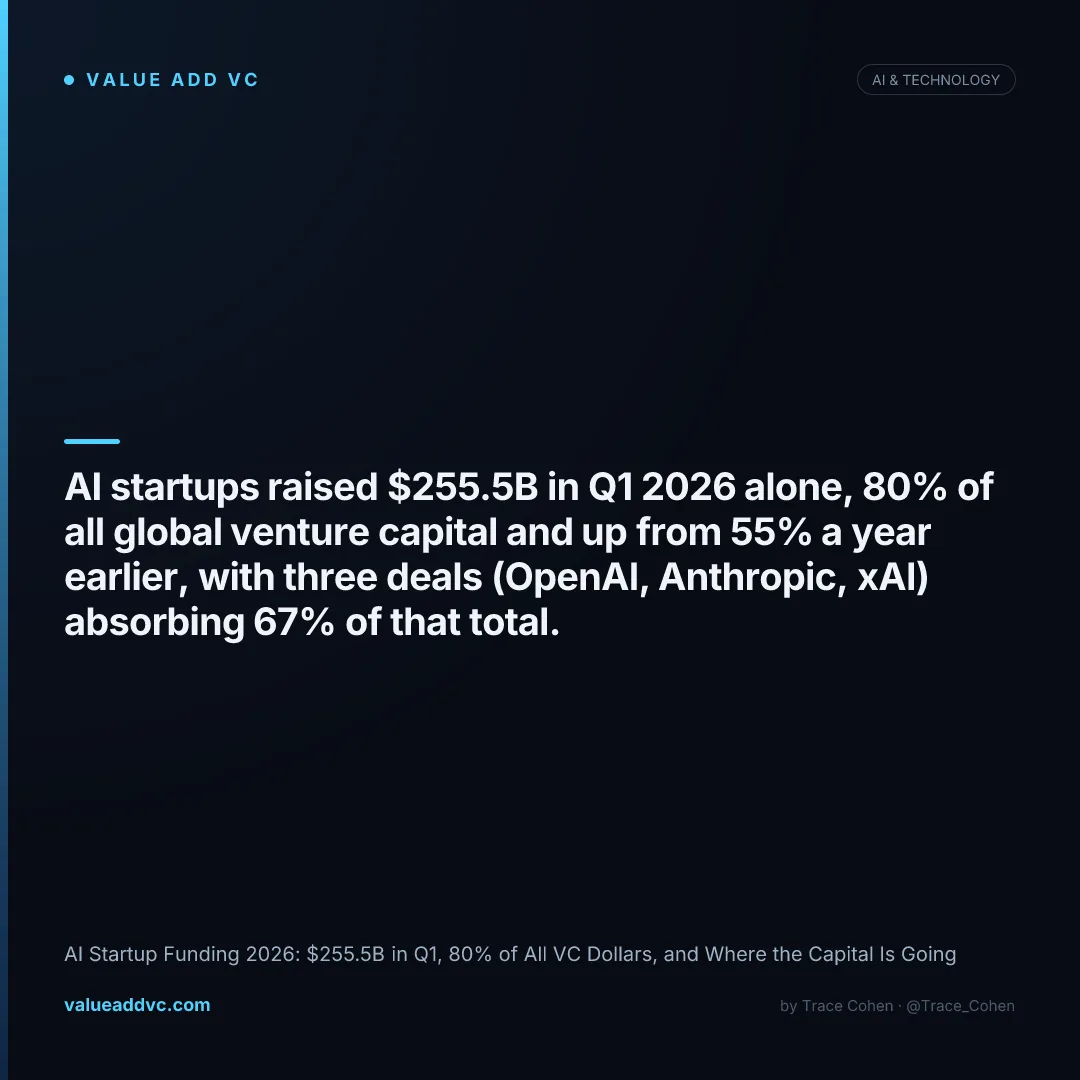
AI startups raised $255.5B in Q1 2026 alone — 80% of every dollar of global venture funding, up from 55% just a year earlier. Where those dollars are concentrating — and which sectors are getting squeezed out — is the real story.
A single quarter of AI funding now exceeds what the entire sector raised in all of 2025. But that headline number hides a market that is bifurcating hard: three companies soaked up two-thirds of the capital, while everyone else — robotics, defense tech, vertical AI, dev tools — is fighting over what's left, and fighting harder every quarter.
How Much AI Startup Funding Happened in 2026, and Where It Went
AI startup funding in 2026 hit $255.5B in Q1 alone, per PitchBook, already ahead of the roughly $254B raised across all of 2025. Crunchbase puts the same quarter at $242B, or 80% of the $297B in total global venture funding — up sharply from AI's 55% share in Q1 2025 and roughly 50% for the full 2025 calendar year.
| Sector | Q1 2026 Capital | Deal Count | Notable Deals | Trend |
|---|---|---|---|---|
| Foundation Models / Horizontal | $197B | 396 | OpenAI $122B, Anthropic $30B, xAI $20B | Surpassed all of 2025 in one quarter |
| Autonomous Machines / Robotics | $29B | 118 | Waymo $16B Series D | Record quarter, tripled prior quarter |
| Defense Tech | $14.6B (YTD) | N/A | Anduril $5B Series H at $30.5B | Already above full-year 2025 record |
| Vertical AI Applications | Consolidating | -51% vs. 2022 peak | Avg deal size doubled YoY to $24M | Fewer, larger, defensible bets |
| AI Infrastructure / Chips | Secondary share | N/A | CoreWeave, Databricks, Cerebras | Steady, non-frontier-lab capital |
| Coding Agents / Dev Tools | $2.3B (single deal) | 1 major round | Cursor / Anysphere Series D | Enterprise coding agents scaling fast |
| Physical AI / Humanoid Robotics | $3.7B+ (combined) | 4 major rounds | Figure $1B, Skild AI $1.4B, Apptronik $935M | Betting embodied AI is the next platform |
Figures are Q1 2026 unless marked YTD, blended from PitchBook, Crunchbase, and company funding announcements. Infrastructure and dev-tools rows reflect representative deals, not full-category totals, since neither tracker breaks those out as cleanly as foundation models, robotics, and defense.
Why AI Startup Funding Concentration Keeps Getting Worse
Three deals — OpenAI's $122B round, Anthropic's $30B raise, and xAI's $20B round — accounted for 67% of all Q1 2026 AI capital, or about $172B of the $255.5B total. That is a higher concentration than most people assume when they read the 80%-of-VC headline. It isn't that AI investing broadened into hundreds of new winners; it's that crossover investors (hedge funds, sovereign wealth funds, mutual fund complexes) are writing venture-sized checks into three frontier labs to avoid missing the round. Track how these valuations stack up on our AI Valuations dashboard.
The trend line makes this look inevitable in hindsight. AI went from roughly 50% of full-year 2025 global VC dollars, to 55% in Q1 2025 specifically, to 63.3% on a trailing-12-month PitchBook basis by Q3 2025, to 80% in Q1 2026. Each step up came from the same handful of names getting bigger checks, not from AI startups broadly becoming easier to fund.
Which AI Sectors Are Actually Winning Outside the Frontier Labs
Autonomous machines and robotics posted a record $29B across 118 deals in Q1 2026, more than triple the prior quarter, driven largely by Waymo's $16B Series D. Defense tech is having its own moment: $14.6B has gone into military, national security, and law enforcement-focused startups in 2026 already, surpassing the sector's previous full-year record of $9.6B set in 2025. Anduril's $5B Series H priced the company at $30.5B in that round (a mark that has since climbed further, per its most recent raise). Explore more of this shift on our Defense Tech dashboard.
Vertical AI applications tell a different story: deal count fell 51% from its Q1 2022 peak even as average deal size more than doubled year-over-year to $24M. Capital isn't leaving vertical AI, it's consolidating into fewer companies that investors believe have built defensible moats within a specific niche, rather than spreading thin across the field. Coding agents had their own breakout moment when Cursor's parent company Anysphere closed a $2.3B Series D, and humanoid robotics absorbed over $3.7B combined across Figure ($1B), Skild AI ($1.4B), Apptronik ($935M), and FieldAI ($405M).
What the 2026 AI Startup Funding Surge Means for Founders and LPs
If you are raising outside of foundation models, the math is straightforward and unforgiving: total AI dollars are up, but the pool available to everyone who isn't OpenAI, Anthropic, or xAI has actually gotten more competitive, not less, because deal counts in vertical AI are falling even as check sizes rise. That favors founders with real revenue, a defensible niche, and enterprise customers over founders with a compelling demo and a large total addressable market slide. For LPs, the concentration risk is now a portfolio-construction problem, not an abstraction — a fund that isn't in the top handful of frontier-lab rounds is, almost by definition, exposed to the 20% of the market growing far more slowly. Compare fund-level exposure and returns on our VC Performance dashboard.
The Bottom Line
AI captured 80% of all global venture funding in Q1 2026, but 67% of that AI capital went to just three companies. That is the real story behind the headline number: this isn't broad-based AI enthusiasm, it's a market where three frontier labs are absorbing an unprecedented share of global venture capital while defense tech, robotics, and vertical AI fight over a shrinking, increasingly consolidated remainder. If you're a founder outside the foundation-model tier, the surge headline doesn't help you — the deal-count decline in your category does. And if you're an LP, ask your GP exactly how much of their AI exposure sits in the top three names versus everything else, because that answer now determines most of a fund's risk profile.
Latest from the Pulse
Get VC data most people never see
— 100% free
Weekly benchmarks, valuations, and fund data. Join 5,000+ investors. No spam.