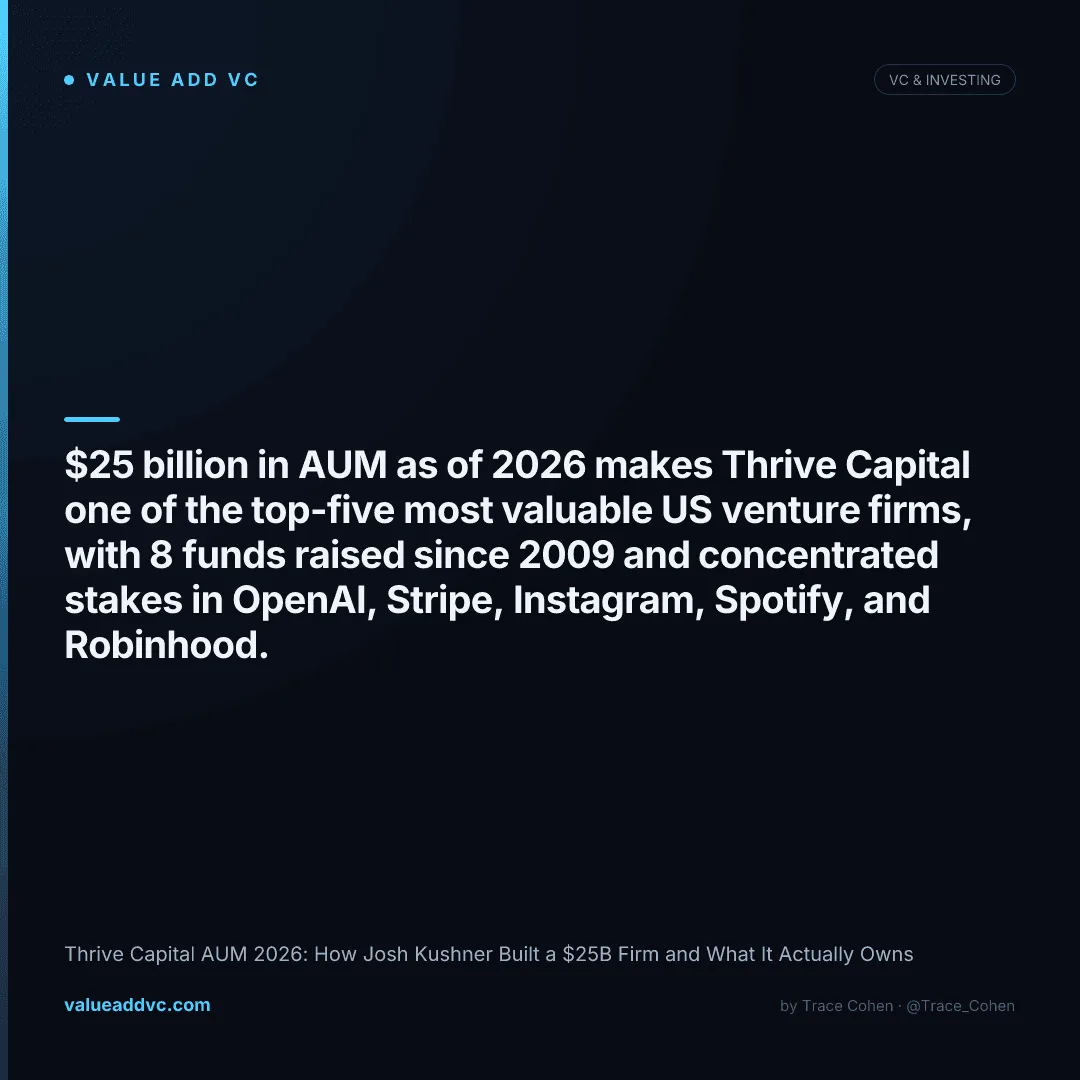
Thrive Capital manages $60 billion in AUM as of August 2026 — making Josh Kushner's quietly-built firm one of the five most valuable venture capital franchises in the world.
That's the short answer. The longer answer is more interesting. Thrive started in 2009 as a $40 million debut fund Kushner raised at age 24. Seventeen years later, it manages more capital than IVP, Founders Fund, or Lightspeed, runs one of the most concentrated portfolios in venture, and owns positions in OpenAI, Stripe, Instagram, and Robinhood that represent roughly $8.7 billion in marked value on their own.
Thrive Capital AUM 2026: The $60B Snapshot
Thrive Capital manages approximately $60 billion in assets under management as of August 2026 — up from roughly $25 billion in mid-2026 — spread across eight flagship funds and a permanent-capital holding vehicle launched in 2024. That places Thrive not just ahead of Founders Fund (~$15B AUM), Greylock (~$16B), and IVP (~$10B), though still behind a16z's more than $90B, despite operating with roughly one-third the headcount of the platform firms it now surpasses.
The trajectory itself is what makes the story worth telling. In 2014, when Thrive raised its $400 million Fund IV, the firm was a credible early-stage shop with positions in Instagram and Spotify. Ten years later, it sits among the small handful of US venture firms managing over $20 billion. No public scandal, no platform team of 80 marketing operators, no podcast network. Just deeply concentrated bets on a small number of companies that ended up being right.
The fund-by-fund growth tells the story:
Thrive Capital Fund History: Every Vehicle, Every Vintage
| Fund | Vintage | Fund Size | Stage Focus | Notable Positions |
|---|---|---|---|---|
| Fund I | 2010 | $40M | Seed / Series A | Instagram, GroupMe |
| Fund II | 2011 | $150M | Early stage | Warby Parker, Spotify |
| Fund III | 2012 | $200M | Multi-stage | Twitch, Compass |
| Fund IV | 2014 | $400M | Multi-stage | Stripe, Slack, GitHub |
| Fund V | 2016 | $700M | Multi-stage | Robinhood, Plaid |
| Fund VI | 2018 | $1.0B | Multi-stage | Cedar, Ramp, Lattice |
| Fund VII | 2021 | $3.0B | Multi-stage | OpenAI (initial position) |
| Fund VIII | 2024 | $5.0B | Growth-heavy | OpenAI follow-ons, Anthropic, xAI |
| Thrive Holdings | 2024 | $1.0B | Permanent capital | Mature AI/SaaS positions |
Cumulative committed capital: ~$11.5B across 8 funds + $1B holdings vehicle. AUM ($60B per Kushner's August 2026 investor letter) is meaningfully higher than committed capital because of marked-up unrealized gains, particularly OpenAI, Stripe, and Ramp positions.
Inside the Thrive Capital Portfolio: Where the AUM Is Actually Marked
Look at the AUM number — $60 billion — and then look at the committed capital number — $11.5 billion. The roughly $48.5 billion gap is the entire story: the large majority of what Thrive now reports as AUM is unrealized markup on a small number of positions, not capital LPs actually wired in. Thrive runs one of the most aggressively concentrated portfolios in modern venture — at the prior $25 billion AUM level, its top five marked positions ran around 60% of total NAV, versus 25-30% at a16z and Sequoia; how that ratio looks at the new $60 billion level is worth its own look once a fuller marks breakdown is available.
Here's the rough breakdown of where the marks are sitting in 2026:
Series, 2023-2024 follow-ons, Fund VIII led portion of late 2025 secondary
Original $1.75B valuation. Now $91.5B. ~60x mark.
Fund I crown jewel. ~6x at acquisition, but established the firm.
Smaller position than OpenAI by design. Hedge, not conviction.
Co-leader of multiple rounds. ~7x mark at $44B June 2026 round.
Public. Realized portion: ~$300M. Remaining: ~$400M.
Mid-tier mature positions
The OpenAI mark is doing roughly 25% of the work all by itself. If OpenAI's next round prices the company anywhere near $500B (it almost certainly will), the Thrive mark on it pushes north of $8 billion. That single position would then be larger than the entire current AUM of Founders Fund.
How Josh Kushner Built Thrive Capital Into a $60B Firm
Kushner started Thrive in 2009 with $40 million, raised mostly from family and a small circle of LPs. He was 24, at Harvard Business School, and had just left Goldman Sachs. The first investment that mattered was Instagram in 2010 — a roughly $3 million check at a $25 million post-money valuation, two years before Facebook bought the company for $1 billion.
The Instagram return wasn't the financial event that built the firm — at fund-I scale it returned ~6x of the Instagram check, which works out to maybe $15-20M in DPI. But the brand event mattered enormously. By Fund II in 2011, Thrive was getting allocated into deals that prior to Instagram would have been closed to a 25-year-old first-time GP.
Fund IV in 2014 was the inflection point. At $400 million, it was the first vehicle large enough to lead rounds and write meaningful checks. The Stripe position came from this fund — a small $25 million bet at a roughly $1.75 billion valuation. Today that position is worth approximately $1.5 billion, an unrealized 60x. Slack and GitHub came from the same vintage. All three deals individually returned the fund.
Fund VII in 2021 — raised at the absolute peak of the VC market at $3 billion — could have been a disaster. Most funds raised that vintage are now sitting on TVPI under 1.5x. Thrive Fund VII is rumored to be tracking above 3x already, almost entirely because of the OpenAI position established in late 2022 and aggressively followed in 2023.
Thrive vs the Tier-1 Platforms: The Concentration Tradeoff
The most useful way to understand Thrive in 2026 is by contrast with the platform firms that get more coverage. At $60 billion, Thrive runs roughly two-thirds of a16z's book (more than $90 billion, per TechCrunch) while operating with roughly a quarter of the headcount. That math has consequences both ways. (The comparison table below reflects Thrive's AUM at the time it was last compiled and is due for a refresh at the new $60B level — treat the Thrive row and the NAV-concentration column as pre-August figures until then.)
| Firm | AUM (2026) | Investment Team | Portfolio Companies | Top 5 = % of NAV |
|---|---|---|---|---|
| a16z | $90B+ | ~110 | ~750 | ~25% |
| Sequoia (US) | ~$45B | ~75 | ~400 | ~30% |
| General Catalyst | ~$35B | ~90 | ~500 | ~22% |
| Thrive Capital | ~$25B | ~28 | ~180 | ~60% |
| Founders Fund | ~$15B | ~25 | ~150 | ~70% (SpaceX-driven) |
The interesting comparison is actually with Founders Fund, not a16z. Both Thrive and Founders Fund run lean, concentrated, conviction-driven portfolios. Both have one giant position (OpenAI for Thrive, SpaceX for Founders Fund) that drives meaningful chunks of fund NAV. Both deliberately avoid the operational platform overhead that a16z and General Catalyst run. The difference: Founders Fund leans deep tech and contrarian themes; Thrive leans consumer internet and category-leading software. Same playbook, different sandbox.
What Thrive Capital's 2026 AUM Position Tells You About VC
Three things stand out about how Thrive got to $60 billion AUM in 2026, and they matter for anyone thinking about VC fund construction.
First, the power law eats LP diversification arguments alive. If you had backed Thrive Fund I at $40M in 2009 — and held through all eight funds — your blended IRR across the franchise is probably 35-40% net. That's not normal. The median US venture fund vintage since 2009 has returned roughly 13% net IRR per Cambridge data. Thrive sits at roughly 3x the median, which is what happens when one or two positions per fund return the whole vehicle.
Second, headcount is not the moat. Thrive runs at ~$890M AUM per investment professional. a16z runs at roughly $820M per investment professional. The platform thesis says all the extra staff drives returns through marketing, recruiting help, and portfolio support. The Thrive counter-thesis is that returns are driven by access, conviction, and concentration — and that adding more people makes both conviction and concentration harder, not easier. More meetings rarely improves picking.
Third, the OpenAI mark exposes the model. If OpenAI IPOs in 2027 at $500B and Thrive owns ~1.4% post-dilution, that single position alone returns Fund VIII (the $5B fund) two times over before any other holding pays out. That's the asymmetric upside concentration creates. The downside: if OpenAI is worth $150B instead of $500B in 2030, Fund VIII probably underperforms its vintage. Concentration is not a free lunch.
Track the broader fund-by-fund performance picture on the Funds dashboard and individual fund returns on VC Performance.
Thrive Capital got to $60B AUM by writing fewer, larger checks into companies that became category-defining.
The OpenAI position alone may end up worth more than the entire firm was three years ago.
Track VC fund performance, AUM, and concentrated bets on the Funds Dashboard at Value Add VC. Originally published in the Trace Cohen newsletter.
Latest from the Pulse
Get VC data most people never see
— free to subscribe
Trace's notes on venture, AI and startups, a few times a week. Join 5,000+ subscribers. No spam.
No spam, unsubscribe anytime. Sent via Substack · Privacy · or subscribe on Substack ↗