
The critique was straightforward: funds were too large. Ownership would be diluted. The math would not work.
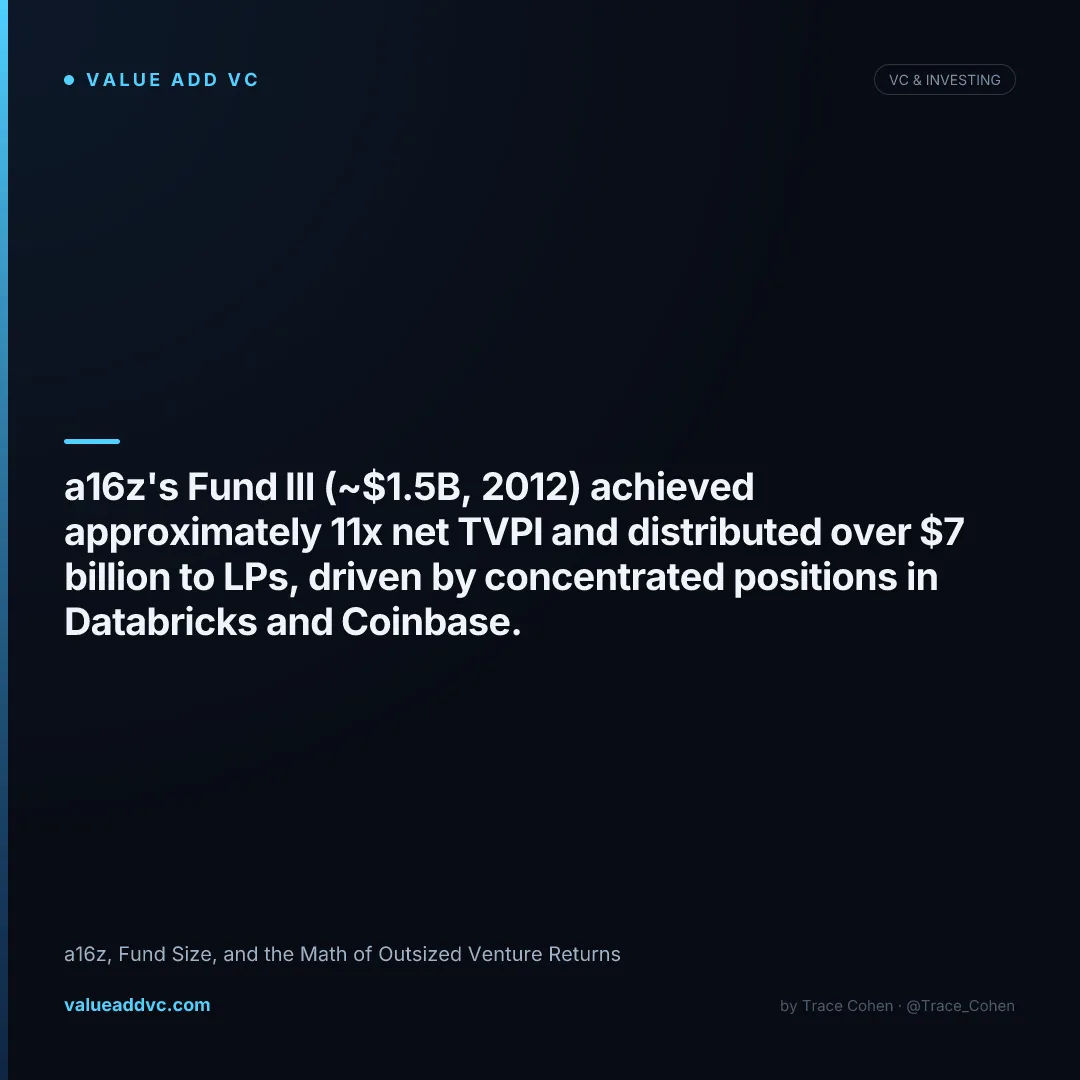
a16z was founded in 2009 with a $300M Fund I. Fund III, raised in 2012 at roughly $1B plus a parallel vehicle, became the clearest test of whether the firm's approach could scale. It aged differently than critics predicted.
The Fund III Track Record
~11x
Net TVPI (reported, including parallel fund)
$7B+
Net distributed to LPs
$7B
Gross distributions from Coinbase alone
The takeaway is not that a16z diversified its way to returns. It concentrated. Databricks, first backed at a $44M post-money valuation, remains one of the largest unrealized positions in all of venture capital.
Concentration Explains the Outcome
Databricks represents ~23% of a16z's net asset value across funds
- → Last private valuation: $134B (IPO expected $200B+)
- → Estimated ownership: ~7–8%
- → Implied value at IPO: $14–16B
- → Potential gross value over time: $20B+
One company meaningfully clearing multiple funds is not a theoretical construct here. It is the model. For the counterargument on why most large funds fail this math, see the real reason venture returns are compressing.
How the Return Math Actually Works at Scale
A fund targeting 3x net DPI typically needs ~4x gross outcomes after fees and carry
Applied to $15B of capital, that implies ~$60B of gross realized value over the life of the funds
At that scale, returns are not driven by many modest exits
They are driven by a small number of very large outcomes with sustained ownership at $100B+ outcomes
Why the Scale Argument Is Weaker Now
The common objection to large venture funds assumes smaller outcomes, faster exits, and fragmented capital allocation. Recent market data does not support those assumptions.
Companies staying private longer
Achieving larger enterprise values before liquidity events
Capital concentrating
Larger checks flowing into fewer companies — total capital rebounded even as round count fell
AI absorbing ~44% of US venture
Ownership accrues to early investors who maintain conviction and follow-on rights
Today's venture market produces fewer companies, much larger outcomes, and longer paths to liquidity.
That environment punishes shallow diversification and rewards concentration held over time.
Related Resources
Explore fund performance data on the VC Fund Performance Dashboard at Value Add VC. Originally published in the Trace Cohen newsletter.
Latest from the Pulse
Get VC data most people never see
— free to subscribe
Trace's notes on venture, AI and startups, a few times a week. Join 5,000+ subscribers. No spam.
No spam, unsubscribe anytime. Sent via Substack · Privacy · or subscribe on Substack ↗