
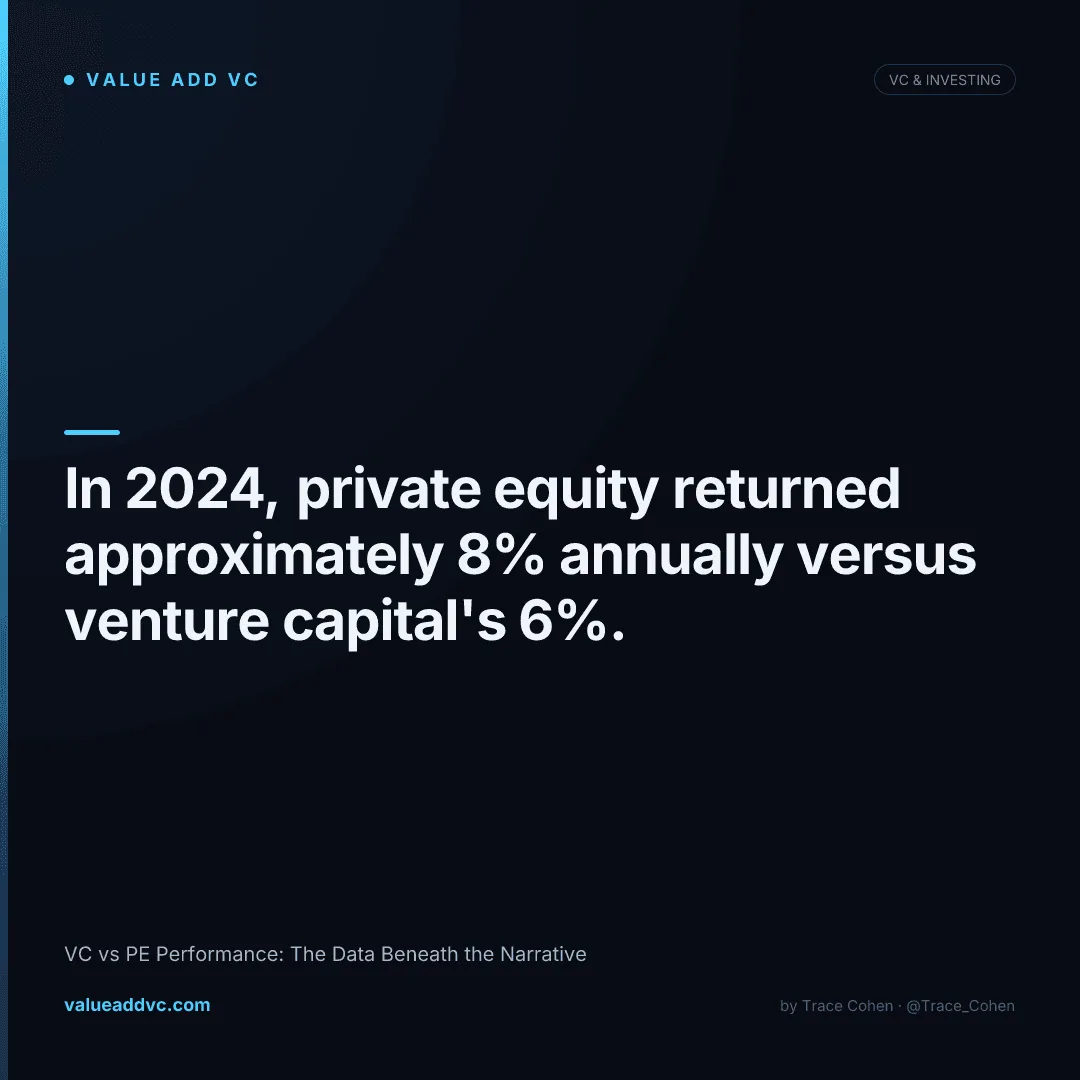
The data shows a shift in where value is created, how long it takes to realize, and which managers actually matter.
Private Equity
~8%
Annual return in 2024
Venture Capital
~6%
Annual return in 2024
Distributions increased materially year over year, but remain below long-term averages. Performance is improving on paper faster than it is in cash.
The Core Structural Difference
Private Equity
- →Majority or control ownership
- →Leverage and operational improvements
- →Predictable cash flow businesses
- →Shorter duration to exit
Venture Capital
- →Minority ownership
- →No control over outcomes
- →Power law distribution of returns
- →Long duration with delayed liquidity
This is why comparing headline IRRs between the two can be misleading. The underlying risk profile and time horizon are fundamentally different.
Why DPI Is Now the Only Metric That Matters
For most of the last decade, TVPI was enough. That has changed.
Today, LPs are overwhelmingly focused on DPI — actual cash returned. TVPI captures unrealized value. IRR is influenced by timing assumptions. DPI reflects reality and cannot be manipulated.
Many 2020–2022 vintages show strong TVPI on paper
DPI remains near zero or low single digits for most of those funds
Older vintages are taking longer to convert TVPI into DPI due to exit delays
Dispersion Is Still Extreme
The most underappreciated reality in venture is dispersion. Across funds in the same vintage:
Top quartile
3x–5x+
Median
~Breakeven
Bottom quartile
<1x
In venture, a single investment can determine the entire fund outcome. In private equity, dispersion exists but is narrower.
What This Means for LPs and GPs
For LPs
- → Prioritize managers with a history of distributions, not just markups
- → Underwrite longer fund durations and delayed liquidity
- → Diversify across vintages rather than trying to time the cycle
- → Expect lower near-term cash flows from venture portfolios
For GPs
- → Raising the next fund requires realized performance
- → Ownership and follow-on strategy matter more than initial entry
- → Portfolio construction needs to account for longer hold periods
- → Clear exit pathways must be part of underwriting, not an assumption
The real divide is no longer between VC and PE.
It is between funds that can return capital and those that cannot.
Explore fund performance data on the VC/PE Performance Dashboard and VC Performance tracker at Value Add VC. Originally published in the Trace Cohen newsletter.
Latest from the Pulse
Get VC data most people never see
— free to subscribe
Trace's notes on venture, AI and startups, a few times a week. Join 5,000+ subscribers. No spam.
No spam, unsubscribe anytime. Sent via Substack · Privacy · or subscribe on Substack ↗