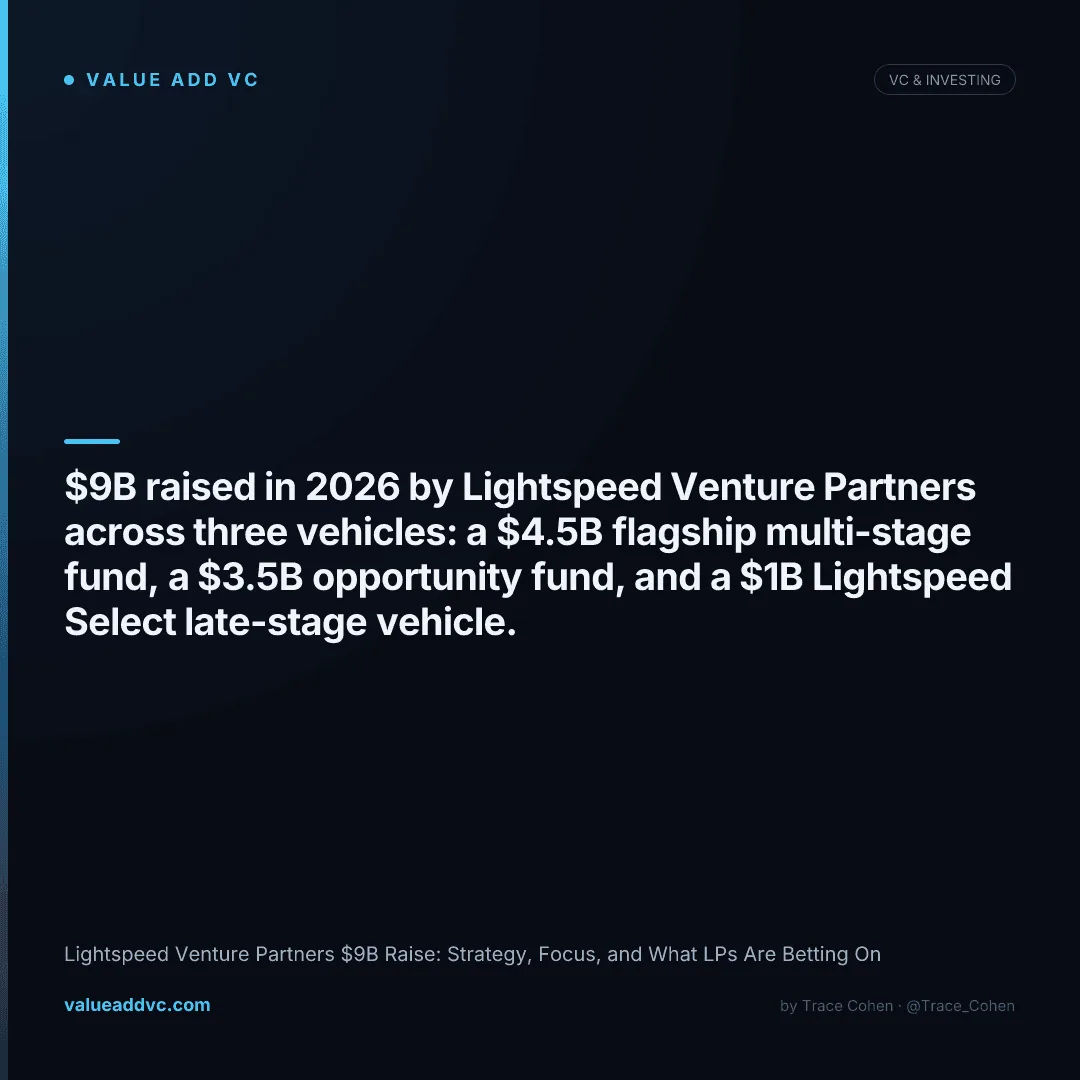
Lightspeed Venture Partners closed roughly $9B across three vehicles in 2026 — a $4.5B flagship, a $3.5B opportunity fund, and a $1B Lightspeed Select late-stage vehicle — making this the largest combined raise in the firm's 24-year history.
That's the short answer. The longer answer is more interesting, because the $9B raise is less a story about Lightspeed and more a story about where the LP market is sending its 2026 venture allocation: into a small number of firms with proven multi-stage operating systems and a credible AI story.
Lightspeed Venture Partners Fundraise 2026: The Three-Fund Breakdown
The Lightspeed Venture Partners fundraise 2026 closed at roughly $9B across three distinct vehicles. The flagship multi-stage fund came in at about $4.5B, the dedicated opportunity fund at about $3.5B, and a new Lightspeed Select late-stage vehicle at about $1B. That structure splits the firm's strategy by check size and risk profile, with 55% of total capital earmarked for AI-adjacent investments and 85% of LP commitments coming from existing investors.
| Vehicle | Size | Stage Focus | Avg Check | Target Net IRR |
|---|---|---|---|---|
| Lightspeed XV (Flagship) | ~$4.5B | Seed through Series B | $5M–$40M | 22–25% |
| Opportunity Fund VI | ~$3.5B | Series C through pre-IPO | $40M–$250M | 15–18% |
| Lightspeed Select II | ~$1.0B | Late-stage breakout positions | $100M–$400M | 12–15% |
Size figures are based on LP filings and reporting from 2025–2026. Net IRR targets are firm-stated and not guaranteed outcomes.
How the $9B Compares to Past Lightspeed Funds
Lightspeed has roughly doubled its raise cadence over a decade. The 2022 fund family came in at $7.1B across two vehicles. The 2018 family closed at $1.8B. The current $9B is a 26% bump over 2022 and a 5x bump over 2018 — a faster scaling rate than the AUM curves at Benchmark or Founders Fund over the same period, though slower than Andreessen Horowitz, which has gone from $4.5B in 2018 to a reported $15B+ AI-led raise in 2025.
2018
$1.8B
Lightspeed XII + Select
2020
$4.2B
Lightspeed XIII + Opportunity IV
2022
$7.1B
Lightspeed XIV + Opportunity V
2024
$2.3B
India + Israel regional funds
2026
$9.0B
Lightspeed XV + Opportunity VI + Select II
Cumulative AUM
$35B+
Across 24 years and 5 offices
Track Record: 24 Years, Seven $1B+ Outcomes
LPs do not commit $9B on vision. They commit on DPI, and Lightspeed has compounded credibility over six full fund cycles. Recent vintages are showing 2.8x–3.4x net TVPI and 19%–24% net IRR per LP filings — top-quartile across 2017, 2019, and 2022 per Cambridge Associates benchmarks; see our full vintage-by-vintage IRR, DPI, and TVPI breakdown for how those numbers stack up historically. The reason: a portfolio that includes Snap (IPO at $24B in 2017), Affirm (IPO at $11.9B in 2021), Mulesoft ($6.5B sale to Salesforce in 2018), Nutanix, Epic Games, Carta, Faire, and an early position in OpenAI worth a reported $2B+ on Lightspeed's books.
Series A lead in 2012 at sub-$50M
Held through IPO before sale
Lightspeed in early seed
Series A lead 2011
Stake taken in growth round
Series A lead 2018
Position taken via secondaries and primary
Lightspeed in Series B
See current performance dashboards on VC Performance.
Lightspeed Venture Partners Fundraise 2026: The LP Base
Roughly 85% of the $9B comes from re-up commitments. The remaining 15% — around $1.35B — was raised from new LPs that Lightspeed's investor relations team began conversations with in early 2025. That split is significantly tighter than the 70/30 re-up/new ratio that emerging managers see, and it's the practical advantage of a 24-year LP book.
Estimated Capital by LP Type
- • US public pensions: ~$2.5B (28%)
- • Sovereign wealth (GIC, Mubadala, ADIA): ~$2.0B (22%)
- • US university endowments: ~$1.8B (20%)
- • Insurance and corporate balance sheets: ~$1.0B (11%)
- • Family offices and HNW: ~$0.9B (10%)
- • Fund-of-funds: ~$0.8B (9%)
Why LPs Re-Upped
- ✓ DPI across last 3 funds clears 1.2x
- ✓ Multi-stage continuity reduces re-allocation churn
- ✓ AI exposure without a new manager underwriting
- ✓ Top-tier reporting and capital-call discipline
- ✓ Demonstrated India and Israel sub-platforms
See the playbook for fund managers raising into this LP segment on the LP Match dashboard.
The AI Strategy Behind the Lightspeed Venture Partners 2026 Raise
About 55% of the $9B — roughly $4.95B — is earmarked for AI infrastructure, AI applications, and AI-native vertical software across the three vehicles. That ratio mirrors the LP capital flows we're seeing across the broader 2026 fundraising market, where AI-led raises are clearing in 4–6 months while non-AI generalists are taking 12–18 months to close.
AI Infrastructure
~$2.0B
Compute, data, inference, vector DBs, model orchestration
AI Applications & Agents
~$1.6B
Vertical SaaS with AI as core workflow, agentic platforms
AI-Native Vertical Software
~$1.35B
Healthcare, legal, defense, supply chain
Enterprise SaaS (non-AI-first)
~$1.8B
Data, observability, security
Consumer + Fintech
~$1.35B
Embedded finance, prosumer, marketplaces
Deep Tech / Defense / Bio
~$0.9B
Dual-use defense, climate, biotech tooling
Lightspeed's OpenAI position — taken through a combination of primary participation and a secondaries trade in 2024 — is the firm's single-largest unrealized mark and the asset most likely to drive returns on Fund XIV before XV starts deploying meaningfully in 2027.
How the Lightspeed $9B Raise Compares to a16z, Sequoia, and Thrive
The $9B raise is not the biggest of the 2025–2026 cycle, but it's in the top three. Andreessen Horowitz raised a reported $15B+ in 2025 across its AI-heavy fund family, Sequoia closed about $8B across its 2024 vehicle structure, and Thrive Capital raised $5B in mid-2024. Lightspeed sits in that cohort but with materially tighter team headcount per dollar raised.
| Firm | Recent Raise | AUM | Investment Professionals | AUM per IP |
|---|---|---|---|---|
| Andreessen Horowitz | ~$15B (2025) | ~$60B | ~180 | ~$333M |
| Sequoia Capital | ~$8B (2024) | ~$85B | ~110 | ~$773M |
| Lightspeed | ~$9B (2026) | ~$35B | ~90 | ~$389M |
| Thrive Capital | ~$5B (2024) | ~$25B | ~30 | ~$833M |
| Founders Fund | ~$4.6B (2023) | ~$18B | ~55 | ~$327M |
AUM and headcount figures are estimates aggregated from SEC Form ADV filings, LP reporting, and public disclosure as of mid-2026.
What the Raise Says About the 2026 VC Market
The single most informative thing about the Lightspeed Venture Partners 2026 raise is not the size — it's the close speed and the LP composition. Lightspeed went from first close to final close in roughly 9 months. That's less than half the 18–24 months the median multi-stage US fund is taking to close in 2026 per Pitchbook data, and signals three structural shifts:
1. LP capital is concentrating in <20 firms
Roughly 60% of all 2025–2026 US venture commitments went to the top 15 firms by AUM. The middle of the market — $300M–$1B funds without an obvious AI thesis or a 15-year track record — is taking 24+ months to close partial vehicles.
2. DPI is the LP underwriting metric again
Lightspeed's last three funds clear 1.2x+ DPI. Funds without realized distributions are getting passed over even if their TVPI marks look strong. Paper marks no longer carry an LP committee.
3. AI exposure is non-negotiable
Every LP slide deck Lightspeed showed in 2025 led with the OpenAI position and the Wiz exit. Without those two, the firm raises closer to $5B at this pace. The line between a venture allocation and an AI allocation has effectively closed for institutional capital in 2026.
Risks and Open Questions
The $9B isn't a costless decision. Three risks LPs flagged in 2025 conversations:
Capital-deployment pressure
Deploying $4.5B at seed and Series A in 3 years requires writing 80–120 checks/year — roughly double the firm's 2022 pace. That tests partner attention.
OpenAI concentration
OpenAI is the largest single mark on the books. A 50% markdown on that position would materially dent reported TVPI on the prior fund family.
Fee compression
Sophisticated LPs are pressing for tiered management fees on the opportunity fund — 1.5% on the first $1B, 1.0% thereafter — versus a flat 2%.
The $9B raise is not a story about Lightspeed.
It is a story about LPs concentrating venture capital into the 15 firms with proven DPI, multi-stage operating models, and a credible AI position — and writing very few checks anywhere else.
Track VC fund performance and AI valuations on the VC Performance Dashboard and AI Valuations Dashboard at Value Add VC. Originally published in the Trace Cohen newsletter.
Latest from the Pulse
Get VC data most people never see
— free to subscribe
Trace's notes on venture, AI and startups, a few times a week. Join 5,000+ subscribers. No spam.
No spam, unsubscribe anytime. Sent via Substack · Privacy · or subscribe on Substack ↗