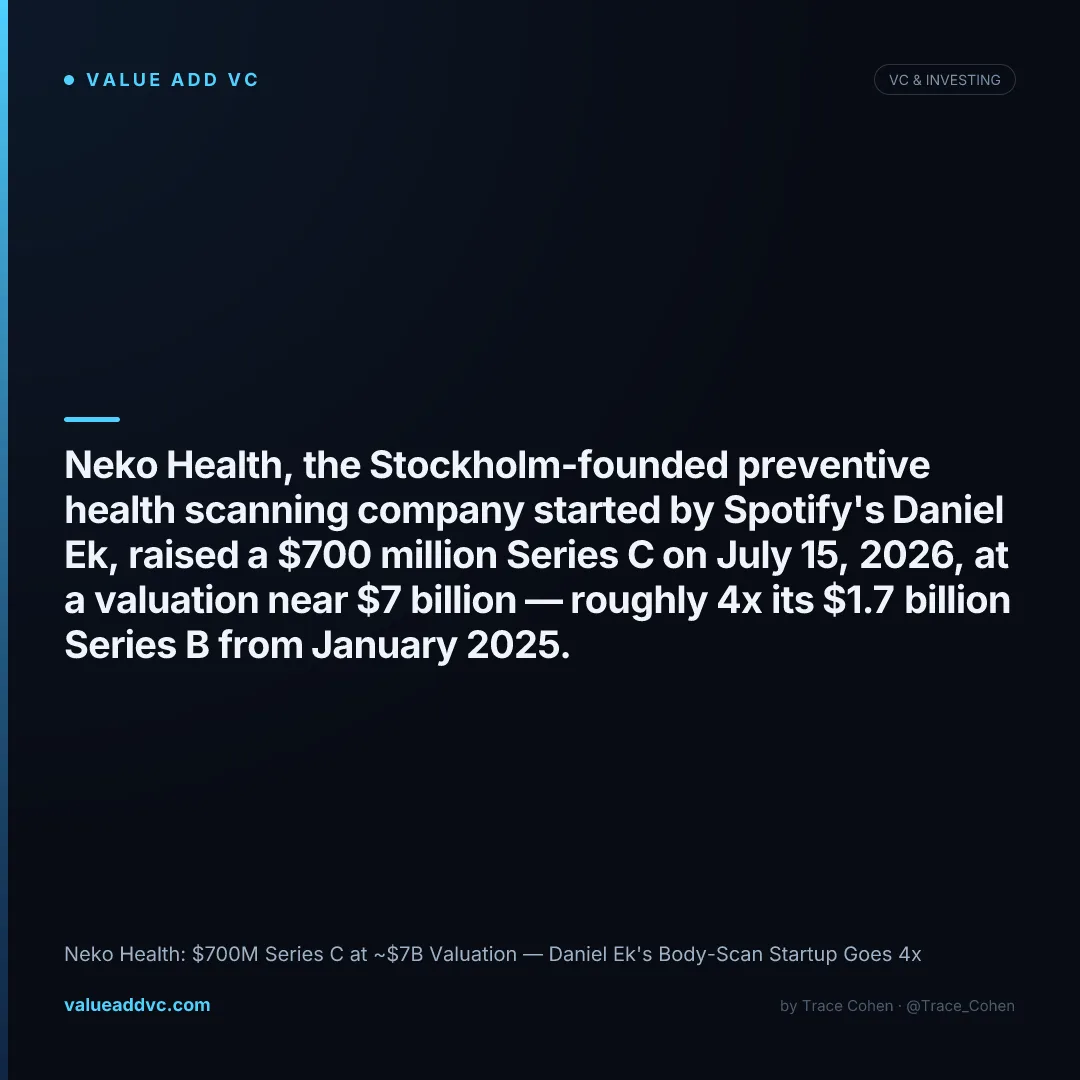
Neko Health raised $700 million at a ~$7 billion valuation led by Lightspeed Venture Partners.
Eighteen months ago, Daniel Ek's full-body scanning company was worth $1.7 billion after its Series B. It's now worth roughly $7 billion — a 4x step-up in a year and a half, on a round large enough that it alone would rank among the biggest raises of any startup in any sector this year. The company still operates a small number of clinics, hasn't launched in the US, and charges consumers directly for a service most insurance won't touch. Investors just don't seem to care.
Figures from Neko Health's press release, TechCrunch, and MedCity News as of July 15, 2026.
Neko Health $700M Series C: Round Terms and Lead Investors
Neko Health closed a $700 million Series C on July 15, 2026, led by Lightspeed Venture Partners and co-led by O.G. Venture Partners, at a valuation of approximately $7 billion. The round drew an unusual mix of individual backers — Mark Zuckerberg and Priscilla Chan, OpenAI, Tim Ferriss, Maria Sharapova, and will.i.am — alongside the institutional capital that has backed the company since its earlier rounds.
What Neko Health Actually Builds
Neko runs physical clinics centered on a single proprietary device: a scanning pod that takes roughly 15 minutes to capture skin imaging, cardiovascular markers, and body composition data, all reviewed with a clinician the same day. The pitch is that most people only find out something is wrong when it's already symptomatic — Neko is betting that cheap, fast, comprehensive scanning catches problems earlier, and that people will pay out of pocket for the peace of mind an annual physical rarely delivers.
The company was founded in 2023 by Daniel Ek, best known as Spotify's co-founder and CEO, and Hjalmar Nilsonne, a Swedish entrepreneur who has built several prior companies. Rather than licensing MRI machines, ultrasound probes, or dermatology imaging tools from established medical device manufacturers, Neko designed, patented, and manufactures its entire scanning hardware and software stack in-house — a decision that gives it more control over the patient experience and unit economics, but also means it's effectively running a hardware company, a software company, and a clinic network all at once.
Why the Valuation Quadrupled in Eighteen Months
A 4x step-up in eighteen months is an aggressive pace for any company, let alone one that operates physical clinics with real capital costs per location. Three things appear to be driving it: a waitlist that has swelled to roughly 350,000 people internationally, proof that the Stockholm-to-Europe expansion model works well enough to replicate, and — most importantly for growth investors — the credibility that comes from Ek's track record building Spotify into one of the largest consumer subscription businesses in the world.
Who's Backing Neko Health
Lightspeed Venture Partners
Lead investor on the Series C — one of Lightspeed's largest and most public consumer health bets, and notable given the firm's parallel exposure to AI-native consumer names like Suno.
O.G. Venture Partners
Co-lead on the round, adding a second growth-stage anchor investor alongside Lightspeed rather than Neko relying on a single lead to price the deal.
Mark Zuckerberg & Priscilla Chan
A high-profile individual check that signals personal conviction in preventive health as a category, distinct from Meta's own corporate strategy.
OpenAI, Tim Ferriss, Maria Sharapova, will.i.am
A mix of a frontier AI lab and celebrity-operator angels, the kind of cap table that generates its own distribution and press cycle independent of the product itself.
The US Bet: Manhattan First
Neko has operated exclusively in Europe since its 2023 Stockholm launch. The Series C capital is earmarked specifically for US market entry, starting with a flagship clinic in Manhattan expected to open later this year. That's a deliberate choice — Manhattan concentrates exactly the demographic Neko has targeted in Europe: high-income, health-conscious consumers already comfortable paying out of pocket for wellness services outside insurance networks, from concierge medicine to longevity clinics.
The US healthcare system is also a fundamentally different environment than the European markets Neko has operated in so far — fragmented insurance, higher consumer price tolerance for premium health services, and a much larger existing market for direct-pay preventive and longevity care. If Neko can prove the Manhattan clinic converts waitlist demand into repeat, paying patients at a similar rate to its European locations, it has a template to scale across every major US metro, which is presumably the growth story this valuation is underwriting.
Neko vs. the Rest of Preventive Health Funding
Neko's raise lands in the middle of a broader resurgence in digital and preventive health funding, which we've tracked in our digital health funding roundup. What sets Neko apart from most of that cohort is that it isn't a software layer on top of existing medical infrastructure — it's a vertically integrated hardware-plus-clinic operator, which means slower unit expansion but potentially much higher defensibility once a location is built and staffed. Not every peer in the category is raising the same way, either — Function Health's $450M deal left its valuation exactly where it started, using a non-dilutive structure instead of a fresh equity mark.
Bull Case vs. Bear Case
Bull Case
- + 350,000-person waitlist is real, pre-existing demand — not a hypothetical market
- + Vertically integrated hardware and clinic model is hard for a software-only competitor to replicate quickly
- + Daniel Ek's Spotify track record gives growth investors a reason to underwrite founder execution risk
- + US direct-pay preventive health market is large and structurally underserved by insurance-based primary care
- + High-profile cap table (Zuckerberg, OpenAI) generates its own marketing and credibility with future patients
Bear Case
- - Physical clinics scale linearly with capital and real estate, not exponentially like software
- - A ~$7B valuation implies a huge multiple on a company with a handful of clinics and no disclosed revenue
- - US healthcare regulation, licensing, and malpractice exposure are materially different from Europe
- - No insurance reimbursement means growth is capped by how many consumers will pay entirely out of pocket
- - Competing longevity and preventive-scan startups (Function Health, Prenuvo, and others) are chasing the same affluent US customer base
Most consumer health startups sell a subscription.
Neko is selling a 15-minute scan for a price the market just valued at $7 billion.
My Take
The number that jumps out to me isn't the $700 million — it's how little disclosed revenue is backing a $7 billion valuation for a company that still operates a small footprint of physical clinics. This is a bet on Daniel Ek and on the category, not on financials that have been made public. That's not disqualifying — Ek has done this before, at Spotify, against skeptics who doubted a subscription music model could work at scale — but it does mean the risk profile here looks a lot more like a growth-stage consumer bet than an infrastructure investment with predictable unit economics.
The Manhattan clinic is the real test. Europe proved Neko could get affluent consumers to pay for a scan once; the US will prove whether the waitlist converts into a repeatable, profitable clinic model against tougher regulation, higher real estate costs, and direct competition from Prenuvo and Function Health, both of which are already established in the exact market Neko is entering.
If Neko can open five or six US clinics in the next eighteen months at utilization rates close to its European locations, the valuation starts to look forward-looking rather than speculative. If Manhattan underperforms the waitlist numbers, this round will be remembered as the moment celebrity-driven capital priced a consumer health company well ahead of its actual unit economics.
The Bottom Line on Neko Health
Neko Health raised $700 million at a ~$7 billion valuation, up roughly 4x from its Series B eighteen months earlier, led by Lightspeed Venture Partners and backed by a cap table spanning Mark Zuckerberg, OpenAI, and Tim Ferriss. The capital funds a Manhattan flagship clinic and broader US expansion, drawing on a 350,000-person international waitlist.
It's one of the largest and most closely watched consumer health raises of 2026 — and a real-time test of whether a vertically integrated preventive-scanning model can scale in the US the way it has in Europe. Track this and other new unicorns on our Unicorn Tracker.
Follow Neko Health and other consumer health funding rounds on the Unicorn Tracker at Value Add VC. Reach out at t@nyvp.com or @Trace_Cohen.
Latest from the Pulse
Get VC data most people never see
— free to subscribe
Trace's notes on venture, AI and startups, a few times a week. Join 5,000+ subscribers. No spam.
No spam, unsubscribe anytime. Sent via Substack · Privacy · or subscribe on Substack ↗