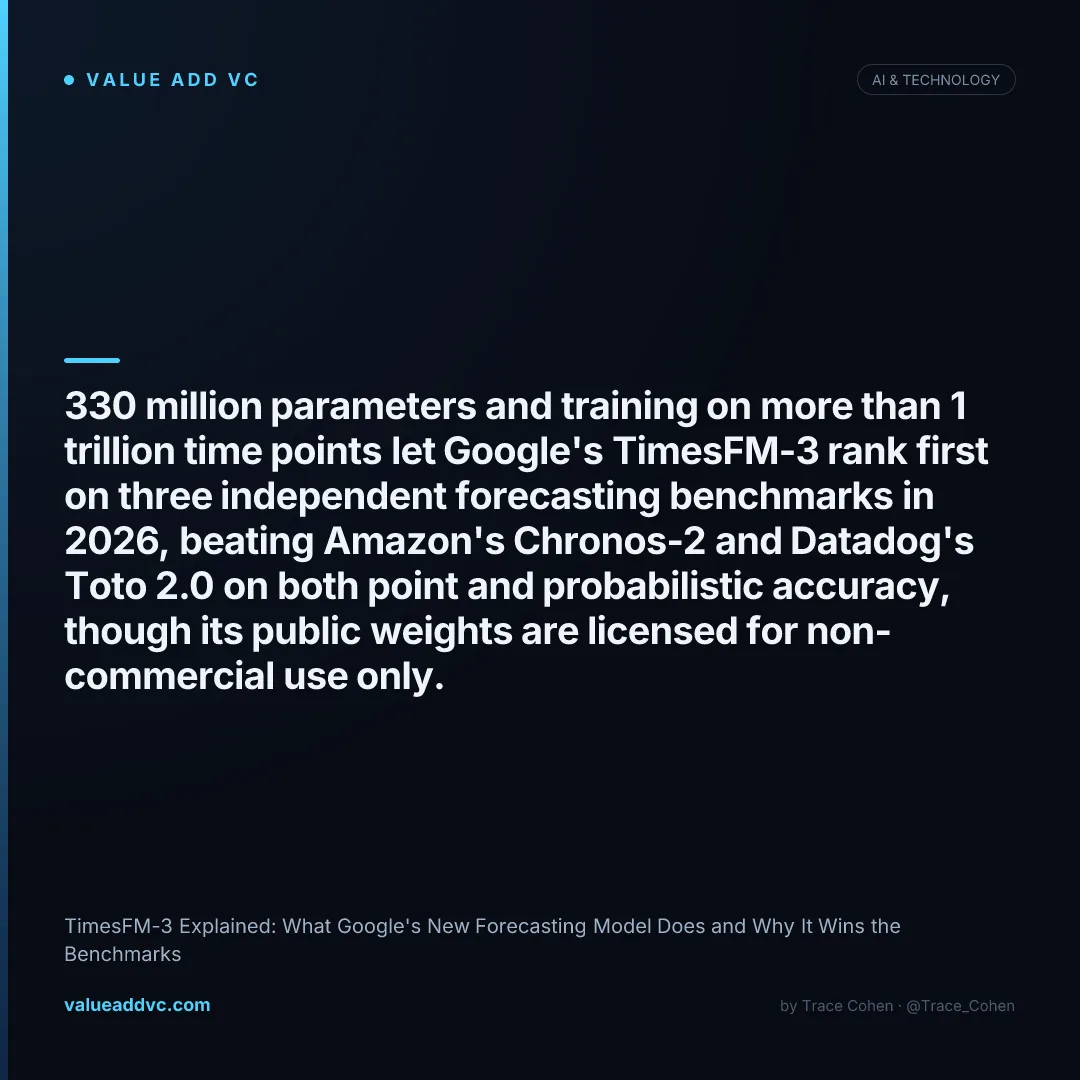
TimesFM-3 is Google Research's 330-million-parameter time-series forecasting model, trained on more than 1 trillion time points and, per Google's own published results, the top-ranked pretrained foundation model on all three major public forecasting benchmarks it was tested against.
Google's August 31, 2026 release announcement made a splash big enough that our Pulse coverage of the launch is still ranking on search a month later. What follows is the durable version: what TimesFM actually is, what changed in the jump to version 3, and how it holds up against Amazon's Chronos and Datadog's Toto — the two other open-weight foundation models fighting for the same forecasting workloads.
What Is TimesFM-3 and Why Google Built It
TimesFM-3 is a 330-million-parameter time-series foundation model that Google Research released on August 31, 2026, pretrained on more than 1 trillion real-world and synthetic time points. It is the first TimesFM version trained natively for multivariate forecasting, meaning it can use related series and known future variables together in one pass, according to Google's own technical writeup.
"Zero-shot" is the operative idea across the whole TimesFM line: instead of training a bespoke model on each company's sales history or server-load logs, a business points a pretrained model at its raw series and gets a forecast back with no retraining step, using historical-only and known-future covariates and producing both point forecasts and full probabilistic quantile ranges in the same forward pass. That is the same pitch behind large language models applied to a different data type — sequences of numbers instead of sequences of words — and it is why Google, Amazon, Salesforce, IBM, and Datadog have all built competing versions of essentially the same idea since 2023.
How TimesFM-3's Architecture Differs From Chronos and Toto
The three major time-series foundation models on the market in 2026 do not share an architecture, which is part of why their benchmark results diverge by data type. TimesFM uses a patched-decoder design: it slices each input series into fixed-length patches, embeds them, and runs them through a decoder-only transformer stack — the same broad family as GPT-style language models, just operating on numeric patches instead of text tokens. Amazon's original Chronos took a different route entirely, converting continuous values into a vocabulary of discrete tokens via uniform binning and forecasting with a T5 encoder-decoder architecture, effectively treating a time series like a sentence in a small, invented numeric language. Chronos-2 moved to an encoder-only design at 120 million parameters, dropping the discrete-token approach in favor of continuous embeddings.
Datadog's Toto sits closer to TimesFM's camp architecturally, but its pretraining corpus is purpose-built rather than general-purpose: the majority of Toto's pretraining data comes from roughly 1 trillion time points of Datadog's own internal observability telemetry — CPU load, request latency, error rates — which Datadog says makes its pretraining corpus 4-10x larger than competing time-series foundation models measured before TimesFM-3's release. That specialization shows up in the Parseable results cited above: Toto's edge over Chronos was largest at 1-minute resolution, the exact granularity observability metrics are sampled at, while general-purpose models like TimesFM held their advantage at coarser, 1-hour resolution more typical of business forecasting.
From TimesFM 1.0 to 3.0: What Actually Changed
Google first introduced TimesFM in an October 2023 paper (later accepted at ICML 2024) describing a 200-million-parameter decoder-only model pretrained on roughly 100 billion real-world time points, limited to univariate forecasting. Version 2.5, released September 15, 2025, actually shrank the parameter count to 200 million while quadrupling the training corpus to more than 400 billion time points and extending the usable context window from 2,048 points to roughly 16,000 — a sign that Google prioritized training-data scale and context length over raw parameter count for that generation. TimesFM-3 reverses the parameter trend, growing to 330 million parameters, while pushing the training corpus past 1 trillion time points and adding the native multivariate capability neither 1.0 nor 2.5 had.
| Model | Maker | Parameters | Training Points | Multivariate? | License |
|---|---|---|---|---|---|
| TimesFM 1.0 | Google Research | 200M | ~100B | No | Research release |
| TimesFM 2.5 | Google Research | 200M | 400B+ | Via XReg add-on | Apache-2.0 |
| TimesFM-3 | Google Research | 330M | 1T+ | Native | Non-commercial |
| Chronos (original) | Amazon Science | 8M-710M (T5 family) | Public datasets | No | Apache-2.0 |
| Chronos-2 | Amazon Science | 120M | Public + synthetic | Native (Oct 2025) | Apache-2.0 |
| Toto 1.0 | Datadog | 151M | Observability-heavy | Yes | Apache-2.0 |
| Toto 2.0 | Datadog | 4M-2.5B family | ~1T (Datadog metrics) | Yes | Apache-2.0 |
Sources: Google Research (TimesFM-3 and TimesFM-2.5 technical blogs), the original TimesFM arXiv paper (2310.10688), Amazon Science's Chronos GitHub repository and Hugging Face model cards, and Datadog's Toto and Toto 2.0 release blogs. Parameter ranges reflect published model families, not a single checkpoint.
How TimesFM-3 Performs Against Chronos-2 and Toto 2.0
Google evaluated TimesFM-3 against Chronos-2 and the Toto 2.0 family — plus its own predecessor, TimesFM-2.5 — on three separate public benchmarks: GIFT-Eval (Salesforce's benchmark spanning 28 datasets and more than 144,000 time series), FEV-Bench (100 forecasting tasks), and the TIME benchmark (98 tasks across 50 domains). According to Google's published results, TimesFM-3 finished first on all three for both point and probabilistic forecasting accuracy among pretrained foundation models, with the largest gains showing up once the model is run in full multivariate mode rather than treating each series independently.
That result should be read as a vendor benchmark, not an independent audit — Google chose the comparison set and ran the evaluation itself. Independent, narrower studies complicate the picture: one third-party observability-focused benchmark from Parseable found Datadog's Toto led at 1-minute data resolution with a mean absolute percentage error of 0.006 — roughly 7x better than Chronos' 0.046 — while TimesFM led at 1-hour resolution with an error of 0.534 against Chronos' 1.79. Which model wins still depends heavily on the data granularity and domain being forecast, not just which vendor published the biggest benchmark table.
Inside the Three Benchmarks Google Used
None of GIFT-Eval, FEV-Bench, or the TIME benchmark are Google-built, which is part of why Google leans on them as evidence rather than a self-graded scorecard — though the choice of which benchmarks to report is still Google's own:
GIFT-Eval
Salesforce AI Research
28 datasets spanning over 144,000 individual time series, plus a non-leaking ~230 billion-point pretraining set, with public results tracked on a Hugging Face leaderboard.
FEV-Bench
Independent benchmark
100 discrete forecasting tasks used to compare pretrained foundation models head-to-head on both point-forecast and probabilistic accuracy.
TIME Benchmark
Independent benchmark
98 tasks spread across 50 distinct domains, built specifically to stress-test generalization across very different data-generating processes.
Google's reported result is that TimesFM-3 already matches or beats the field in univariate mode — treating each series independently, the way TimesFM 1.0 and 2.5 always worked — and then extends its lead further once switched into full multivariate mode, where it can lean on related series and known future covariates that univariate-only competitors like the original Chronos architecture cannot use at all. The field is bigger than the three vendors covered here, too: IBM Research has published its own FlowState model reaching second place among zero-shot foundation models on the GIFT-Eval leaderboard, a reminder that Google, Amazon, and Datadog are competing in a category that also includes IBM, plus a long tail of academic entrants, all measured against the same public leaderboard rather than a closed vendor comparison.
The Licensing Catch: TimesFM-3 Is Not Apache-2.0
The detail most explainer coverage buries: TimesFM-2.5 shipped under a permissive Apache-2.0 license, but TimesFM-3's public weights are released under a non-commercial license (timesfm-non-commercial-license-v1.0), per the model's own GitHub repository. Chronos-2 and both generations of Toto remain Apache-2.0. For a team evaluating which model to actually put into a production pipeline today, that licensing gap matters more than any benchmark table:
- TimesFM-3 weights can be downloaded and tested freely, but a commercial product cannot legally ship on top of them under the current license terms.
- Google's own production surfaces — BigQuery's
AI.FORECASTfunction and AlloyDB's forecasting integration — still run on TimesFM-2.5, not TimesFM-3, as of this writing, since AI.FORECAST reached general availability on November 19, 2025, per Google Cloud's own announcement, months before TimesFM-3 existed. - Chronos-2 and Toto 2.0 remain the more practical starting points for anyone who needs an Apache-licensed, multivariate-capable foundation model in a commercial product today.
Where I Could Be Wrong
Vendor-run benchmarks are not neutral, and "state of the art on three benchmarks" is a claim Google made about its own model using benchmarks it selected the framing around. The Parseable comparison above already shows narrower, independent tests reaching a more mixed verdict depending on data resolution. It is also plausible Google widens TimesFM-3's license to Apache-2.0 later, the way it moved 2.5 to a permissive license after an initial research-only release of 1.0 — in which case the licensing gap described above narrows or disappears entirely, and the practical case for defaulting to Chronos-2 or Toto weakens with it. There is also a simpler read of the parameter-count reversal from 2.5 to 3.0: Google may have concluded that hitting the multivariate ceiling required more capacity than the 200M-parameter 2.5 checkpoint could offer, in which case the jump to 330M is a constraint the architecture forced rather than a strategic choice — a distinction that matters less to a buyer than to anyone trying to predict where TimesFM 4.0 lands.
Who Should Actually Use TimesFM-3
For research teams, forecasting academics, and companies evaluating architecture before committing to a production stack, TimesFM-3's combination of native multivariate support and top benchmark placement makes it worth testing now, even under the non-commercial license. For teams that need to ship a commercial forecasting feature this quarter — demand planning, inventory, or infrastructure capacity forecasting — the practical options today are Google's hosted TimesFM-2.5 inside BigQuery and Vertex AI, or the Apache-licensed Chronos-2 and Toto 2.0 checkpoints run independently.
Google's own production path illustrates the gap between research release and shipped product: AI.FORECAST in BigQuery went generally available on TimesFM-2.5 with dynamic context windows of 64 to 15,000 points, alongside an AI.EVALUATE function for measuring accuracy against holdout data and an AI.DETECT_ANOMALIES function still in public preview. AlloyDB's equivalent forecasting integration remains in preview as well. TimesFM-3's non-commercial license means none of that hosted infrastructure has moved onto the newer model yet, and there is no public timeline from Google for when, or whether, it will.
The bigger signal for anyone tracking the broader AI landscape is that time-series forecasting has become its own foundation-model category, distinct from the large language models most venture dollars have chased. Google, Amazon, Datadog, IBM, and Salesforce are all now running the same zero-shot playbook — pretrain once on a massive numeric corpus, forecast anything with no fine-tuning — on sequences of numbers that OpenAI and Anthropic ran on text. For startups building demand-planning, capacity-planning, or observability tooling, that means the forecasting-model layer itself is fast becoming commoditized infrastructure rather than defensible IP; the differentiation is shifting toward the data pipeline, the UI, and the workflow wrapped around whichever foundation model a vendor picks, not the model itself.
Three benchmarks, one vendor's scorecard.
TimesFM-3 is the strongest forecasting model Google has published — the license, not the accuracy, is what will decide who actually ships it.
Track the broader AI model landscape on the AI Landscape page at Value Add VC. Originally published in the Trace Cohen newsletter.
Latest from the Pulse
Get VC data most people never see
— 100% free
Weekly benchmarks, valuations, and fund data. Join 5,000+ investors. No spam.