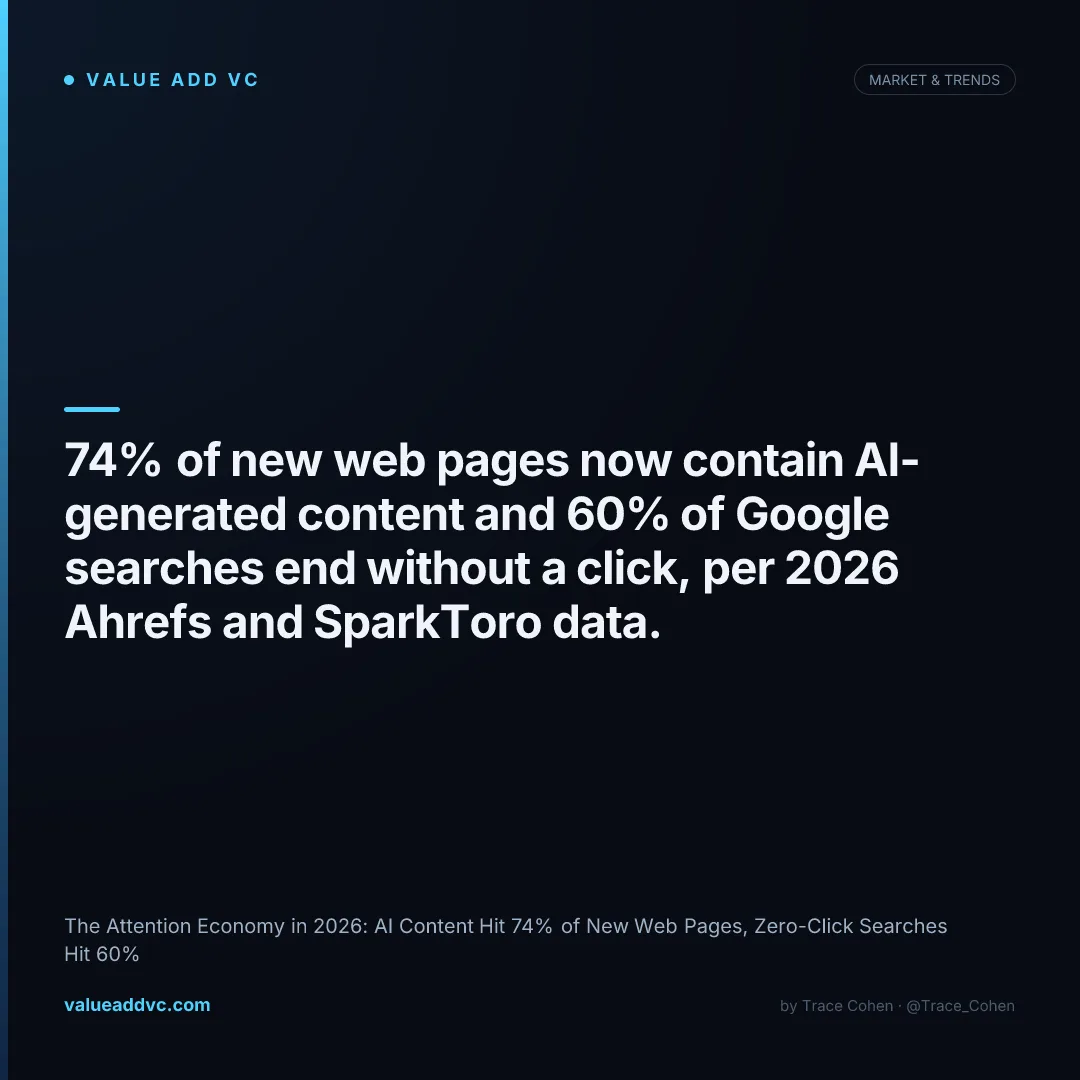
74% of newly published web pages now contain AI-generated content, and 60% of Google searches end without a single click to any website. That's the short answer. The longer answer is more interesting: attention didn't disappear, it just stopped flowing through the open web.
Founders who built a content, SEO, or media-adjacent business before 2024 are asking some version of the same question right now: where did the traffic go, and is it coming back? It isn't. What's actually happened is a re-routing — value moved from open publishers to platforms, and within platforms, it concentrated hard into a small number of creators and channels that own their audience directly instead of renting it from Google.
Figures are 2025-2026 estimates blended from Ahrefs, SparkToro, Circle, and digitalapplied.com creator-economy research. See methodology notes in each section below.
What Is the Attention Economy in 2026, and Why Did AI Content Break It?
The attention economy in 2026 is a market where AI-generated supply exploded while the channels that route attention to that supply consolidated. Ahrefs' study of 900,000 web pages published in April 2025 found that 74.2% contained AI-generated content, though only 2.5% were pure AI output with no human editing — the rest were human-AI blends. Separately, AI-written material now accounts for roughly 64% of newly published internet content overall, with AI-written articles, listings, and posts outpacing purely human-written material by an estimated 17-to-1.
Visual content saturated even faster: 71% of social media images are now AI-generated, and on Instagram, TikTok, and Pinterest specifically, AI-generated visuals account for 79% of everything posted. Business content followed the same curve — 38% of business web content published in 2026 involved AI assistance at some stage, up from just 14% in 2024. Supply exploded roughly 3x in two years. Distribution capacity for that supply did not.
Zero-Click Searches: Why Content Volume Stopped Mattering
Roughly 60% of Google searches in 2026 now end with no click to any website — up from an estimated 35% five years ago — per SparkToro's 2026 tracking. The proximate cause is Google AI Overviews, which now trigger on approximately 48% of tracked queries, a 58% year-over-year jump, and which reduce click-through rate by nearly 60% on the queries where they appear.
The downstream effect on publishers has been brutal and uneven. Google search traffic to publishers fell an estimated 33% globally in the year to November 2025, with U.S. publishers hit harder at roughly -38%. Some individual sites lost far more — HubSpot alone has been cited in multiple industry analyses as losing 70-80% of its organic traffic. Bain & Company estimates the broader effect at a 15-25% organic traffic decline across many sectors as a direct result of AI Overviews. If you built a business on the assumption that publishing content earns proportional traffic, that assumption quietly stopped being true sometime around 2024-2025.
The Attention Economy's Ad Market: Bifurcating, Not Collapsing
Global digital ad spend still grew to roughly $740 billion in 2026, up 11.4% year-over-year — the attention economy isn't shrinking in dollar terms, it's redistributing. But that growth masks a sharp split: display prospecting CPMs (lower-tier, remnant inventory) fell about 48% year-over-year through April-May 2026, while premium, curated, brand-safe inventory saw the opposite move — the CPM gap between commodity open-exchange placements and premium inventory has widened more than 60% since 2024.
That bifurcation is the clearest signal of what AI content saturation actually did to the market: it commoditized generic, high-volume content and made scarce, trusted, verifiably-human attention more valuable, not less. For AI-native and SaaS founders watching this play out, it's the same dynamic showing up in AI company valuation multiples — differentiated, defensible positions still command a premium even as commodity AI-adjacent offerings compress.
Where the Attention Economy's Value Actually Went: The Creator Data
The creator economy is estimated to exceed $250 billion globally in 2026, with several forecasts projecting it surpasses $1 trillion by the early 2030s at a compound annual growth rate in the low-to-mid 20% range. But the internal structure of that market changed completely. Per Circle's 2026 creator survey, only 18% of creators now earn revenue primarily from advertising or sponsorships — down sharply from a market that used to run almost entirely on ad-based monetization. Paid memberships now lead at 88% adoption, followed by course sales (53%) and coaching or services (51%).
Earnings concentration got worse, not better. The top 1% of creators captured 21% of all ad-payment volume in 2025, up from 15% in 2023; the top 10% captured 62%, up from 53%. YouTube remains the most reliable ad-based channel, paying creators $3 to $30 per 1,000 views depending on niche and geography, but creators who can prove ROI to brands are now earning 2-3x what they made on old flat-fee sponsorship deals — performance-based payment structures have replaced flat fees as the default.
| Attention economy segment | 2026 figure | Direction since 2023-2024 |
|---|---|---|
| New web pages with AI content | 74.2% | Up sharply (near-zero pre-2023) |
| Zero-click Google searches | 60% | Up from ~35% in 2021 |
| Google AI Overview trigger rate | ~48% of queries | Up 58% YoY |
| Publisher traffic from Google (US) | -38% | Down, year to Nov 2025 |
| Global digital ad spend | ~$740B | Up 11.4% YoY |
| Display prospecting CPMs | -48% YoY | Down (remnant inventory) |
| Creator economy market size | $250B+ | Up, ~20%+ CAGR |
| Top 10% creators' ad-payment share | 62% | Up from 53% in 2023 |
Figures are 2025-2026 estimates blended from Ahrefs, SparkToro, Bain & Company, digitalapplied.com, and Circle's 2026 creator economy survey. Ad-payment share data reflects platform-reported ad revenue distribution, not total creator earnings across all monetization channels.
What the 2026 Attention Economy Means for Founders and Investors
For any startup whose growth model still assumes SEO-driven or content-driven organic acquisition at 2022 efficiency, the math has changed permanently. A 15-25% organic traffic haircut from AI Overviews alone is now a baseline planning assumption, not a worst case. The businesses adapting best are the ones building first-party audience relationships — email lists, paid communities, owned apps — rather than renting distribution from a search engine that increasingly answers the query itself before a click happens.
This is also a quiet but real signal for anyone underwriting consumer or media-adjacent startups: distribution moats built on content volume are worth less than they were three years ago, and moats built on owned audience, trust, and verified-human output are worth more. It's the same lesson showing up across SaaS valuation multiples — differentiation is what still commands a premium once a market gets commoditized, whether that market is AI models or AI content.
How to Actually Compete in the 2026 Attention Economy
The practical playbook that's emerging from this data has three parts. First, stop measuring content success by publish volume or even raw organic sessions — measure it by first-party capture rate: what percentage of visitors convert into an email subscriber, app install, or logged-in account before Google or an AI Overview ever gets another chance to intercept them. A site losing 25% of its organic traffic to AI Overviews but converting 40% of remaining visitors into owned-audience relationships is in a stronger position than one holding flat traffic with a 2% capture rate.
Second, treat AI search citation as a distinct channel from classic SEO, not a subset of it. AI Overviews and answer engines like Perplexity and ChatGPT search cite sources differently than Google ranks them — well-edited, factually grounded, clearly-sourced content performs roughly 12% better in AI search citations than purely human content with no structure, while sloppy, unedited AI content performs about 34% worse. The editorial bar didn't disappear when AI made publishing cheaper; it moved to a different, less forgiving surface.
Third, budget for the CPM bifurcation directly. If your growth model depends on paid acquisition, the 48% year-over-year drop in remnant display CPMs looks like an opportunity, but it's cheap precisely because it's low-intent, commoditized inventory competing against an AI-content flood. The premium inventory where the CPM gap widened 60%+ since 2024 is expensive for the same reason bond investors pay up for quality in a volatile market — it's scarce, verified, and still converts. Budgeting for both tiers, rather than defaulting to whichever was cheap last quarter, is now a real strategic decision rather than a rounding error.
Bottom line: 74% of new web pages now contain AI-generated content and 60% of Google searches end with zero clicks — the attention economy in 2026 didn't shrink, it re-routed. Value moved away from open-web publishers and toward platforms and the top 10% of creators, who now capture 62% of ad-payment volume by owning audience relationships directly instead of renting them from search.
Latest from the Pulse
Get VC data most people never see
— free to subscribe
Trace's notes on venture, AI and startups, a few times a week. Join 5,000+ subscribers. No spam.
No spam, unsubscribe anytime. Sent via Substack · Privacy · or subscribe on Substack ↗