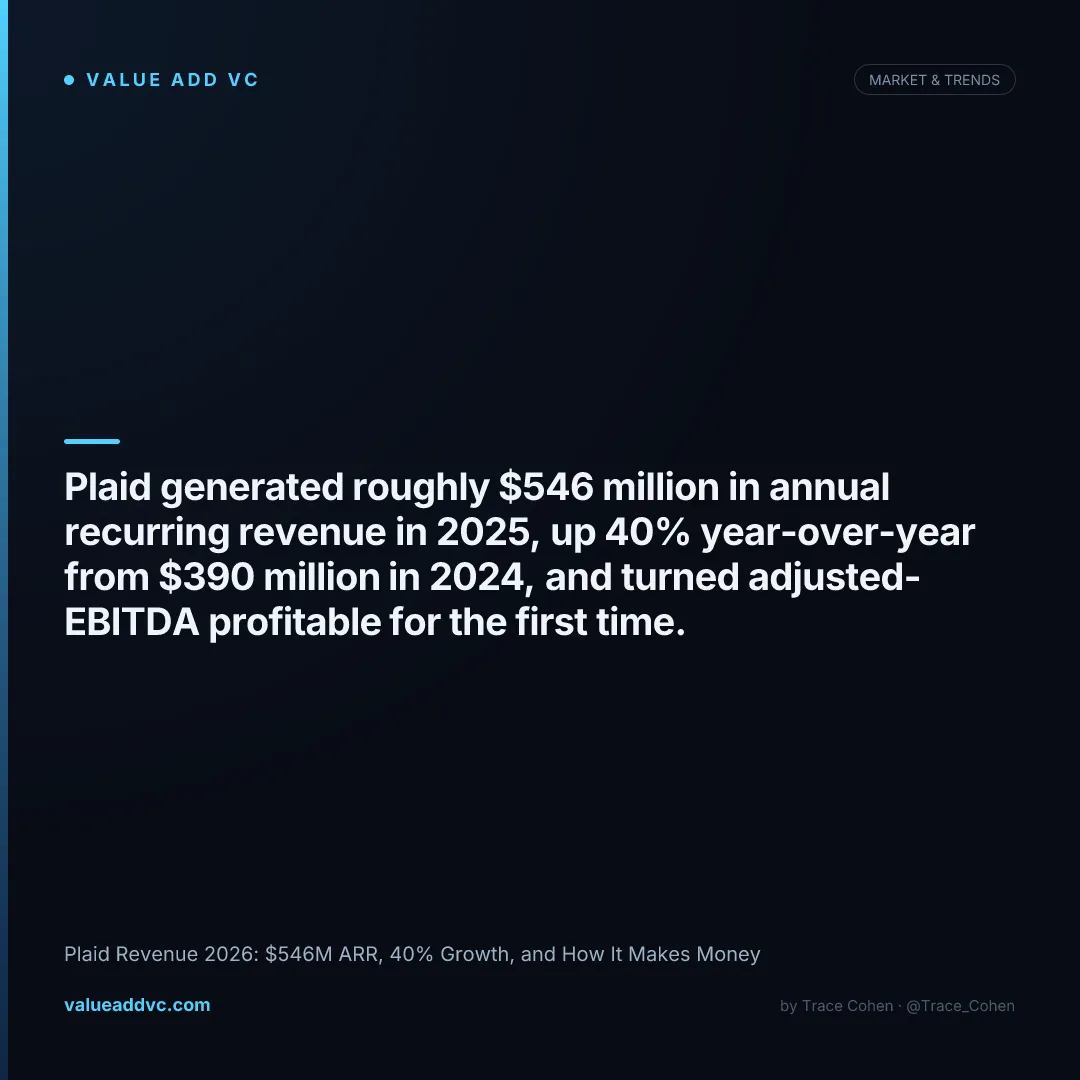
Plaid pulled in roughly $546 million in annual recurring revenue in 2025 — up 40% from $390 million the year before — and turned profitable for the first time. That's the short answer. The longer answer is that the company's growth is no longer just about linking bank accounts.
Plaid doesn't file public financials, so every figure below comes from research firms, reported secondary-market data, and the company's own 2025 shareholder letter from CEO Zach Perret. Together they paint a clear picture: after a multi-year slowdown, Plaid's revenue reaccelerated, its product mix diversified, and the business finally started generating more cash than it burns.
Figures are 2025-2026 estimates blended from Sacra, TechFundingNews, and Plaid CEO Zach Perret's 2025 shareholder letter. Plaid is private and does not disclose audited financials.
What Is Plaid's Revenue in 2026?
Plaid closed 2025 at roughly $546 million in annual recurring revenue, according to Sacra's research, up 40% from $390 million in 2024. Plaid has not published a specific 2026 ARR figure yet — the company reports through an annual shareholder letter rather than quarterly earnings, so the most current confirmed number remains the 2025 year-end total.
For context on scale: that $546 million ARR is generated from more than 150 million connected consumer bank accounts across 7,000+ fintech apps, including Coinbase, Venmo, Robinhood, and Chime. If the 40% growth rate from 2025 holds through 2026, Plaid would be on pace to cross $750-800 million in ARR by year-end.
How Does Plaid Make Money?
Plaid earns revenue by charging fintech apps and financial institutions — not consumers — for API access to bank account data and related services. A company like Robinhood pays Plaid on a per-connection or usage basis every time a customer links a checking account, and that relationship continues generating fees for ongoing balance checks, transaction history pulls, and fraud signals.
The original product, core account linking and data connectivity, still anchors the business, but it's increasingly commoditized as banks build their own open-banking APIs. That's why Plaid has spent the last three years pushing into identity verification, fraud detection (Plaid Protect), payments initiation, and credit underwriting (Plaid Check) — higher-margin products sold to the same customer base that already depends on the linking layer.
Which Plaid Products Are Growing Fastest?
Plaid's anti-fraud product, Plaid Protect, grew roughly 400% year-over-year in 2025 — the fastest-growing line in the company. Payments facilitation grew roughly 250%, and new products overall (fraud, payments, credit, identity combined) grew more than 90%, well ahead of the 40% blended company-wide rate.
That gap matters. It means core account-linking revenue is growing meaningfully slower than the 40% headline number, dragged down by pricing pressure as banks and card networks build competing open-banking rails. The new products are doing the heavy lifting on growth, which is also why they now account for more than a fifth of total ARR after being a rounding error just three years ago.
Is Plaid Profitable?
Yes — Plaid reached full-year adjusted EBITDA profitability in 2025, its first profitable year since being founded in 2013. That milestone came alongside the 40% ARR growth and is a big reason the company is now exploring a US IPO rather than needing another private capital raise purely to fund operations.
Profitability plus reaccelerating growth is a meaningfully different pitch to public-market investors than Plaid could have made in 2022 or 2023, when growth had slowed to roughly 12% and the company was still burning cash. It's the combination — not either metric alone — that analysts point to when explaining why Plaid's valuation recovered from a $6.1 billion secondary sale in April 2025 to an $8 billion primary round in February 2026.
How Does Plaid's Revenue Compare to MX, Yodlee, and Other Financial Data Aggregators?
Plaid is roughly 5-6x larger by revenue than its closest independent competitor, MX Technologies, and dwarfs most of the category on both scale and growth rate. The financial data connectivity market has consolidated heavily — two of Plaid's biggest historical rivals, Finicity and Tink, were acquired by card networks rather than staying independent.
| Company | Est. revenue/ARR | Ownership | Last known valuation | 2025 growth |
|---|---|---|---|---|
| Plaid | $546M ARR | Private (exploring IPO) | $8B (Feb 2026) | +40% |
| MX Technologies | ~$95M ARR (est.) | Private | $1.9B (2021 Series C) | Not disclosed |
| Envestnet Yodlee | Not disclosed | Owned by Bain Capital | Undisclosed (2024 buyout) | Legacy, low growth |
| Finicity | Not disclosed | Owned by Mastercard | $825M (2020 acquisition) | Not disclosed |
| Tink | Not disclosed | Owned by Visa | $1.9B (2021 acquisition) | Not disclosed |
| Trustly | Not disclosed | Private (IPO explored 2021) | $9-11B (2021 IPO estimate) | Not disclosed |
Figures are blended from PitchBook, Crunchbase, Sacra, GetLatka estimates, and company/acquirer press releases (Mastercard, Visa). Private-company revenue figures marked "est." are third-party estimates, not audited disclosures.
What the headline growth numbers miss
The 40% ARR growth figure is real, but it's a blended average that flatters the story. Core account-linking revenue — still the majority of Plaid's business — is growing well below 40%, since new products at 90%+ growth are pulling the average up from a smaller base. If Plaid's new products plateau before they scale past 30-40% of ARR, the blended growth rate will fall back toward whatever the core linking business is doing on its own, which has faced price compression for years as banks build direct open-banking APIs. It's also worth remembering these are Plaid's own disclosed figures from a shareholder letter, not an audited S-1 — the numbers deserve the same scrutiny any pre-IPO company's self-reported metrics get.
Plaid's revenue story flipped in two years.
From 12% growth and no profitability in 2023 to $546M ARR, 40% growth, and its first profitable year in 2025 — that's the pitch behind the IPO exploration.
Bottom Line: What Plaid's Revenue Means for an IPO
At $546 million in ARR growing 40% and now profitable, Plaid has the financial profile of a company that can credibly go public — a very different position than it was in during the 2022-2023 fintech pullback, when growth had slowed to around 12%. The $8 billion valuation implies roughly a 15x ARR multiple, well below the 34x multiple its $13.4 billion 2021 round carried on a much smaller revenue base — for how that stacks up against other software companies, see our SaaS valuation multiples dashboard.
The number to watch through the rest of 2026 is the new-product ARR share. If fraud, payments, and credit keep compounding at 90%+ and cross 30-40% of total ARR, Plaid starts looking like a diversified fintech infrastructure platform rather than a single-product API company — and that reframing is exactly what determines whether public investors pay a premium or a discount multiple relative to the $8 billion private mark. Track the IPO timeline itself on our full Plaid IPO breakdown, and see how it stacks up against this year's other listings on the IPO Tracker.
Follow Plaid's revenue growth and IPO timeline on the IPO Tracker at Value Add VC. Reach out at t@nyvp.com or @Trace_Cohen.
Latest from the Pulse
Get VC data most people never see
— free to subscribe
Trace's notes on venture, AI and startups, a few times a week. Join 5,000+ subscribers. No spam.