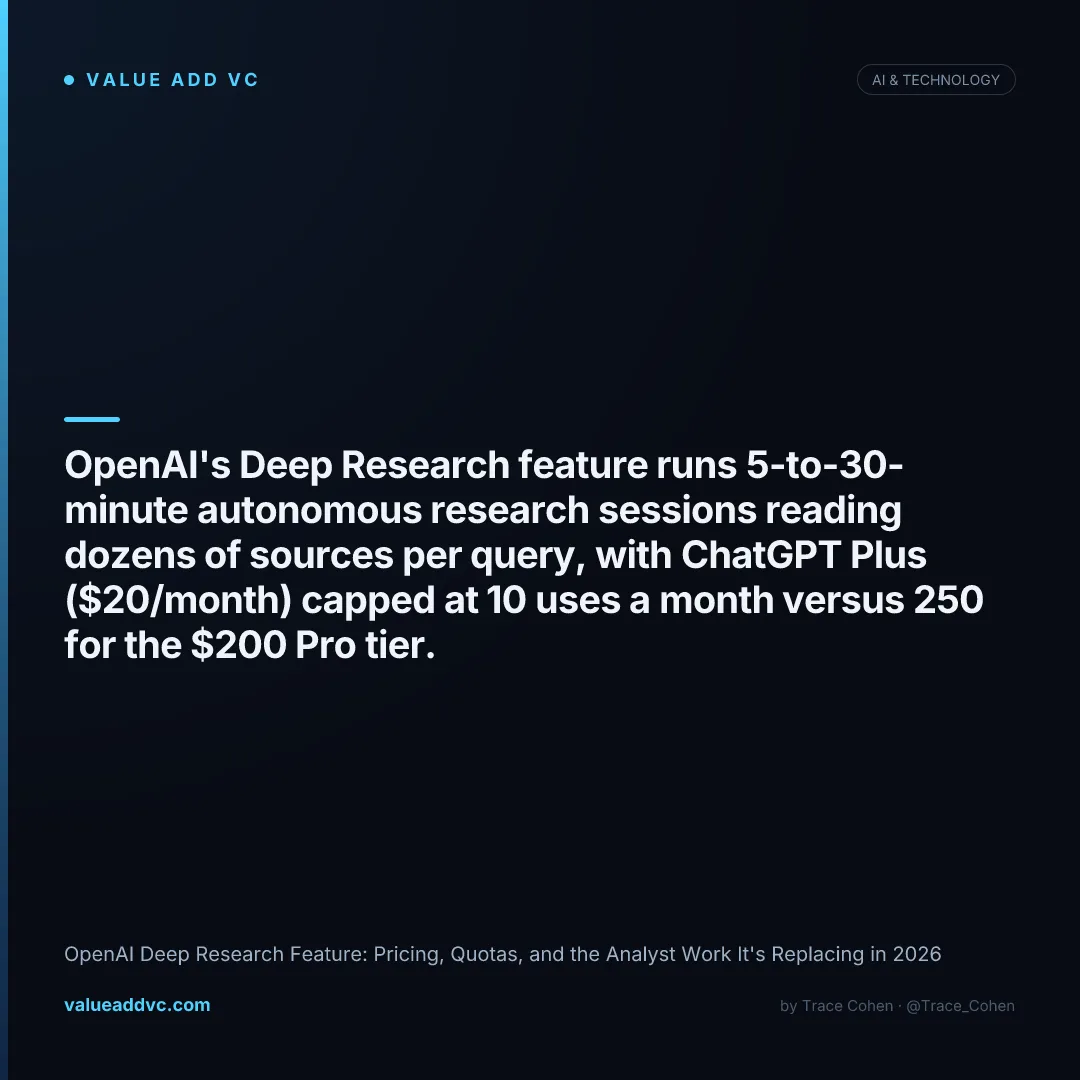
ChatGPT Plus subscribers get just 10 Deep Research queries a month in 2026, while $200/month Pro subscribers get 250 — a 25x gap for a feature that reads dozens of sources and writes a cited report in 5 to 30 minutes. That's the short answer. The longer answer is what this feature is actually doing to entry-level research jobs.
Hiring for junior analysts and research associates has quietly cooled over the past year, and OpenAI's Deep Research is a big part of the reason. It's not hype — it's a specific agentic feature with specific quotas, specific pricing tiers, and a specific competitive set that includes Google and Anthropic. Here's what it actually costs, how it works, and what the data says about the jobs it's automating.
Figures are 2026 estimates blended from OpenAI's product pages, ChatGPT pricing documentation, and industry labor-market research. See sourcing notes below each section.
What Is the OpenAI Deep Research Feature and How Does It Work?
OpenAI's Deep Research feature is an autonomous agent inside ChatGPT that plans a research outline, independently browses and reads dozens of web sources, and returns a cited, multi-page synthesis from a single prompt. It launched on February 2, 2025, originally powered by a specialized version of the o3 reasoning model, and each session runs roughly 5 to 30 minutes depending on scope.
A February 10, 2026 update expanded the feature meaningfully: users can now connect Deep Research to any MCP server or third-party app, restrict web searches to a whitelist of trusted sites, track progress in real time, and interrupt a run mid-task to redirect it with a follow-up prompt or new source. That last change matters most for professional use — it turns Deep Research from a one-shot black box into something closer to an iterative research assistant you can steer.
The output format has also matured since the February 2025 launch. Early Deep Research reports were dense, footnote-heavy walls of text that read like a raw research dump. The 2026 version organizes findings into scannable sections with inline citations linked back to the exact source passage, and the MCP integration means a report can now pull directly from a connected Notion workspace, a Google Drive folder, or an internal knowledge base rather than only the open web — which is what makes it usable for the kind of proprietary, company-specific diligence that VCs and operators actually need, not just generic market overviews.
How Much Does the OpenAI Deep Research Feature Cost in 2026?
Deep Research isn't sold as a standalone product — it's a usage-capped allowance bundled into existing ChatGPT subscription tiers, and the caps vary by a wide margin. Free-tier users get roughly 5 lightweight queries a month. ChatGPT Plus, at $20/month, includes 10 Deep Research queries — down from the 25-per-month allotment OpenAI extended to Plus, Team, Enterprise, and Edu users in an April 2025 quota increase, suggesting the company has since tightened access on its cheapest paid tier as usage scaled.
The real capacity sits in the two Pro tiers OpenAI now runs side by side: a $100/month mid-tier Pro plan with roughly 50 Deep Research sessions a month, and the $200/month Pro plan with 250 runs — 25 times the Plus allowance. For a research-heavy user, that's the difference between rationing two or three serious deliverables a month and running a Deep Research query almost daily.
| ChatGPT tier | Monthly price | Deep Research queries/month | Cost per query (approx.) |
|---|---|---|---|
| Free | $0 | ~5 | $0 |
| Plus | $20 | 10 | ~$2.00 |
| Pro (mid) | $100 | ~50 | ~$2.00 |
| Pro (top) | $200 | 250 | ~$0.80 |
| Team / Enterprise / Edu | Custom | Pooled, admin-set | Varies |
| Typical session length | — | 5-30 minutes | Reads dozens of sources |
Figures are 2026 pricing estimates from OpenAI's ChatGPT pricing pages and third-party pricing trackers (costbench.com, aipricing.guru). Cost-per-query is illustrative, calculated as subscription price divided by monthly quota, and does not reflect OpenAI's actual internal compute cost per run.
Is the OpenAI Deep Research Feature Actually Replacing Junior Analyst Work?
Partially, and the data is more nuanced than either the doomer or dismissive takes suggest. Industry estimates as of early 2026 put AI's share of a typical analyst's 2024 weekly workload at roughly 30-40% — mostly the pulling, reading, cross-referencing, and first-draft-synthesizing of source material that used to be the core training ground for entry-level hires. Job postings for pure report-generation roles built around recurring dashboards and scheduled queries have measurably declined over the same period.
That said, the World Economic Forum's Future of Jobs Report still projects data analyst roles to grow 30-35% by 2027 — the roles aren't disappearing, they're changing shape. The emphasis has shifted toward strategic thinking, validating AI-generated output, and communicating findings to non-technical stakeholders, rather than manually assembling the underlying research. OpenAI's own analysis of roughly 1.5 million ChatGPT conversations found that 49% of usage falls into the "asking and research" category, which is exactly the workload Deep Research targets directly.
For VC-backed startups specifically, this shows up first in headcount planning: research, market-sizing, and competitive-intelligence functions that used to require a dedicated junior hire now often run through a Deep Research query plus an hour of human validation. That's a real cost-structure shift worth tracking on our hiring dashboard, where entry-level research and analyst postings are one of the categories showing the sharpest year-over-year compression.
OpenAI's Deep Research Feature vs Google Gemini and Perplexity
OpenAI wasn't first, and it isn't alone. Google shipped Gemini Deep Research in December 2024, roughly two months ahead of OpenAI's version, using the same core pattern: plan an outline, browse dozens of sources autonomously, return a cited report. Perplexity runs a lighter, faster version of the same idea built on its existing search index. Anthropic has taken a different approach entirely — rather than a single "Deep Research" button, Claude's agentic tool-use and Projects features let users build equivalent multi-step research workflows manually, and Claude Opus 4.8, shipped May 28, 2026, leads competing benchmarks specifically on complex, ambiguous multi-step reasoning tasks.
On raw research and reasoning benchmarks, independent 2026 comparisons give Gemini 3.1 Pro a slight edge over both GPT-5.5 and Claude Opus 4.8. But OpenAI answered directly: GPT-5.5, released April 23, 2026, added a "reasoning_effort" control and a Background Mode purpose-built for long-running, multi-step Deep Research jobs that can now run without keeping the app in the foreground. Meanwhile Anthropic has been winning on a different axis entirely — it overtook OpenAI in U.S. enterprise AI spending and adoption for the first time in 2026, driven largely by coding rather than research use cases.
| Provider | Deep-research product | Launch date | 2026 differentiator |
|---|---|---|---|
| OpenAI | Deep Research (ChatGPT) | Feb 2, 2025 | MCP connections, Background Mode (GPT-5.5) |
| Gemini Deep Research | Dec 2024 | Leads on pure research/reasoning benchmarks | |
| Perplexity | Deep Research | Feb 2025 | Faster, lighter, search-index native |
| Anthropic | Claude agentic tool-use / Projects | Ongoing, no single launch | Opus 4.8 leads ambiguous multi-step reasoning |
| xAI | Grok DeepSearch | 2025 | Real-time X/Twitter data integration |
| Enterprise spend leader (2026) | Anthropic | — | Overtook OpenAI in U.S. enterprise adoption |
Figures are 2026 estimates blended from company product announcements, tech-insider.org and CNBC 2026 model comparisons, and enterprise-adoption reporting. Benchmark leadership varies by task type and shifts with each model release.
What the OpenAI Deep Research Feature Means for VCs and Founders
Deep Research is a useful stress test for any startup pitching a "research assistant" or "market intelligence" product: if the core value prop is "we read a lot of sources and summarize them," that's now a $20-to-$200-a-month feature bundled inside a product most buyers already have. The startups still raising well in this category are the ones adding something Deep Research structurally can't — proprietary data, workflow integration, or domain-specific validation — not just a better prompt wrapped around the same web-search-and-synthesize loop.
On the investing side, this is also reshaping how LPs and GPs evaluate diligence-heavy workflows. A first-pass market map or competitive landscape that used to take an associate two days now takes a Deep Research query plus an afternoon of verification — which is exactly the kind of productivity shift we track across our VC performance benchmarking data, where fund operating costs and headcount-per-dollar-deployed ratios are both starting to move.
The practical playbook for any founder or fund right now has two parts. First, don't build a product whose entire moat is "we synthesize public information faster" — that gap closes every time OpenAI, Google, or Anthropic ships a model update, and Deep Research quotas keep expanding even as prices hold flat. Second, do audit your own team's research workflow for the same commodity risk: if a $200-a-month ChatGPT Pro subscription can replicate 30-40% of a junior hire's output, the ROI math on that next associate hire needs to explicitly account for what Deep Research already covers, not ignore it.
Bottom line: OpenAI's Deep Research feature gives ChatGPT Plus subscribers 10 autonomous, cited research runs a month for $20, and Pro subscribers up to 250 for $200 — and it's already automating an estimated 30-40% of the source-gathering and synthesis work that used to define junior analyst jobs. The roles aren't vanishing outright (data analyst headcount is still projected to grow 30-35% by 2027), but the entry-level task list has permanently changed, and any startup or fund not accounting for that in its own research workflows is underwriting against a cost structure that no longer exists.
Latest from the Pulse
Get VC data most people never see
— free to subscribe
Trace's notes on venture, AI and startups, a few times a week. Join 5,000+ subscribers. No spam.
No spam, unsubscribe anytime. Sent via Substack · Privacy · or subscribe on Substack ↗