Oklo made $1.21 million in Q2 2026 revenue and lost $48.5 million doing it. The stock still trades near an $8 billion market cap — because Wall Street isn't pricing today's revenue, it's pricing whether Oklo can become the utility that powers the AI data center boom.
Oklo (NYSE: OKLO) is a Sam Altman-backed fission startup that went public via SPAC merger in May 2024 and has spent the two years since racking up gigawatts of preliminary power deals with the same hyperscalers driving the AI infrastructure buildout. It has almost no revenue, a widening quarterly loss, and no operating commercial reactor. It also has $3 billion in cash, an accelerating NRC review, and offtake conversations with Equinix and Meta that, if they convert, would make it one of the larger new power producers in the country. Both things are true at once, and untangling them is the whole story.
Figures from Oklo's Q2 2026 10-Q, TradingView, and stockanalysis.com, as of August 25, 2026.
How Does Oklo Actually Make Money?
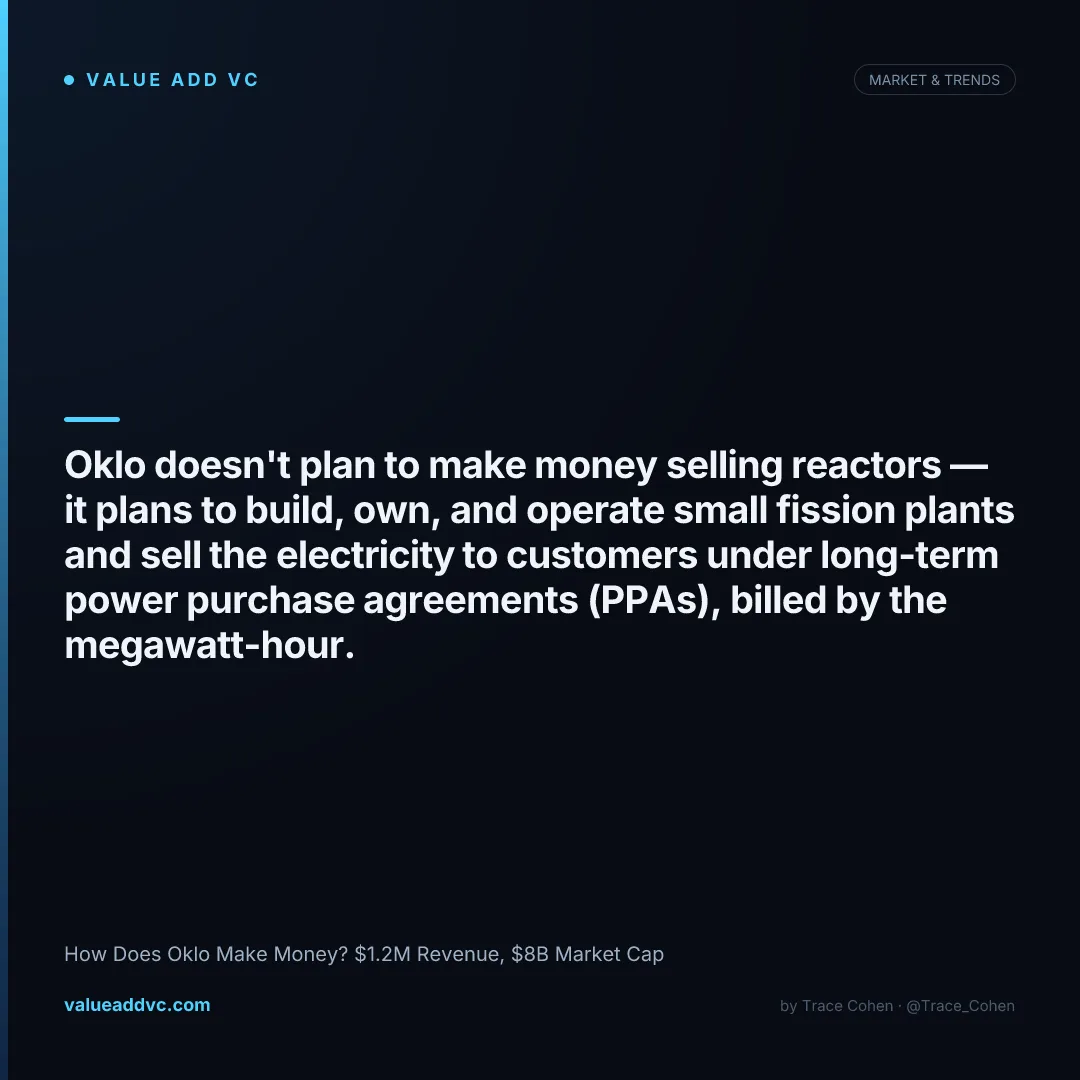
Oklo's model is not to sell nuclear reactors the way a traditional vendor like Westinghouse or GE Hitachi sells plants to utilities. Instead, Oklo intends to design, build, finance, own, and operate its own small fission power plants — branded the Aurora Powerhouse — and then sell the electricity itself, directly to customers, under long-term power purchase agreements (PPAs) billed by the megawatt-hour. It's closer to an independent power producer than an equipment manufacturer: the company keeps the asset on its own balance sheet and earns recurring revenue for as long as the plant runs, rather than booking a one-time equipment sale.
That structure is why Oklo is effectively pre-revenue today. Its Q2 2026 numbers show $1.21 million in revenue, up from zero a year earlier, but that figure reflects early engineering, licensing, and services work — not power sales, since no Aurora plant is yet operating commercially. The real revenue event doesn't happen until a plant is licensed, built, and delivering electrons under a signed PPA, which is still years away for Oklo's first sites. Its closest DOE-backed peer, Kairos Power and its molten-salt reactor design, faces the same pre-revenue timeline problem despite a Google offtake deal already signed. For context on how the broader nuclear buildout for AI infrastructure is being financed, see our Nuclear & SMR Tracker.
The AI Data Center Power Demand Angle
Oklo's valuation only makes sense in the context of one macro trend: AI data centers need enormous, reliable, 24/7 power, and the U.S. grid is struggling to add capacity fast enough. Hyperscalers like Meta and Google have responded by signing direct deals with nuclear developers to lock in future electricity supply years before a reactor is built — treating power procurement the same way they treat chip procurement, as a strategic bottleneck to secure early.
The clearest evidence for Oklo specifically is its 1.2-gigawatt agreement with Meta, announced in 2026, to develop a nuclear energy campus on 206 acres in Pike County, Ohio, that Oklo owns (formerly Department of Energy land). The deal lets Meta prepay for power and provide early project funding to advance certainty for the site, which supports Meta's AI supercluster buildout in nearby New Albany, Ohio. Pre-construction and site work are slated to begin in 2026, with the first phase targeted to come online as early as 2030. Oklo also holds a December 2023 master power agreement with Equinix for up to 500 megawatts across future Aurora deployments — evidence the company was courting data-center offtake well before the current AI-nuclear rally accelerated.
NRC Licensing: Where Oklo Actually Stands
Oklo's first planned deployment, Aurora-INL, is a liquid metal-cooled, metal-fueled fast reactor rated at up to 75 MWe, sited at Idaho National Laboratory, where Oklo broke ground in September 2025. The company is still in pre-application and phased-licensing activities with the Nuclear Regulatory Commission rather than holding a full operating license, but it has posted a genuine milestone: in May 2026, the NRC approved Oklo's Principal Design Criteria topical report for the Aurora Powerhouse on an accelerated review timeline — in less than half the time such reviews traditionally take.
That's a real regulatory data point, not just a company press release framed as one — the NRC's own site confirms Oklo is furthest along of the advanced-reactor cohort on phased pre-application work. It is not, however, the same as holding a combined construction and operating license, which is the actual gate before Aurora-INL can generate revenue-producing power.
Oklo's Balance Sheet: Burning Cash to Buy Time
Oklo ended Q2 2026 with roughly $3 billion in cash and marketable securities ($1.6 billion in cash and equivalents, $1.4 billion in marketable securities), funded by its SPAC merger and subsequent capital raises. Against that, the company posted a $48.5 million net loss in the quarter and an $81.6 million net loss for the first half of 2026, with a $124.2 million operating loss partially offset by $44.5 million in interest and dividend income on its cash pile.
Management has raised its own 2026 guidance for operating cash use to $120-150 million and capital spending to $400-500 million as it accelerates construction and licensing work — a sign the company is deliberately front-loading spend to hit its 2030-era power-delivery targets rather than trying to conserve cash for its own sake. At the current burn rate, the $3 billion balance buys Oklo years of runway, which matters because nothing about nuclear licensing moves quickly.
Who Owns Oklo — and Sam Altman's Role
Oklo was founded in 2013 by Jacob DeWitte and Caroline Cochran. Sam Altman, now CEO of OpenAI, met DeWitte through Y Combinator in 2014, invested in Oklo in 2015, and has served as chairman of its board since. Altman also co-founded AltC Acquisition Corp, the blank-check company that took Oklo public via SPAC merger on May 9, 2024, with shares beginning to trade on the NYSE the next day. The deal delivered about $306 million in gross proceeds to Oklo at close.
Altman's dual role — OpenAI CEO and Oklo chairman — is one reason the stock gets grouped with the broader "AI needs power" trade rather than treated as a standalone utility bet. It doesn't change the underlying mechanics of the business: Oklo still has to license, finance, and build physical reactors before any of that AI-power narrative converts into cash flow.
Oklo vs. Its Nuclear-for-AI Peers
| Metric | Oklo | Kairos Power | Standard Nuclear |
|---|---|---|---|
| Status | Public (NYSE: OKLO) | Private, DOE-backed | Public (STDN) |
| Reactor type | Liquid metal-cooled fast reactor | Fluoride salt-cooled (molten salt) | Microreactor |
| Largest disclosed hyperscaler deal | 1.2 GW with Meta (Ohio) | 500 MW with Google | Not disclosed |
| First reactor site | Aurora-INL, Idaho | Hermes, Oak Ridge, TN | Varies by project |
| Revenue status | $1.21M Q2 2026 (services) | Not disclosed; DOE cost-share | Pre-revenue |
Figures from company disclosures, DOE, and Kairos Power/Google press releases, 2024-2026. Private-company figures are drawn from public announcements and may not reflect the complete financial picture.
Oklo vs. Kairos Power: Disclosed Hyperscaler Offtake
Company and DOE press releases, 2024-2026
The Bull and Bear Case for Oklo
The bull case is that Oklo is the furthest along of the advanced-reactor cohort on NRC pre-application work, has locked in genuine gigawatt-scale demand signals from Meta and Equinix, and sits on roughly $3 billion in cash — enough to fund years of construction and licensing without needing to raise capital under distress. If Aurora-INL comes online anywhere near its 2030-era target and Oklo can replicate that success across its Ohio campus with Meta, the recurring-revenue PPA model could scale into a genuinely large power business.
The bear case is that nothing in nuclear moves on schedule, historically. Oklo is still years from its first commercial kilowatt-hour of revenue, its net losses are widening even as spending accelerates, and an $8 billion-plus market cap on $1.21 million of quarterly revenue only holds up if licensing, construction, and offtake conversion all go close to plan — a bar most first-of-a-kind reactor projects in U.S. history have missed. Track how the rest of the nuclear-for-AI cohort is pricing that same risk on our Nuclear & SMR Tracker and Fusion Energy Timeline.
Bottom line: Oklo doesn't make money selling reactors — it plans to own and operate small fission plants and sell the power itself under long-term contracts, and as of Q2 2026 that model has produced $1.21 million in revenue against a $48.5 million net loss. The stock's roughly $8 billion market cap is a bet on Meta's 1.2-gigawatt Ohio agreement, Equinix's 500-megawatt master deal, and an NRC review that's moving faster than typical — not on anything Oklo has actually delivered to the grid yet.
Latest from the Pulse
Get VC data most people never see
— free to subscribe
Trace's notes on venture, AI and startups, a few times a week. Join 5,000+ subscribers. No spam.