
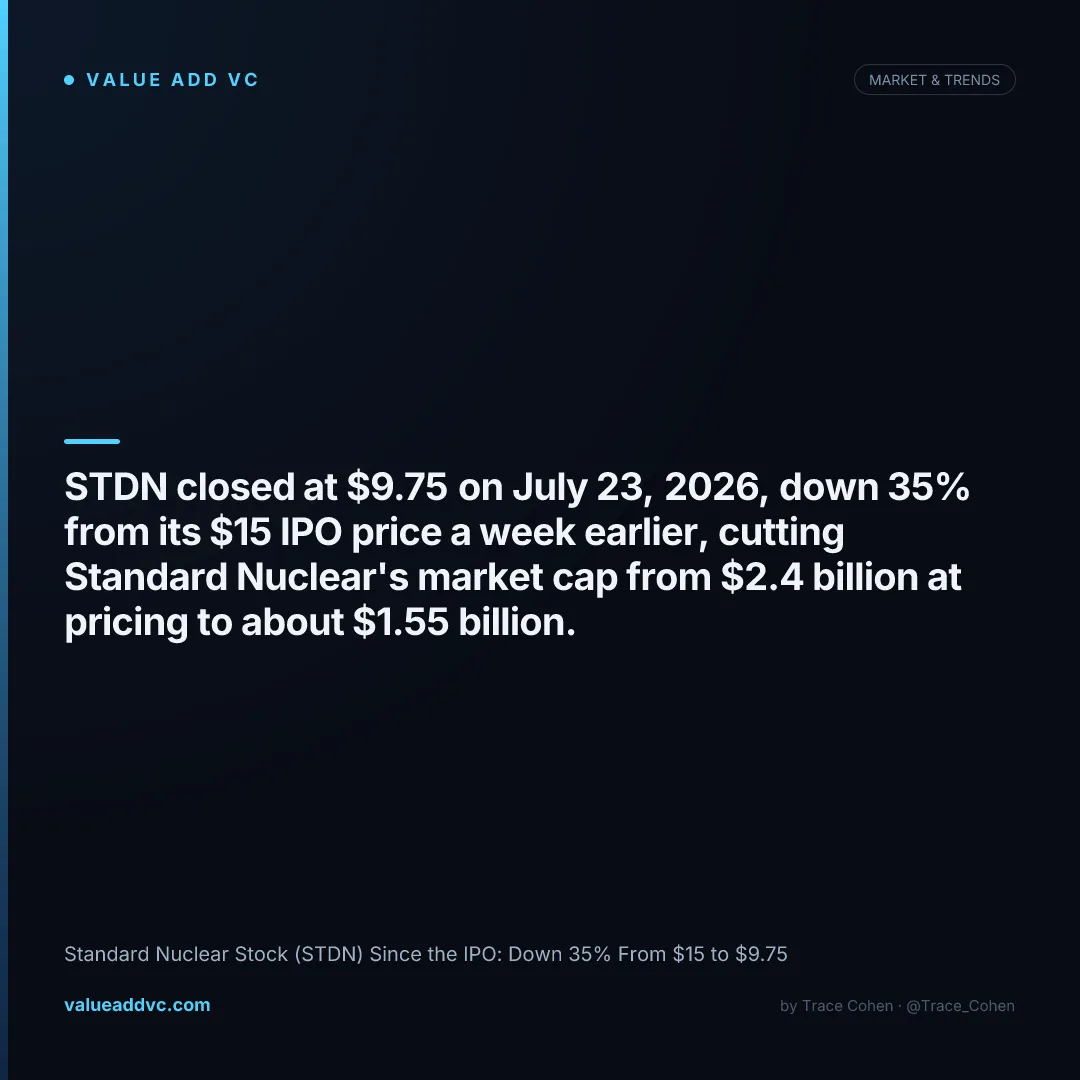
STDN closed at $12.92 on September 22, 2026 — 13.9% below its $15 IPO price, but 32.5% above the $9.75 low it hit eight days after the July 15 pricing. In between, the stock rallied as high as $16.56 on Q2 earnings and a sixfold jump in contract backlog, then gave back nearly a quarter of that gain in a single September session.
Standard Nuclear filed its S-1 on July 7 chasing a $3.55 billion valuation, priced at $15.00 on July 15, and fell to a $9.75 close by July 23 as a downsized offering met a sector-wide nuclear selloff. Analyst coverage in August pushed the stock back above $16, and Q2 2026 earnings on August 26 showed revenue jumping to $4.7 million with a $576.9 million contract backlog — but the stock has since pulled back to $12.92 as of September 22, 2026. What's happened since is still a case study in how fast sentiment can swing on a name with almost no trading history to anchor it.
What Is Standard Nuclear's Stock Price After the IPO?
Standard Nuclear (NYSE: STDN) closed at $12.92 on September 22, 2026, after trading between $12.88 and $13.57 during the session. That's down 13.9% from a $15.00 IPO price on July 15, but up 32.5% from the $9.75 close it hit on July 23 — the stock's post-IPO low came a few days after that, near $7.05, before analyst coverage and Q2 earnings drove it as high as $16.56 in late August/early September. Market cap sits at roughly $2.02 billion today on about 156.6 million shares outstanding, down from a peak near $2.6 billion but still above the $1.55 billion it touched at the July low.
| Date | Event | Price | Change vs IPO Price |
|---|---|---|---|
| Jul 7, 2026 | S-1 filed | n/a (targeting up to $3.55B) | — |
| Jul 15, 2026 | IPO priced | $15.00 | 0% |
| Jul 16, 2026 | Trading debut — opens | $13.50 | -10.0% |
| Jul 16, 2026 | Trading debut — closes | $12.30 | -18.0% |
| Jul 17, 2026 | Day 2 close | $11.07 | -26.2% |
| Jul 23, 2026 | Sector selloff extends losses | $9.75 | -35.0% |
| ~Jul 27-31, 2026 | 52-week low reached | ~$7.05 | ~-53.0% |
| Aug 10, 2026 | Goldman Sachs, BofA, UBS, William Blair, Barclays initiate Buy | n/a (coverage day) | — |
| Aug 16, 2026 | Rally continues | $13.72 | -8.5% |
| Aug 17, 2026 | Prior update's close | $13.31 | -11.3% |
| Aug 26, 2026 | Q2 2026 earnings: $4.7M revenue, first gross profit | n/a (after close) | — |
| Aug 27, 2026 | Day-after earnings reaction | $14.31 | -4.6% |
| Sep 1, 2026 | Peak close; UBS raises target to $20 from $14 | $16.56 | +10.4% |
| Sep 2, 2026 | Shares give back ~9-11% in a single session | $14.66 | -2.3% |
| Sep 22, 2026 | Latest close (intraday range $12.88-$13.57) | $12.92 | -13.9% |
Figures blend July-September 2026 trading data from StockTitan, Investing.com, StockAnalysis.com, and BusinessWire/Nasdaq press releases, as of September 22, 2026 (the most recent close at publication). The ~Jul 27-31 low is estimated from reported sector-wide percentage declines; exact closing prints for that session were not independently confirmed.
The Standard Nuclear IPO: What Changed Between the S-1 and Pricing
Standard Nuclear's original S-1 filing targeted 18.3 million shares at $18–$21, aiming to raise up to $356 million at a fully diluted valuation near $3.7 billion. By pricing day on July 15, that had shrunk to 10 million shares at a flat $15.00 — a $150 million raise, well under half the original target dollar amount, and a headline valuation of roughly $2.4 billion instead of $3.55 billion.
A downsized, below-range IPO followed by a negative debut is a specific signal: underwriters (BofA Securities and Goldman Sachs led the book) couldn't find enough demand at the original terms and cut both the price and the share count to get the deal done at all. That's a very different setup than the typical hot-IPO pattern where a company prices conservatively to guarantee a first-day pop — but the chart above shows the stock has clawed back most of that gap since, which the next section covers. Track how STDN compares to other 2026 listings on the IPO Tracker.
Why Did Standard Nuclear Stock Drop Since Its IPO?
Three things compounded at once during IPO week. First, the offering itself signaled weak demand before the stock even opened. Second, STDN got caught in a sector-wide nuclear selloff that hit nearly every advanced-reactor and fuel name simultaneously — Oklo fell 15.8% for the week, NuScale dropped 14.6%, and X-energy, Nano Nuclear, and Uranium Energy Corp all lost 8-9% in a single session on July 16 as the VanEck Uranium and Nuclear ETF (NLR) slid 16% for the month. Third, STDN-specific reports of heightened regulatory scrutiny tied to reactor-safety questions added company-level pressure on top of the sector move, with the stock trading down as much as 14% in a single stretch on that news.
Nuclear-Sector IPO Week: STDN vs Peers (% Change, Week of July 16-23)
Yahoo Finance, TipRanks, Foreign Policy Journal, July 2026.
STDN's IPO-week decline was more than double the sector average, which tells you the drop wasn't purely macro. A brand-new IPO with $3.36 million in trailing revenue and no public trading history to anchor sentiment gets punished harder in a risk-off week than an established name like Oklo, which at least has years of price discovery and a larger investor base absorbing the selling. The utilities largely sat this out — Constellation Energy fell just 2% and Vistra actually rose 5% over the same stretch. This was a growth-and-story selloff, not a broad energy-sector rotation, and that same thin-float, story-driven dynamic is exactly what fueled the rally back the other way once analysts started covering the stock.
STDN Since the Last Update: Q2 Earnings, a $576.9M Backlog, and a September Pullback
The August reversal started with analyst coverage, not company news. Around August 10, 2026, five banks initiated coverage on Standard Nuclear within days of each other — Goldman Sachs at Buy with an $18 price target, Bank of America at Buy with $15, UBS at Buy with $14, plus William Blair and Barclays also at Buy. That set up the stock's real catalyst: Q2 2026 earnings, reported after market close on August 26, 2026. Revenue reached $4.7 million (up from $0.6 million a year earlier) on the company's first commercial TRISO fuel deliveries, and gross profit turned positive at $3.2 million, versus a gross loss a year prior. Net loss narrowed to $3.4 million, or $(0.12) per share, down from a $7.7 million net loss in Q1 2026. Total contract backlog grew sixfold from the March level to $576.9 million — including funded backlog of $119.3 million — after Standard Nuclear signed a post-quarter fuel supply agreement with Antares Nuclear and an August 20, 2026 agreement with Radiant Industries covering TRISO deliveries through 2031, per Standard Nuclear's disclosed backlog figures.
The stock kept climbing after the report, peaking at a $16.56 close on September 1, 2026 — the same day UBS raised its price target to $20 from $14 while keeping its Buy rating. Eight analysts now cover the name with a consensus "Strong Buy" rating and an average 12-month price target around $16, per Investing.com's consensus estimates page. But the rally didn't hold: shares fell roughly 9-11% in a single session on September 2, 2026, and have continued to swing sharply through September, closing at $12.92 on September 22 — down about 22% from the September 1 peak.
What the headline misses
A stock that rallies 70% from its early-August level to a September 1 peak, then gives back nearly a quarter of that gain within three weeks, is still trading on thin-float mechanics as much as fundamentals — the same dynamic that made the initial 35% drop overshoot on the way down. The $576.9 million contract backlog is real and disclosed, but it's backlog, not booked revenue: funded backlog is only $119.3 million, and the company has roughly $696.3 million more in "qualified prospective orders" that haven't converted to contracts at all. None of the analyst price targets in the $11-$20 range have moved in lockstep with the stock's own swings, which tells you the targets are anchoring on the backlog story more than on any single quarter's print.
Standard Nuclear Stock: Does the Rally Make the Valuation Math Better?
At the original $3.55 billion IPO target, Standard Nuclear was priced at roughly 1,050x its $3.36 million trailing-twelve-month revenue at the time. At the $1.55 billion post-IPO low, that multiple had compressed to roughly 460x. At today's $2.02 billion market cap, and annualizing 2026's disclosed first-half revenue of $5.3 million (Q1 plus Q2), the multiple works out to roughly 190x — a real compression, but it comes from revenue actually growing (Q2 alone was $4.7 million, up from $0.6 million a year earlier) rather than from the stock simply falling further.
The balance sheet improved too. Standard Nuclear's IPO closed July 17, 2026 with net proceeds of $137.7 million, and the company reported $102.2 million in cash and equivalents at June 30, 2026 — roughly $239.9 million on a pro forma, debt-free basis once IPO proceeds are included. Against a combined $11.1 million net loss across Q1 and Q2 2026, that funds several years of runway without needing to raise again, which matters for a company whose thesis depends on SMR developers actually placing large fuel orders over the next 3-5 years — the $576.9 million contract backlog is evidence that's starting to happen, but funded backlog is only $119.3 million of it, and the rest hasn't converted to booked revenue.
What Improved Since the Last Update
- ✓ Q2 revenue hit $4.7M with a first quarterly gross profit of $3.2M
- ✓ Contract backlog grew sixfold to $576.9M, funded backlog to $119.3M
- ✓ Pro forma cash of ~$239.9M, debt-free, funds years of runway
- ✓ Revenue multiple compressed to ~190x annualized H1 revenue from ~460x at the July low
What's Still a Concern
- ✗ Stock gave back ~22% of gains from its Sep 1 peak in three weeks
- ✗ GAAP net loss widened to $(0.12)/share in Q2 vs $(0.06) a year earlier
- ✗ $696.3M of "qualified pipeline" is not yet under signed contract
- ✗ Small float means the next move could be just as sharp in either direction
What This Means for the Rest of the 2026 Nuclear IPO Pipeline
Standard Nuclear was supposed to be a proof point for the advanced-nuclear investment thesis translating into public-market appetite. Instead, its debut is a warning shot for the other pre-revenue nuclear and SMR names eyeing 2026-2027 listings: a compelling narrative around AI power demand and DOE policy tailwinds isn't automatically enough to clear a $2-3 billion valuation bar when a company is still reporting single-digit-million-dollar revenue. Underwriters on the next nuclear IPO will likely price more conservatively after watching STDN's book-building process force a near-50% cut to the raise before the stock even traded.
For investors, the more useful read isn't "nuclear is overhyped" — Constellation and Vistra's resilience during the same selloff argues against that — it's that the market is now differentiating sharply between profitable nuclear operators and pre-revenue nuclear-adjacent bets. That distinction didn't really exist six months ago, when nearly every ticker with "nuclear" or "SMR" in its story got bid up together. Compare how other 2026 debuts are trading on the Tech IPO dashboard.
How Standard Nuclear's Debut Compares to Other 2026 IPO Stumbles
STDN isn't the only 2026 listing that priced ambitiously and traded down hard once the story met a public order book. Cerebras (CBRS) fell from a $386 opening peak to under $170 before a further earnings-driven crash, and several AI-adjacent IPOs this year have followed a similar arc: strong pre-IPO narrative, aggressive S-1 valuation target, then a sharp reset once quarterly numbers or sector sentiment force a rerating. What sets Standard Nuclear apart is the speed in both directions — the initial 35% decline happened inside a single week of trading, and the 62% rebound off the low happened inside a single week too, because the offering was already downsized going in and the sector selloff hit before the stock had time to build its own independent trading base.
There's a structural reason volatility keeps running hotter for names like STDN than for Cerebras or an established peer like Oklo: the free float is small (10 million IPO shares, a fraction of the roughly 155-160 million shares outstanding on a fully diluted basis), trading volume is still dominated by short-term traders rather than long-only institutional holders who did diligence on the S-1, and there was no earnings history to anchor a floor price until analyst initiations gave the stock a new reference point in mid-August. That combination — thin float and no earnings anchor — is why STDN can move 35% one way and 62% the other inside a month, independent of whether the underlying TRISO fuel business is sound.
Standard Nuclear rallied on Q2 earnings, then gave much of it back.
$15 IPO price. $9.75 low. $16.56 peak. $12.92 now, as of September 22, 2026. A $2.02B market cap against $4.7M in Q2 2026 revenue and a $576.9M contract backlog.
The Bottom Line on Standard Nuclear Stock
The Standard Nuclear IPO went from a $3.55 billion target to a $2.4 billion pricing to a $1.55 billion market cap low in under three weeks, rallied to a roughly $2.6 billion peak by September 1 on Q2 earnings, and has since settled near $2.02 billion. The initial drop was a sector-wide nuclear selloff plus a downsized, under-demanded offering. The August-September swing was earnings-driven — Q2 revenue jumped to $4.7 million and the contract backlog grew sixfold to $576.9 million — but the stock has already given back nearly a quarter of its post-earnings gain. None of it changes the underlying thesis: if advanced nuclear reactors get built in the US at scale over the next decade, someone has to supply the fuel, and Standard Nuclear remains the only domestic commercial-scale TRISO producer with a signed DOE agreement.
What changed is the price you're paying for that bet, and it's changed three times since the IPO. At $12.92 as of September 22, 2026, the revenue multiple is far cheaper than the IPO ask and the roughly $239.9 million pro forma cash balance still buys time for the order book to materialize, but the stock's own volatility — up 70% in three weeks, then down 22% in the next three — means the "right" price is still being discovered. Standard Nuclear's Q3 2026 results will be the next real test of whether the backlog converts into revenue at the pace analysts are pricing in. Track STDN and the rest of the 2026 IPO class on the IPO Tracker.
Track Standard Nuclear and other 2026 IPOs on the IPO Tracker at Value Add VC. Reach out at t@nyvp.com or @Trace_Cohen.
Latest from the Pulse
Get VC data most people never see
— free to subscribe
Trace's notes on venture, AI and startups, a few times a week. Join 5,000+ subscribers. No spam.
No spam, unsubscribe anytime. Sent via Substack · Privacy · or subscribe on Substack ↗