
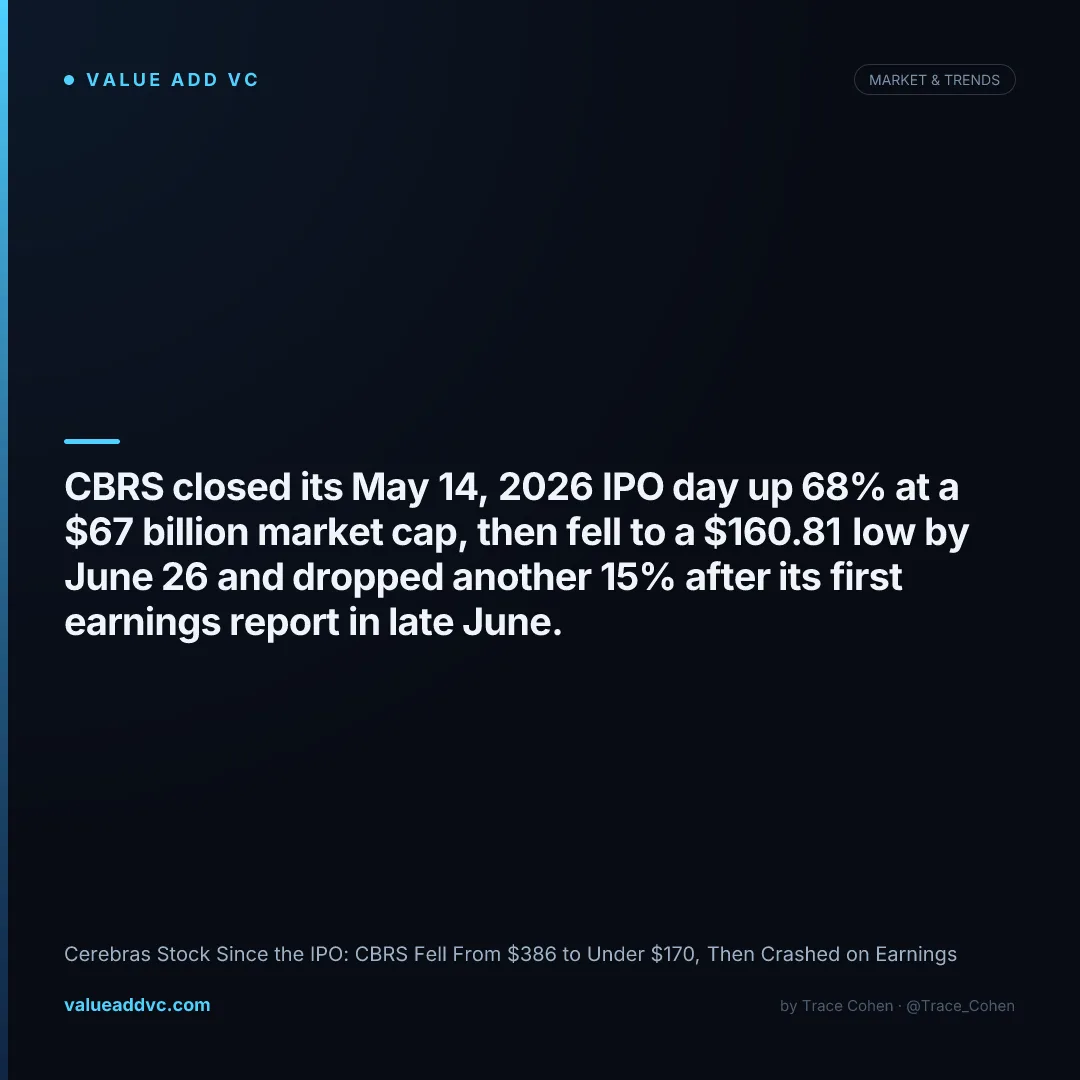
Cerebras stock (CBRS) closed at $216.90 on August 19, 2026 — down 44% from its $386.34 IPO-day peak but up 35% from its $160.81 low, after a second post-earnings crash on August 12 and a rally tied to OpenAI's new Ultrafast inference mode and the CS-4 chip launch. Nearly every big swing in CBRS since May traces back to the same question: how much of Cerebras's growth is really OpenAI, and can that be trusted to keep expanding.
Cerebras was one of the biggest tech IPOs of 2026, raising $5.55 billion and giving retail investors their first direct shot at an Nvidia challenger in wafer-scale AI chips. Three months later, the stock has already crashed twice on earnings days and rallied twice on OpenAI-related news — a case study in how a hot AI IPO keeps getting repriced every time Wall Street gets a fresh look at customer concentration.

Figures blended from Cerebras Q2 2026 earnings release (Aug 12, 2026), stockanalysis.com, CNBC, and TipRanks, as of market close August 19, 2026.
Cerebras stock since the IPO: the full price timeline
Cerebras stock since the IPO has moved through five distinct phases: a euphoric debut, a two-month slide, a summer recovery, a second earnings-day crash, and an August rally. CBRS priced at $185 per share on May 13, 2026, began trading May 14, opened at $350, and closed its first trading day up 68% at $311.07 — a $67 billion market cap for a company that had been valued at $23 billion just three months earlier in its Series H round.
The stock touched its all-time high of $386.34 that same opening day before gravity took over, bottoming at $160.81 on June 26, 2026. From there it clawed back to roughly $208 by July 21, kept climbing into its August 12 earnings date, and closed that day at $262.06 — up 42% from the IPO price — before the print itself sent shares down about 14% in extended trading, with the stock touching a post-earnings low near $234.85 on August 13.
CBRS then rallied again in the days after, on news that OpenAI's newly launched Ultrafast inference mode runs on Cerebras hardware and on the August 18 unveiling of Cerebras's next-generation CS-4 chip. By market close on August 19, 2026, shares sat at $216.90, according to stockanalysis.com pricing data, on 237.56 million shares outstanding — a roughly $51.5 billion market cap.
Why has Cerebras crashed after both of its earnings reports?
The first crash, in late June, came despite strong numbers: Q1 2026 GAAP revenue of $193.4 million, with core revenue up 92% year over year to $191.3 million. Shares still fell more than 15% because investors zeroed in on the $24.6 billion in remaining performance obligations (RPO) Cerebras disclosed — the vast majority tied to a single customer, its multi-year deal with OpenAI for 750 megawatts of compute capacity, worth more than $10 billion and set to be delivered by 2028. That's the same customer-concentration risk we've flagged across the broader AI valuations landscape.
The second crash, on August 12, 2026, was a different problem: a headline miss. Q2 GAAP revenue of $180.1 million came in below the $194 million analysts expected, even though core revenue of $209.9 million was up 103% year over year and management raised full-year core revenue guidance to $880-890 million from $855-865 million. Shares fell roughly 14% in extended trading anyway — a sign that, at Cerebras's post-IPO multiple, a beat-and-raise on the metric Wall Street cares less about (core revenue) doesn't offset a miss on the one it watches first (GAAP revenue).
Both selloffs reversed at least partially within days. The rebound this time came from a specific, verifiable catalyst rather than sentiment alone: OpenAI's new "Ultrafast" mode, which Wedbush analyst Matt Bryson noted can process requests up to 14 times faster than OpenAI's standard mode, runs on Cerebras hardware — the same relationship we covered in depth in our piece on GPT-5.6 Sol running at 750 tokens per second on Cerebras chips.
The August rebound: CS-4, ARK Invest, and a raised price target
Three things happened in quick succession after the post-earnings dip. On August 13, 2026, Wedbush raised its 12-month price target on CBRS from $280 to $290 and kept an "Outperform" rating. On August 18, Cathie Wood's ARK Invest bought roughly $8.84 million of CBRS shares — the same day Cerebras held its Supernova 2026 event in San Francisco and unveiled the CS-4, a rack-scale system built from three WSE-3 Turbo processors delivering a combined 750 petaFLOPs of compute, which the company says can decode tokens up to 30 times faster than GPU-based inference services.
None of that changes the underlying concentration math — it's still largely the same OpenAI relationship generating the headlines, just expressed through a faster chip and a new inference mode instead of a funding announcement. One read on this: the market is treating "OpenAI ships another feature on Cerebras hardware" as validation that the relationship is durable, not just large — but that's an inference from a handful of data points over three months, not a settled fact.
Cerebras valuation history: from $8.1B to a ~$51.5B public market cap
Cerebras's valuation trajectory in the run-up to its IPO was one of the steepest of any 2026 tech listing. The company raised an $1.1 billion Series G in September 2025 at an $8.1 billion valuation, then closed a $1 billion Series H just five months later, in February 2026, at roughly $23 billion — a nearly threefold jump, led by Tiger Global with participation from Benchmark, Fidelity, AMD, and Coatue. The IPO itself, two months after that, priced the company at over $50 billion before day-one trading pushed the market cap to $67 billion.
| Milestone | Date | Valuation / Market Cap | Notes |
|---|---|---|---|
| Series G | Sept 2025 | $8.1B | $1.1B raised |
| Series H | Feb 2026 | $23B | $1B raised, led by Tiger Global |
| IPO pricing | May 13, 2026 | ~$50B+ | Priced at $185/share, raised $5.55B |
| Day-1 close | May 14, 2026 | $67B | +68% from IPO price |
| 52-week low | June 26, 2026 | $160.81/share | -58% from ATH |
| Mid-July 2026 | Jul 21, 2026 | ~$49B | Recovering toward $208/share |
| Close (8/19/26) | Aug 19, 2026 | ~$51.5B | 237.56M shares at $216.90 |
Figures blended from Cerebras press releases, Bloomberg, DataCenterDynamics, and stockanalysis.com. Valuation figures are post-money at each round; IPO and public figures reflect market capitalization at the stated date.
Cerebras vs its AI chip peers: Groq, SambaNova, and Nvidia
Cerebras's post-IPO wobble looks different depending on which peer you compare it to. Groq, once seen as Cerebras's closest inference-speed rival, licensed its inference technology to Nvidia in a non-exclusive deal structured to pay out up to $20 billion in cash and lost founder Jonathan Ross to Nvidia — Groq itself remains independent, but the deal reset its private valuation to $3.5 billion, roughly half its September 2025 peak. SambaNova, the other major wafer-scale challenger, raised $1 billion in July 2026 at an $11 billion valuation led by General Atlantic, less than a quarter of Cerebras's current public market cap for comparable technology.
That gap is the clearest evidence that public markets are still pricing Cerebras as the legitimate #2 to Nvidia in AI inference hardware, even after two post-earnings selloffs — CBRS's ~$51.5 billion market cap is still well above SambaNova's private valuation. The August 18 launch of the CS-4, which Cerebras says decodes tokens up to 30 times faster than GPU-based inference, is the company's answer to that gap: a faster chip is one lever it controls directly, unlike customer diversification, which so far hasn't happened.
What Cerebras stock's post-IPO swings mean for AI chip investors
Cerebras remains a Wall Street favorite on paper — 10 analysts rate the stock a "Strong Buy" with zero sell ratings, and the consensus 12-month price target sits around $291.64, roughly 34% above the August 19 close. But the gap between that bullish coverage and a stock that's now crashed twice on its own earnings reports tells you analysts are betting on customer diversification that still hasn't happened, not validating the current backlog concentration.
For investors tracking the broader AI infrastructure trade alongside our Big Tech earnings dashboard, Cerebras is a useful reminder that a hot IPO, strong revenue growth, and a raised guide don't insulate a stock from concentration risk once quarterly disclosures force the market to actually price it. The OpenAI relationship keeps producing real, verifiable news — Ultrafast mode, the CS-4 launch, ARK Invest buying shares — but it is still one counterparty, and that dependency is exactly what got repriced hard in both June and August.
The next catalyst: Cerebras's insider lock-up expires November 9, 2026
The next scheduled catalyst for CBRS isn't another earnings report — it's the insider lock-up expiration. Cerebras's 180-day IPO lock-up releases at 6:00 a.m. Eastern on the second trading day after its Q3 2026 earnings release, or on November 9, 2026, whichever comes first. That's the date the roughly $1.9 billion in stock held by CEO Andrew Feldman and the $1 billion held by co-founder and CTO Sean Lie technically become freely tradable, alongside every other pre-IPO employee and investor stake.
Insider activity through mid-August has stayed limited to routine "sell to cover" transactions used to pay tax withholding on vesting RSUs, the same pattern flagged in late June — pre-arranged, tax-driven sales explicitly carved out of the lock-up agreement, not discretionary bets against the stock. The real test comes in November, when insiders who've watched the stock swing from $386 to $161 and back above $260 get their first chance to sell at will — a standard overhang risk for any newly public company, but one that matters more here given how much of Cerebras's float is still locked up relative to its trading volume.
Bottom line: Cerebras stock has been one of the most volatile large-cap debuts of 2026 — up 68% on IPO day to a $67 billion market cap, down to a $160.81 low six weeks later, and hit with two separate double-digit earnings-day drops in June and August despite steep core revenue growth both times — 92% year over year in June and 103% year over year in August. By August 19, 2026 the stock closed at $216.90, a ~$51.5 billion market cap that's recovered well off its lows but still sits 44% below its opening-day peak. The core issue hasn't changed since June: a business built substantially around one customer's spending decisions will keep getting repriced hard every quarter, no matter how fast the next chip is, until Cerebras shows a second or third material customer on its books.
Latest from the Pulse
Get VC data most people never see
— free to subscribe
Trace's notes on venture, AI and startups, a few times a week. Join 5,000+ subscribers. No spam.
No spam, unsubscribe anytime. Sent via Substack · Privacy · or subscribe on Substack ↗