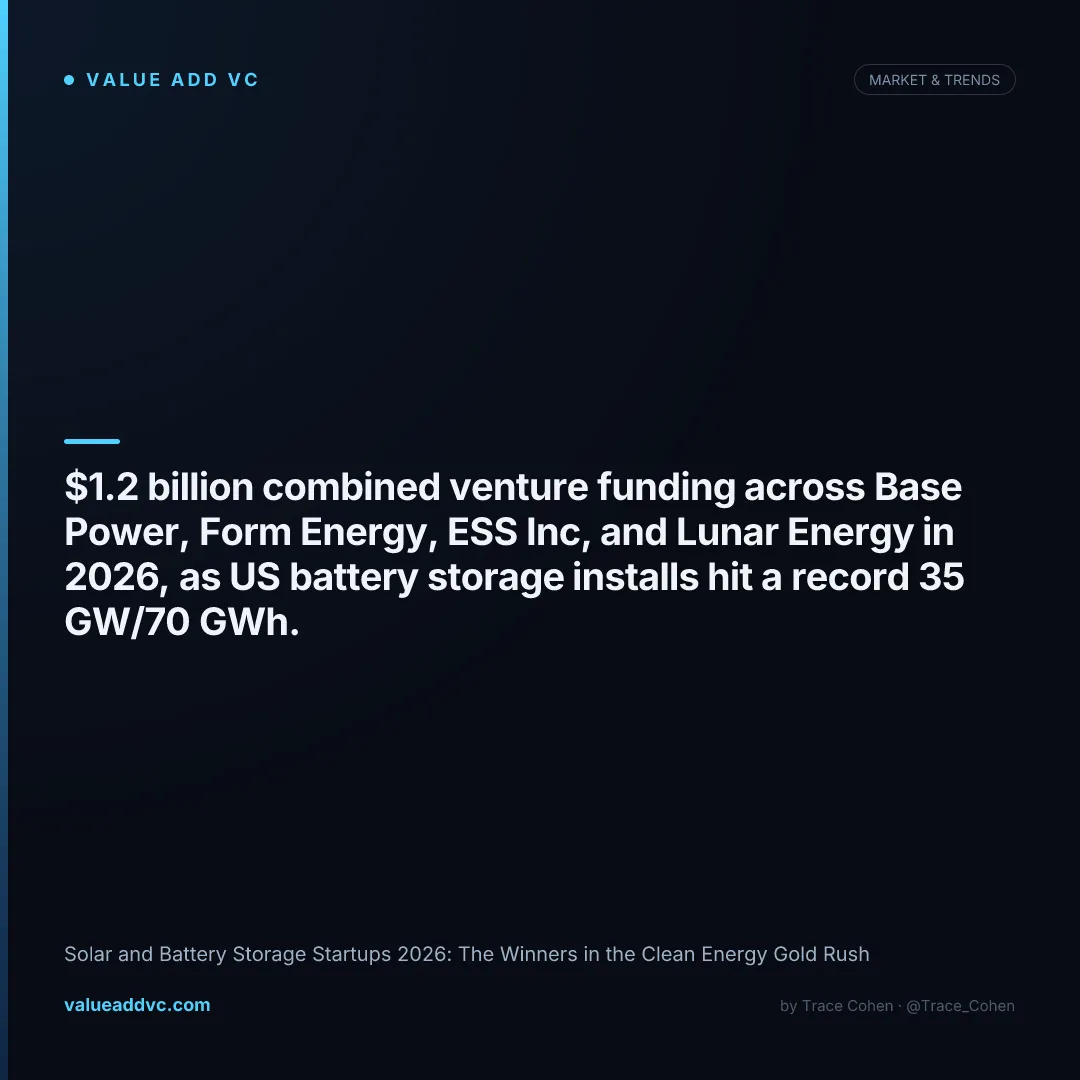
Base Power raised $1 billion at a $1.2 billion valuation, Google paid Form Energy roughly $1 billion for a single 100-hour battery deal, and the US is on pace to install a record 35 GW/70 GWh of battery storage in 2026. That's the short answer. The longer answer is that the winners aren't the companies making the most headlines — they're the ones who figured out who actually pays for storage.
Battery storage stopped being a climate-tech side bet the moment AI data centers started needing firm, multi-day backup power that the existing grid can't reliably deliver. That shift shows up directly in the funding data: the startups raising the biggest rounds in 2026 aren't necessarily the ones with the best chemistry — they're the ones selling to the buyer with the least patience for downtime, whether that's a hyperscaler, a utility, or a Texas homeowner tired of ERCOT blackouts.
Figures are 2026 data blended from the American Clean Power Association's US Energy Storage Monitor, Wood Mackenzie/SEIA, the US Energy Information Administration, Energy-Storage.News, TechCrunch, and pv magazine reporting through July 2026.
Which Solar and Battery Storage Startups Are the Winners in 2026?
The clearest winners in the 2026 clean energy gold rush are Base Power, Form Energy, ESS Inc, and Lunar Energy — four startups that have collectively raised over $2 billion and are each selling into a different, durable buyer: homeowners on unreliable grids, hyperscalers needing long-duration backup, industrial customers with sodium-ion demand, and utilities managing distributed residential batteries. What separates them from the hundreds of other funded energy-storage startups is that each has landed a repeatable commercial contract, not just a pilot.
Base Power: The $1.2 Billion Bet on Texas Homeowners
Base Power has raised $1 billion in Series C financing led by venture fund Addition, with talks reportedly valuing the company at $1.2 billion as of May 2026. Base sells home battery systems directly to Texas homeowners and aggregates them into a virtual power plant, and it has already sold over 100 MWh of residential storage in the state, plus a landmark April 2026 partnership with municipal utility Austin Energy to use its aggregated home batteries for grid stability. Texas's deregulated ERCOT market — and its history of grid failures — has made it the single best market in the country for a company selling resilience directly to consumers.
Form Energy: Long-Duration Storage Finds Its Buyer in AI Data Centers
Form Energy has raised $405 million in Series F funding for its iron-air battery technology, which can discharge for up to 100 hours — far longer than the 2-4 hour window of standard lithium-ion systems. In February 2026, Google contracted Form Energy for a 100-hour battery system to help power a new Minnesota data center alongside wind and solar, in a deal reported at roughly $1 billion. That contract is the clearest signal yet that long-duration storage's first mass-market buyer isn't the grid — it's AI infrastructure operators who need firm power and can't wait years for transmission upgrades.
ESS Inc and Lunar Energy: Chemistry and Software Bets
ESS Inc has raised $431.2 million and is manufacturing 8.5 gigawatt-hours of sodium-ion cells through a partnership with Alsym Energy, targeting AI data centers, commercial and industrial facilities, and microgrids that want long-duration storage without iron-air's footprint or lithium's supply chain exposure. Lunar Energy has raised $232 million — a $102 million Series D led by B Capital and Prelude Ventures, plus a previously unannounced $130 million Series C led by Activate Capital — to build its integrated home battery and Gridshare software platform, which manages distributed residential batteries as a coordinated grid asset rather than isolated devices.
The Market Behind the Winners: US Battery Storage Hits Record Installs in 2026
The startups above are riding a market that's growing faster than almost any other segment of energy infrastructure. The US is on pace to install 35 GW/70 GWh of battery storage in 2026, up from a record 15 GW of utility-scale additions in 2025 to a projected 24 GW this year. Q1 2026 alone set a new quarterly record at 3.3 GW/8.4 GWh, beating the previous Q1 record by 54%, and the EIA expects total utility-scale battery capacity to hit almost 65 GW by the end of the year. Three states — Texas (53%, 12.9 GW), California (14%, 3.4 GW), and Arizona (13%, 3.2 GW) — account for roughly 80% of everything being built.
How Do the Startups Compare to the Public Market Leader?
Tesla's Energy Generation and Storage segment remains the category's dominant player by revenue, deploying a record 46.7 GWh of storage in 2025 — up 49% year over year — and generating $12.8 billion in segment revenue, up 26.6%, at a 29.8% gross margin. That scale is the benchmark every storage startup is implicitly measured against, even though none of them compete with Tesla directly yet; Base Power and Lunar Energy are still building out regional footprints, while Form Energy and ESS Inc sell into a long-duration niche Tesla's Megapack doesn't yet address.
The Full Scoreboard: Solar and Battery Storage Startups vs. the Market Leader
| Company | Total Raised / Revenue | Valuation | Core Buyer | 2026 Signal |
|---|---|---|---|---|
| Base Power | $1.0B raised | ~$1.2B | Texas homeowners | 100+ MWh sold, Austin Energy deal |
| Form Energy | $405M raised | Not disclosed | Hyperscalers / utilities | ~$1B Google data center contract |
| ESS Inc | $431.2M raised | Not disclosed | Industrial / microgrids | 8.5 GWh sodium-ion partnership |
| Lunar Energy | $232M raised | Not disclosed | Residential + utility VPP | Series D led by B Capital, Prelude |
| Tesla Energy (public) | $12.8B revenue (2025) | N/A (segment of $1T+ co.) | All segments | 46.7 GWh deployed, +49% YoY |
| Silicon Ranch (solar) | $2.35B raised | Highest-funded solar startup | Utility-scale solar | Top-funded company in solar sector |
Figures are 2025-2026 data blended from company disclosures, Crunchbase, Energy-Storage.News, TechCrunch, pv magazine, and Tesla's Q4 2025 shareholder deck. Valuations marked "Not disclosed" reflect private companies that have not published post-money figures publicly as of July 2026.
Why AI Data Centers Changed the Buyer Profile for Storage Startups
The single biggest structural change in this market over the past 18 months is who's actually signing the checks. Traditional storage demand came from utilities running slow, multi-year procurement cycles and grid operators managing seasonal peak load. AI data centers operate on a completely different clock: hyperscalers need gigawatts of firm power committed and delivered within a year or two, not a decade, because the alternative is a multi-billion-dollar cluster of GPUs sitting idle waiting on a grid interconnection queue. That urgency is what let Form Energy convert a single Google contract into a roughly $1 billion deal for one battery system, and it's why long-duration and sodium-ion players like ESS Inc are increasingly pitching data center operators directly instead of waiting on utility RFPs.
This also changes the risk profile for investors. A startup selling to a hyperscaler with a signed take-or-pay contract has far more predictable revenue than one waiting on a state utility commission to approve a rate case, even if the hyperscaler relationship is more concentrated. Expect more of 2026's largest storage rounds to trace back to a single anchor customer rather than a diversified utility pipeline — Base Power's Austin Energy partnership and Form Energy's Google deal are both early examples of that pattern playing out before the rest of the market catches up.
What This Means for Investors Looking at Solar and Battery Storage Startups
The lesson from 2026's funding data is that storage startups win by picking a buyer with urgency, not by having the best cell chemistry in isolation. Base Power won by targeting a state where blackouts are a lived experience. Form Energy won by finding a hyperscaler willing to pay $1 billion for 100 hours of certainty. The solar sector overall has absorbed $231 billion in cumulative VC and PE funding across 3,733 companies, but most of that capital went to companies without a Base Power- or Form Energy-style anchor customer — which is exactly why so few solar startups from the 2010s are still independent today. We track adjacent infrastructure funding trends on our AI valuations dashboard, where compute-driven power demand is increasingly the variable investors have to model alongside traditional unit economics.
The risk for 2026 vintage storage deals is the same as any infrastructure-adjacent startup: capital intensity. Base Power's $1 billion round and Form Energy's manufacturing scale-up both require sustained, expensive capex years before full payback, and any pullback in data center buildouts or interest-rate relief delay would hit these balance sheets hard. But with utility-scale storage capacity still tracking toward 65 GW by year-end and three states absorbing 80% of new supply, the demand side of this market isn't the constraint right now — capital and manufacturing throughput are.
Bottom line: Base Power, Form Energy, ESS Inc, and Lunar Energy have collectively raised over $2 billion and are the clearest winners in the 2026 battery storage market, each because they landed a buyer with real urgency — Texas homeowners, AI data centers, industrial microgrids, and grid operators, respectively. The backdrop is a record year for the category overall: 35 GW/70 GWh of US installs, a Q1 that beat the prior record by 54%, and a $1 billion Google-Form Energy contract that proves long-duration storage finally has its first scaled commercial buyer. The startups to watch next are the ones that can turn a single anchor contract, like Form Energy's Google deal, into a repeatable product line before capital gets more expensive again.
Latest from the Pulse
Get VC data most people never see
— free to subscribe
Trace's notes on venture, AI and startups, a few times a week. Join 5,000+ subscribers. No spam.
No spam, unsubscribe anytime. Sent via Substack · Privacy · or subscribe on Substack ↗