Fewer than 0.1% of VC-backed startups IPO. Over 90% of successful exits are acquisitions. Yet most founders spend zero time thinking about what makes their company a compelling acquisition target versus an awkward distress sale.
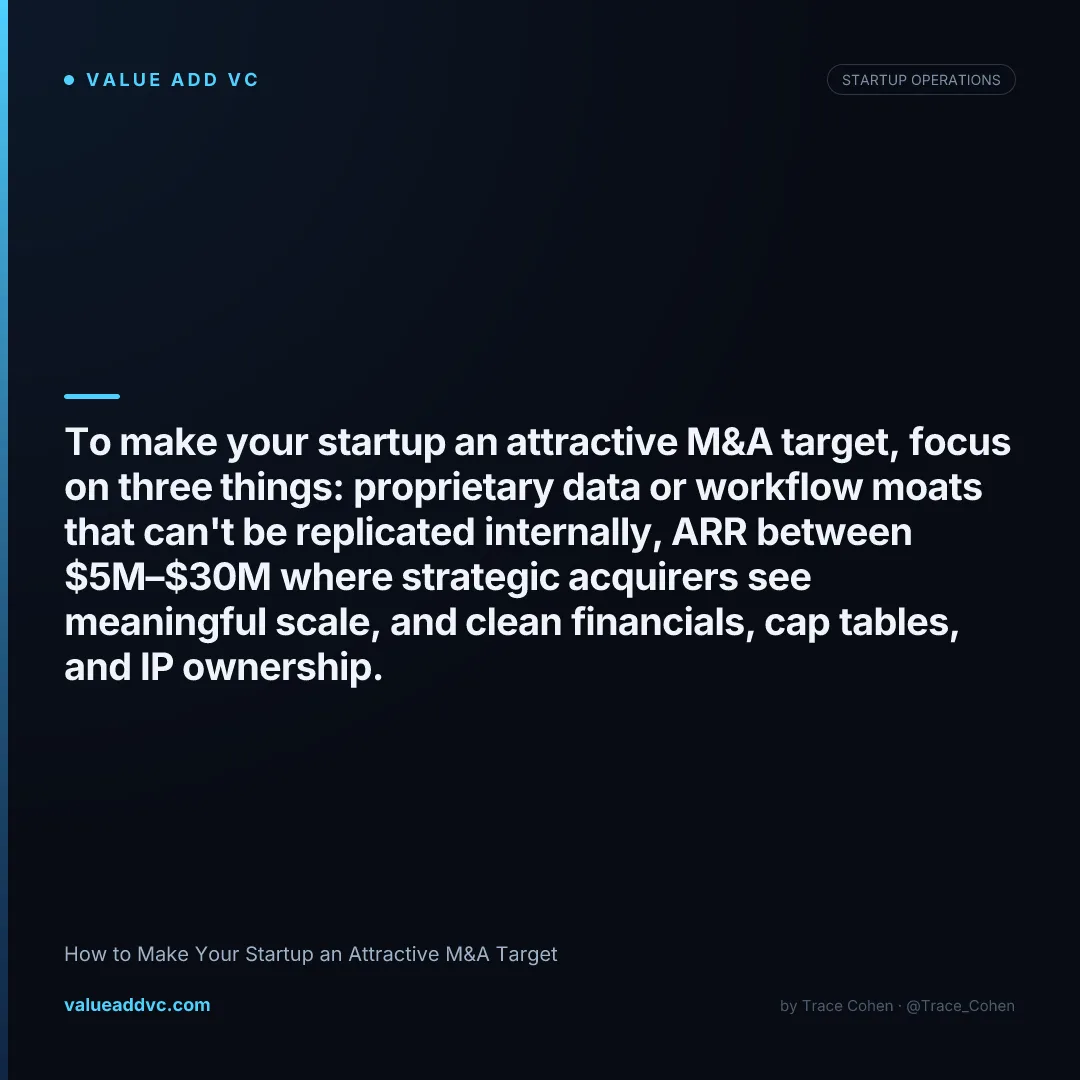
The difference between getting acquired at 8x ARR and 25x ARR is not luck or timing — it is whether you built the right things intentionally. Companies that make themselves attractive acquisition targets share specific structural characteristics that can be engineered. Here is what they are.
The M&A Math Every Founder Needs to Understand
In 2025, tech M&A crossed $100B in announced deals — nearly all of it concentrated in AI, vertical software, cybersecurity, and developer infrastructure. The multiples paid varied enormously:
| Acquirer | Target | Price | Est. ARR Multiple |
|---|---|---|---|
| Google (Alphabet) | Wiz | $32B | ~30x ARR |
| Windsurf | ~$2.4B | ~20x ARR | |
| OpenAI | Statsig | ~$1.1B | ~12x ARR |
| Xero | Melio | ~$2.5B | ~8x ARR |
Source: Public deal announcements, estimated ARR from industry reporting.
Wiz got 30x ARR because it had a clear category leadership position, 120%+ NRR, and multiple bidders including Microsoft. Melio got 8x ARR because it was a good but not irreplaceable business. The multiple you earn tracks directly to how defensible and urgently needed you are.
The Five Things That Make a Startup an Attractive Acquisition Target
How to Position for an Attractive Acquisition Target Without Telegraphing Desperation
There is a right and wrong way to signal to potential acquirers. Wrong: cold emails from the CEO saying "we are open to strategic discussions." Right: deep integration partnerships that make the acquirer's products better, making them realize the cost of not owning you.
Do
- ✓ Build native integrations on their platform
- ✓ Publish case studies featuring their customers
- ✓ Speak at their partner conferences
- ✓ Reference their tools in your docs
Don't
- ✕ Reach out asking if they want to acquire you
- ✕ Tell investors your exit plan is acquisition
- ✕ Run a process before you have multiple buyers
- ✕ Sign exclusivity before LOI terms are locked
The Metrics Acquirers Pull on Day One of Diligence
Corporate development teams run a consistent playbook. Within 48 hours of signing an NDA, they will request these specific numbers. Companies that have them clean and ready signal operational maturity — which itself increases price:
Track your SaaS valuation multiples against public comps on the Value Add VC dashboard to benchmark where your metrics land.
The M&A Process: What Happens After You Get the Call
Most founders have never run a sale process and get outmaneuvered by corporate development teams that do this for a living. Key things to know:
- →Hire a banker for deals above $20M. For anything meaningful, an investment bank running a controlled auction will add 25–40% to the price by creating competitive tension. Their 2–4% fee is almost always worth it. Below $20M, a good M&A attorney is sufficient.
- →Never sign exclusivity until economics are agreed. Exclusivity locks out other buyers while the acquirer does diligence and often chips the price. Agree on the headline number and deal structure in the LOI before signing away your ability to run a process.
- →Understand your liquidation preference stack first. In many deals, early investors with 1x or 2x non-participating preferences get paid before founders see a dollar. Model your waterfall before you enter negotiation — knowing your real take-home changes your minimum acceptable price significantly.
- →Negotiate your retention package separately from the deal price. Acquirers often structure 20–30% of the total deal value as retention for the team, paid out over 2–4 years of employment. This is separate from your equity — negotiate both independently.
See the corporate development tracker for recent acquisition trends and pricing data across tech sectors.
The best acquisitions are not exits. They are outcomes that were engineered.
Build the proprietary data moat, keep the cap table clean, and get to $10M+ NRR-adjusted ARR — the call will come. Your job is to make sure you have leverage when it does.
Track M&A multiples and acquisition trends on the Corp Dev Dashboard and compare SaaS multiples at Value Add VC. Originally published in the Trace Cohen newsletter.
Latest from the Pulse
Get VC data most people never see
— free to subscribe
Trace's notes on venture, AI and startups, a few times a week. Join 5,000+ subscribers. No spam.
No spam, unsubscribe anytime. Sent via Substack · Privacy · or subscribe on Substack ↗