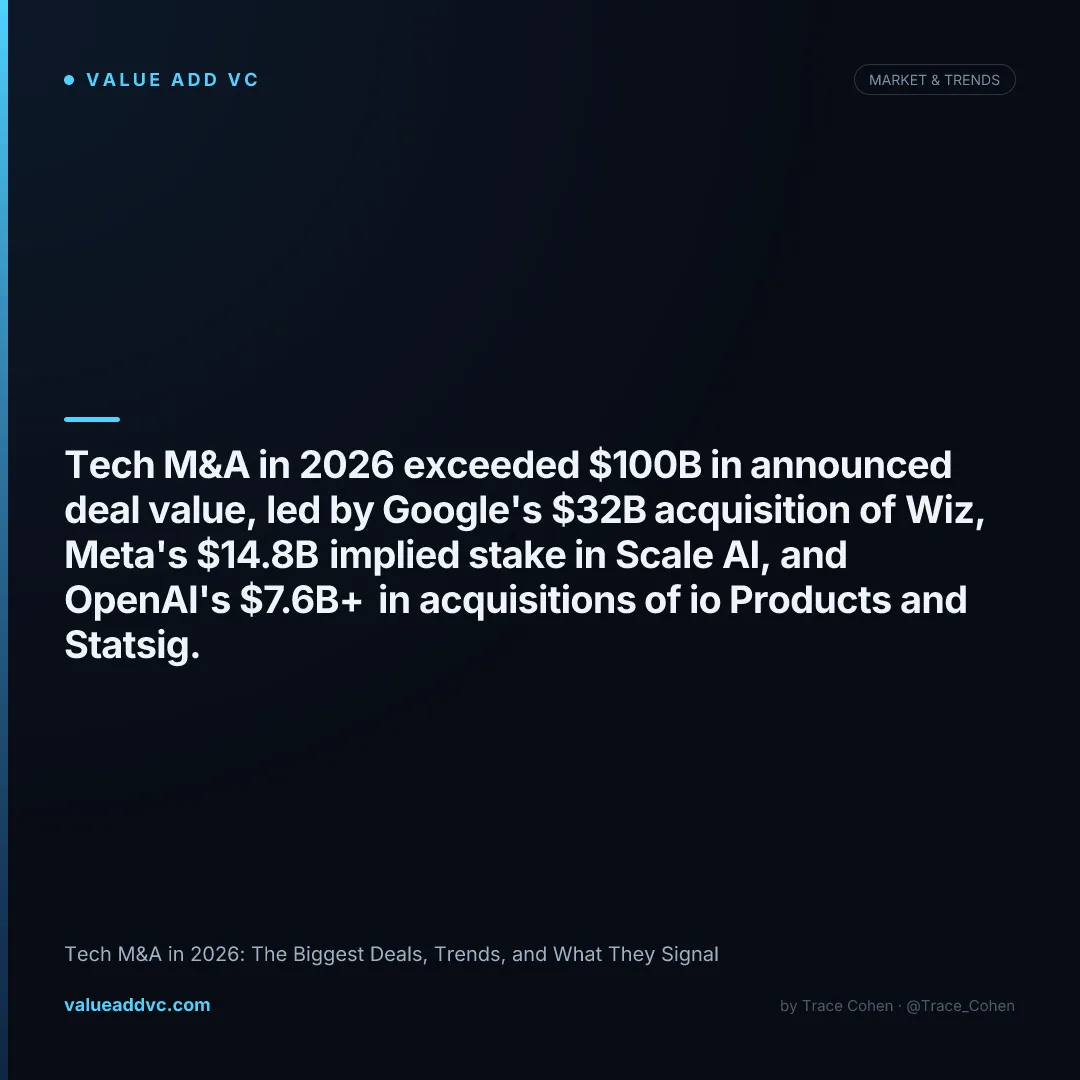
Tech M&A in 2026 was not a recovery. It was a strategic reset — and the biggest acquirers weren't buying market share. They were buying survival.
Over $100B in announced deal value. A more permissive antitrust environment. And a cohort of highly strategic targets — AI-native companies with proprietary data, workflow ownership, or infrastructure lock-in — that had stayed private through the 2022–2024 funding drought and emerged as must-buys rather than nice-to-haves.
The result was the most consequential year for tech M&A since the 2021 ZIRP-fueled boom, but for entirely different structural reasons. In 2021, acquirers were buying growth. In 2025, they were buying capability they couldn't replicate internally before a competitor did. That momentum has only accelerated into 2026 — see the full breakdown of this year's megadeal surge and antitrust posture.
The Biggest Tech M&A Deals of 2025
Here are the landmark transactions that defined 2025's M&A landscape, by deal size:
~$500M ARR (64x revenue)
Data labeling + AI training infrastructure
AI-native consumer hardware
Digital SMB insurance underwriting
AI-first developer IDE
SMB payments + AP automation
Product experimentation platform
What Drove Tech M&A Volume in 2025
Three structural forces converged to make 2025 a landmark year:
Antitrust Thaw
The new administration reversed the Khan-era FTC stance. Vertical acquisitions and sub-$5B horizontal deals face minimal regulatory friction. The Google-Wiz deal — which the previous DOJ was expected to challenge — closed cleanly. Big tech now has deal confidence it lacked from 2021–2024.
Private Company Overhang
High-quality AI startups that stayed private through the 2022–2024 funding drought emerged as strategic targets. Companies like Scale AI and Wiz had built defensible positions with no near-term IPO pressure — creating a window where both buyers and sellers were motivated to transact.
AI Capabilities Gap
Internal AI development at large enterprises is consistently 18–36 months behind frontier startups. CFOs running build-vs-buy analysis are finding that acquiring a purpose-built AI company is cheaper than staffing and training the equivalent internal team, especially when proprietary data is part of the asset.
The Three M&A Categories Dominating 2025
1. AI Security (The Highest-Value Category)
Google's $32B acquisition of Wiz is the defining deal of 2025 — and the largest pure software acquisition in history. Wiz had built the dominant cloud-native security posture management (CSPM) platform, with ~$500M ARR growing at 100%+ year-over-year. The 64x revenue multiple reflects a simple reality: cloud security is not discretionary spend. Every enterprise running workloads on AWS, Azure, or GCP needs it. Google needed it to compete with Microsoft's Defender for Cloud. The strategic premium over any financial return model was obvious.
As of mid-2026, AI security remains the fastest-growing M&A category in tech, with acquirers paying 20–60x ARR for platforms that own workflow. Watch the AI Landscape Dashboard for emerging acquisition targets in this space.
2. AI Data Infrastructure (The Strategic Backstop)
Meta's effective acquisition of Scale AI — buying a 49% stake at a $14.8B implied valuation — is less about revenue (Scale AI was generating ~$500M+ ARR) and more about locking in the world's largest data labeling operation. AI model quality is a direct function of training data quality. Scale AI processes millions of data points per day across defense, autonomous vehicles, and enterprise AI. For Meta, owning the infrastructure that trains its next generation of Llama models is not optional. This deal is the data equivalent of acquiring a chip foundry.
3. Developer Tooling (The Distribution Play)
Google's ~$2.4B acquisition of Windsurf (formerly Codeium) and OpenAI's ~$1.1B acquisition of Statsig both reflect the same thesis: whoever owns the developer workflow owns the model purchase decision. Developers embedded in an AI coding tool or experimentation platform route API calls through the platform's preferred model. Windsurf defaults to Gemini. Statsig's infrastructure now integrates natively with OpenAI's feature management tools. These acquisitions are distribution wins disguised as product acquisitions.
Valuation Benchmarks: What Acquirers Are Actually Paying
| Category | Typical Revenue Multiple | 2025 Example |
|---|---|---|
| AI Security (strategic) | 30–65x ARR | Wiz @ ~64x |
| AI Infrastructure / Data | 20–40x ARR | Scale AI @ ~30x |
| Developer Tools (distribution) | 10–25x ARR | Windsurf @ ~15x est. |
| Vertical SaaS (workflow owner) | 8–20x ARR | Melio @ ~12x est. |
| Horizontal SaaS (no moat) | 4–10x ARR | Market clearing price |
Revenue multiples are approximate based on reported or estimated ARR at time of deal announcement.
What 2025 Tech M&A Signals for Founders
The pattern across every major 2025 deal is clear: acquirers are paying the highest premiums for three things.
→ Proprietary data that cannot be replicated
Scale AI's moat is the cumulative volume and diversity of labeled data it has processed. No amount of capex can compress the time it would take to rebuild that asset. This is why Meta paid infrastructure prices for a services business.
→ Workflow ownership in a regulated or critical vertical
Wiz owns the security workflow for 40%+ of Fortune 500 cloud environments. Ripping it out is not a procurement decision — it's an operational risk. This workflow stickiness is why the multiple cleared 60x revenue.
→ Developer distribution at the point of model selection
Windsurf and Statsig both sit at the moment a developer decides which AI model to call. Controlling that decision point is worth 10–25x ARR to a hyperscaler whose model revenue depends on developer adoption.
The inverse is equally true. Horizontal SaaS with no vertical depth, AI tools with no proprietary training data, and productivity software without workflow lock-in are facing the same commoditization pressure in M&A that they face in the market. These assets are clearing at 4–10x ARR — down 50–70% from 2021 peaks.
Track current SaaS valuation multiples and AI company valuations on our live dashboards to benchmark where your company sits relative to current M&A clearing prices.
What Comes Next: The 2026 M&A Pipeline
The conditions that drove 2025's M&A volume are not transient. Antitrust is structurally more permissive. The AI capabilities gap between large enterprises and frontier startups is widening, not closing. And the cohort of high-quality AI-native companies that stayed private through 2022–2024 is not fully depleted.
Watch for continued consolidation in: AI security (next wave after Wiz), AI-native CRM and ERP (Salesforce and SAP are both under pressure), healthcare AI (FDA-approved clinical decision tools), and defense tech (government contractors acquiring dual-use AI startups). Monitor the Tech IPO Dashboard — many 2025 M&A targets had originally planned to go public. When the IPO window looks uncertain, strategic M&A looks more attractive.
The highest 2025 M&A multiples went to companies that owned something irreplaceable.
Proprietary data. Workflow lock-in. Developer distribution. Everything else trades at commodity prices.
Track real-time AI company valuations and acquisition trends on the AI Valuations Dashboard at Value Add VC. Originally published in the Trace Cohen newsletter.
Latest from the Pulse
Get VC data most people never see
— free to subscribe
Trace's notes on venture, AI and startups, a few times a week. Join 5,000+ subscribers. No spam.
No spam, unsubscribe anytime. Sent via Substack · Privacy · or subscribe on Substack ↗